

8.2 Multiphase Transient Coupling Model in Laser Welding with Filler Wires
205
r w —Wire radius;
w f —Wire feed rate;
H d —Total enthalpy of the droplet.
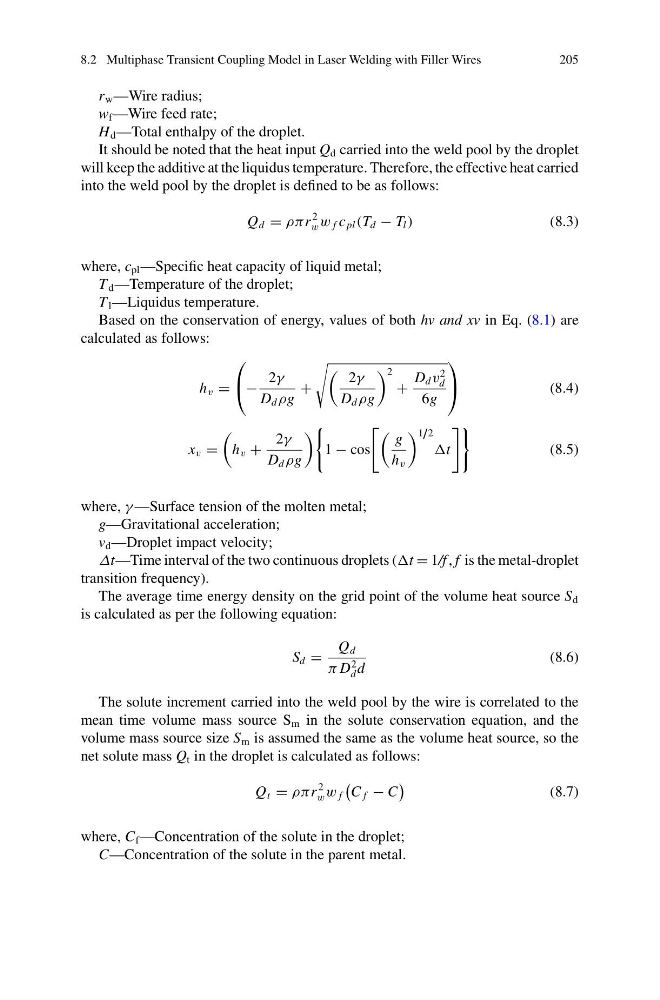
It should be noted that the heat input Q d carried into the weld pool by the droplet
will keep the additive at the liquidus temperature. Therefore, the effective heat carried
into the weld pool by the droplet is defined to be as follows:
Q d = ρπr
2
w w f c pl (T d − T l )
(8.3)
where, c pl —Specific heat capacity of liquid metal;
T d —Temperature of the droplet;
T l —Liquidus temperature.
Based on the conservation of energy, values of both hv and xv in Eq. (8.1) are
calculated as follows:
h v =
⎛
⎝ −
2γ
D d ρg
+
2γ
D d ρg
2
+
D d v
2
d
6g
⎞
⎠
(8.4)
x v =
h v +
2γ
D d ρg
1 − cos
g
h v
1 / 2
t
(8.5)
where, γ —Surface tension of the molten metal;
g—Gravitational acceleration;
v d —Droplet impact velocity;
Δt—Time interval of the two continuous droplets (t = 1/f , f is the metal-droplet
transition frequency).
The average time energy density on the grid point of the volume heat source S d
is calculated as per the following equation:
S d =
Q d
π D
2
d d
(8.6)
The solute increment carried into the weld pool by the wire is correlated to the
mean time volume mass source S m in the solute conservation equation, and the
volume mass source size S m is assumed the same as the volume heat source, so the
net solute mass Q t in the droplet is calculated as follows:
Q t = ρπr
2
w w f
C f − C
(8.7)
where, C f —Concentration of the solute in the droplet;
C—Concentration of the solute in the parent metal.
205
r w —Wire radius;
w f —Wire feed rate;
H d —Total enthalpy of the droplet.
It should be noted that the heat input Q d carried into the weld pool by the droplet
will keep the additive at the liquidus temperature. Therefore, the effective heat carried
into the weld pool by the droplet is defined to be as follows:
Q d = ρπr
2
w w f c pl (T d − T l )
(8.3)
where, c pl —Specific heat capacity of liquid metal;
T d —Temperature of the droplet;
T l —Liquidus temperature.
Based on the conservation of energy, values of both hv and xv in Eq. (8.1) are
calculated as follows:
h v =
⎛
⎝ −
2γ
D d ρg
+
2γ
D d ρg
2
+
D d v
2
d
6g
⎞
⎠
(8.4)
x v =
h v +
2γ
D d ρg
1 − cos
g
h v
1 / 2
t
(8.5)
where, γ —Surface tension of the molten metal;
g—Gravitational acceleration;
v d —Droplet impact velocity;
Δt—Time interval of the two continuous droplets (t = 1/f , f is the metal-droplet
transition frequency).
The average time energy density on the grid point of the volume heat source S d
is calculated as per the following equation:
S d =
Q d
π D
2
d d
(8.6)
The solute increment carried into the weld pool by the wire is correlated to the
mean time volume mass source S m in the solute conservation equation, and the
volume mass source size S m is assumed the same as the volume heat source, so the
net solute mass Q t in the droplet is calculated as follows:
Q t = ρπr
2
w w f
C f − C
(8.7)
where, C f —Concentration of the solute in the droplet;
C—Concentration of the solute in the parent metal.