

194
7 Keyhole and Weld Pool Dynamics in Dual-Beam Laser Welding
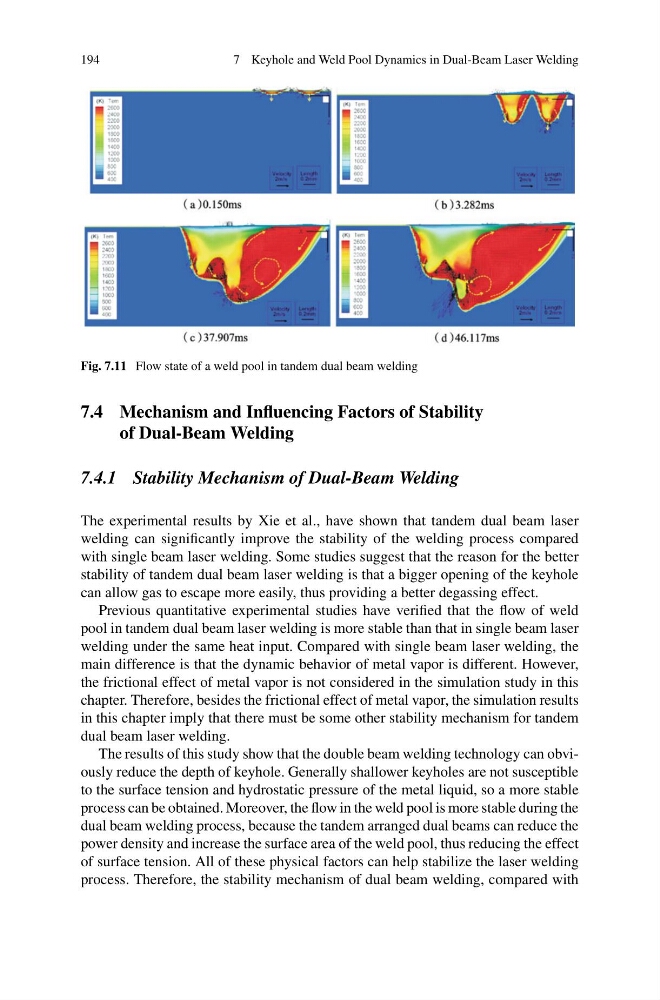
Fig. 7.11 Flow state of a weld pool in tandem dual beam welding
7.4 Mechanism and Influencing Factors of Stability
of Dual-Beam Welding
7.4.1 Stability Mechanism of Dual-Beam Welding
The experimental results by Xie et al., have shown that tandem dual beam laser
welding can significantly improve the stability of the welding process compared
with single beam laser welding. Some studies suggest that the reason for the better
stability of tandem dual beam laser welding is that a bigger opening of the keyhole
can allow gas to escape more easily, thus providing a better degassing effect.
Previous quantitative experimental studies have verified that the flow of weld
pool in tandem dual beam laser welding is more stable than that in single beam laser
welding under the same heat input. Compared with single beam laser welding, the
main difference is that the dynamic behavior of metal vapor is different. However,
the frictional effect of metal vapor is not considered in the simulation study in this
chapter. Therefore, besides the frictional effect of metal vapor, the simulation results
in this chapter imply that there must be some other stability mechanism for tandem
dual beam laser welding.
The results of this study show that the double beam welding technology can obviously reduce the depth of keyhole. Generally shallower keyholes are not susceptible
to the surface tension and hydrostatic pressure of the metal liquid, so a more stable
process can be obtained. Moreover, the flow in the weld pool is more stable during the
dual beam welding process, because the tandem arranged dual beams can reduce the
power density and increase the surface area of the weld pool, thus reducing the effect
of surface tension. All of these physical factors can help stabilize the laser welding
process. Therefore, the stability mechanism of dual beam welding, compared with
7 Keyhole and Weld Pool Dynamics in Dual-Beam Laser Welding
Fig. 7.11 Flow state of a weld pool in tandem dual beam welding
7.4 Mechanism and Influencing Factors of Stability
of Dual-Beam Welding
7.4.1 Stability Mechanism of Dual-Beam Welding
The experimental results by Xie et al., have shown that tandem dual beam laser
welding can significantly improve the stability of the welding process compared
with single beam laser welding. Some studies suggest that the reason for the better
stability of tandem dual beam laser welding is that a bigger opening of the keyhole
can allow gas to escape more easily, thus providing a better degassing effect.
Previous quantitative experimental studies have verified that the flow of weld
pool in tandem dual beam laser welding is more stable than that in single beam laser
welding under the same heat input. Compared with single beam laser welding, the
main difference is that the dynamic behavior of metal vapor is different. However,
the frictional effect of metal vapor is not considered in the simulation study in this
chapter. Therefore, besides the frictional effect of metal vapor, the simulation results
in this chapter imply that there must be some other stability mechanism for tandem
dual beam laser welding.
The results of this study show that the double beam welding technology can obviously reduce the depth of keyhole. Generally shallower keyholes are not susceptible
to the surface tension and hydrostatic pressure of the metal liquid, so a more stable
process can be obtained. Moreover, the flow in the weld pool is more stable during the
dual beam welding process, because the tandem arranged dual beams can reduce the
power density and increase the surface area of the weld pool, thus reducing the effect
of surface tension. All of these physical factors can help stabilize the laser welding
process. Therefore, the stability mechanism of dual beam welding, compared with