

7.3 Coupling Behavior of Keyhole and Weld Pool in Dual-Beam Welding
193
7.3.2 Flow Behavior of Moving Weld Pool in Welding
In tandem double beam welding, when the two keyholes merge together, the flow
velocity on the surface of the keyhole opening is more intense and complex than that
on the surface of other areas of the weld pool. There exists an intense downward
flow near the front wall of the keyhole. Besides, there are some characteristic flows
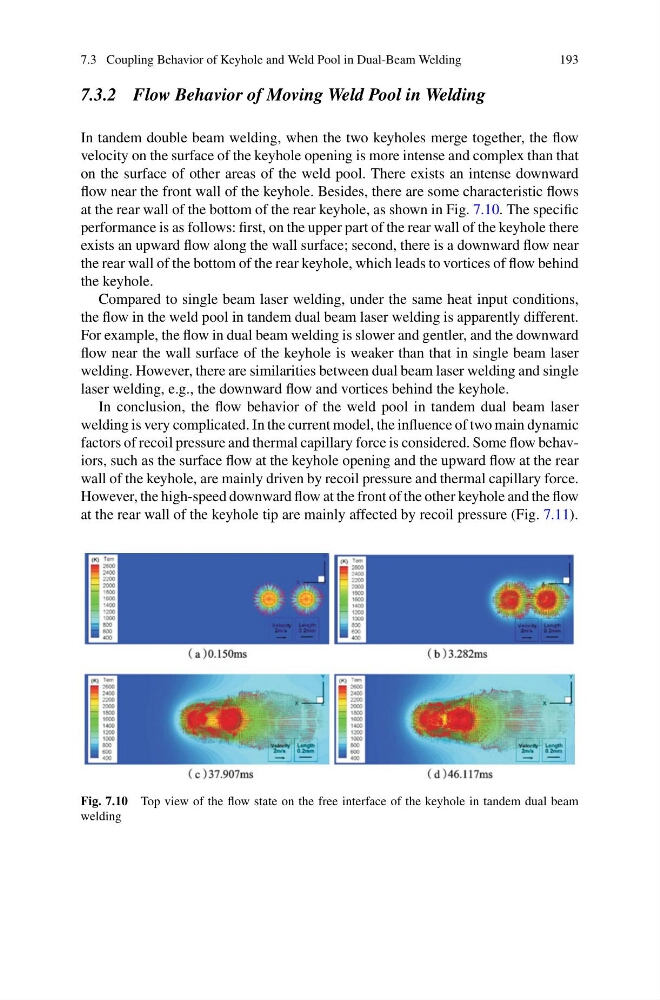
at the rear wall of the bottom of the rear keyhole, as shown in Fig. 7.10. The specific
performance is as follows: first, on the upper part of the rear wall of the keyhole there
exists an upward flow along the wall surface; second, there is a downward flow near
the rear wall of the bottom of the rear keyhole, which leads to vortices of flow behind
the keyhole.
Compared to single beam laser welding, under the same heat input conditions,
the flow in the weld pool in tandem dual beam laser welding is apparently different.
For example, the flow in dual beam welding is slower and gentler, and the downward
flow near the wall surface of the keyhole is weaker than that in single beam laser
welding. However, there are similarities between dual beam laser welding and single
laser welding, e.g., the downward flow and vortices behind the keyhole.
In conclusion, the flow behavior of the weld pool in tandem dual beam laser
welding is very complicated. In the current model, the influence of two main dynamic
factors of recoil pressure and thermal capillary force is considered. Some flow behaviors, such as the surface flow at the keyhole opening and the upward flow at the rear
wall of the keyhole, are mainly driven by recoil pressure and thermal capillary force.
However, the high-speed downward flow at the front of the other keyhole and the flow
at the rear wall of the keyhole tip are mainly affected by recoil pressure (Fig. 7.11).
Fig. 7.10 Top view of the flow state on the free interface of the keyhole in tandem dual beam
welding
193
7.3.2 Flow Behavior of Moving Weld Pool in Welding
In tandem double beam welding, when the two keyholes merge together, the flow
velocity on the surface of the keyhole opening is more intense and complex than that
on the surface of other areas of the weld pool. There exists an intense downward
flow near the front wall of the keyhole. Besides, there are some characteristic flows
at the rear wall of the bottom of the rear keyhole, as shown in Fig. 7.10. The specific
performance is as follows: first, on the upper part of the rear wall of the keyhole there
exists an upward flow along the wall surface; second, there is a downward flow near
the rear wall of the bottom of the rear keyhole, which leads to vortices of flow behind
the keyhole.
Compared to single beam laser welding, under the same heat input conditions,
the flow in the weld pool in tandem dual beam laser welding is apparently different.
For example, the flow in dual beam welding is slower and gentler, and the downward
flow near the wall surface of the keyhole is weaker than that in single beam laser
welding. However, there are similarities between dual beam laser welding and single
laser welding, e.g., the downward flow and vortices behind the keyhole.
In conclusion, the flow behavior of the weld pool in tandem dual beam laser
welding is very complicated. In the current model, the influence of two main dynamic
factors of recoil pressure and thermal capillary force is considered. Some flow behaviors, such as the surface flow at the keyhole opening and the upward flow at the rear
wall of the keyhole, are mainly driven by recoil pressure and thermal capillary force.
However, the high-speed downward flow at the front of the other keyhole and the flow
at the rear wall of the keyhole tip are mainly affected by recoil pressure (Fig. 7.11).
Fig. 7.10 Top view of the flow state on the free interface of the keyhole in tandem dual beam
welding