

190
7 Keyhole and Weld Pool Dynamics in Dual-Beam Laser Welding
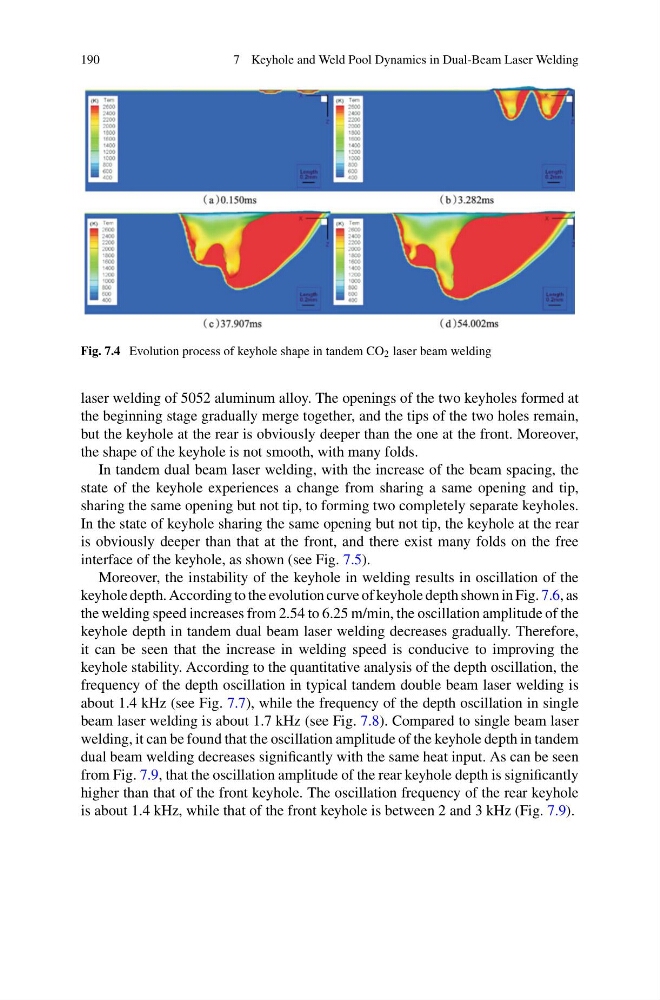
Fig. 7.4 Evolution process of keyhole shape in tandem CO 2 laser beam welding
laser welding of 5052 aluminum alloy. The openings of the two keyholes formed at
the beginning stage gradually merge together, and the tips of the two holes remain,
but the keyhole at the rear is obviously deeper than the one at the front. Moreover,
the shape of the keyhole is not smooth, with many folds.
In tandem dual beam laser welding, with the increase of the beam spacing, the
state of the keyhole experiences a change from sharing a same opening and tip,
sharing the same opening but not tip, to forming two completely separate keyholes.
In the state of keyhole sharing the same opening but not tip, the keyhole at the rear
is obviously deeper than that at the front, and there exist many folds on the free
interface of the keyhole, as shown (see Fig. 7.5).
Moreover, the instability of the keyhole in welding results in oscillation of the
keyhole depth. According to the evolution curve of keyhole depth shown in Fig. 7.6, as
the welding speed increases from 2.54 to 6.25 m/min, the oscillation amplitude of the
keyhole depth in tandem dual beam laser welding decreases gradually. Therefore,
it can be seen that the increase in welding speed is conducive to improving the
keyhole stability. According to the quantitative analysis of the depth oscillation, the
frequency of the depth oscillation in typical tandem double beam laser welding is
about 1.4 kHz (see Fig. 7.7), while the frequency of the depth oscillation in single
beam laser welding is about 1.7 kHz (see Fig. 7.8). Compared to single beam laser
welding, it can be found that the oscillation amplitude of the keyhole depth in tandem
dual beam welding decreases significantly with the same heat input. As can be seen
from Fig. 7.9, that the oscillation amplitude of the rear keyhole depth is significantly
higher than that of the front keyhole. The oscillation frequency of the rear keyhole
is about 1.4 kHz, while that of the front keyhole is between 2 and 3 kHz (Fig. 7.9).
7 Keyhole and Weld Pool Dynamics in Dual-Beam Laser Welding
Fig. 7.4 Evolution process of keyhole shape in tandem CO 2 laser beam welding
laser welding of 5052 aluminum alloy. The openings of the two keyholes formed at
the beginning stage gradually merge together, and the tips of the two holes remain,
but the keyhole at the rear is obviously deeper than the one at the front. Moreover,
the shape of the keyhole is not smooth, with many folds.
In tandem dual beam laser welding, with the increase of the beam spacing, the
state of the keyhole experiences a change from sharing a same opening and tip,
sharing the same opening but not tip, to forming two completely separate keyholes.
In the state of keyhole sharing the same opening but not tip, the keyhole at the rear
is obviously deeper than that at the front, and there exist many folds on the free
interface of the keyhole, as shown (see Fig. 7.5).
Moreover, the instability of the keyhole in welding results in oscillation of the
keyhole depth. According to the evolution curve of keyhole depth shown in Fig. 7.6, as
the welding speed increases from 2.54 to 6.25 m/min, the oscillation amplitude of the
keyhole depth in tandem dual beam laser welding decreases gradually. Therefore,
it can be seen that the increase in welding speed is conducive to improving the
keyhole stability. According to the quantitative analysis of the depth oscillation, the
frequency of the depth oscillation in typical tandem double beam laser welding is
about 1.4 kHz (see Fig. 7.7), while the frequency of the depth oscillation in single
beam laser welding is about 1.7 kHz (see Fig. 7.8). Compared to single beam laser
welding, it can be found that the oscillation amplitude of the keyhole depth in tandem
dual beam welding decreases significantly with the same heat input. As can be seen
from Fig. 7.9, that the oscillation amplitude of the rear keyhole depth is significantly
higher than that of the front keyhole. The oscillation frequency of the rear keyhole
is about 1.4 kHz, while that of the front keyhole is between 2 and 3 kHz (Fig. 7.9).