

7.3 Coupling Behavior of Keyhole and Weld Pool in Dual-Beam Welding
189
Temperature T/K
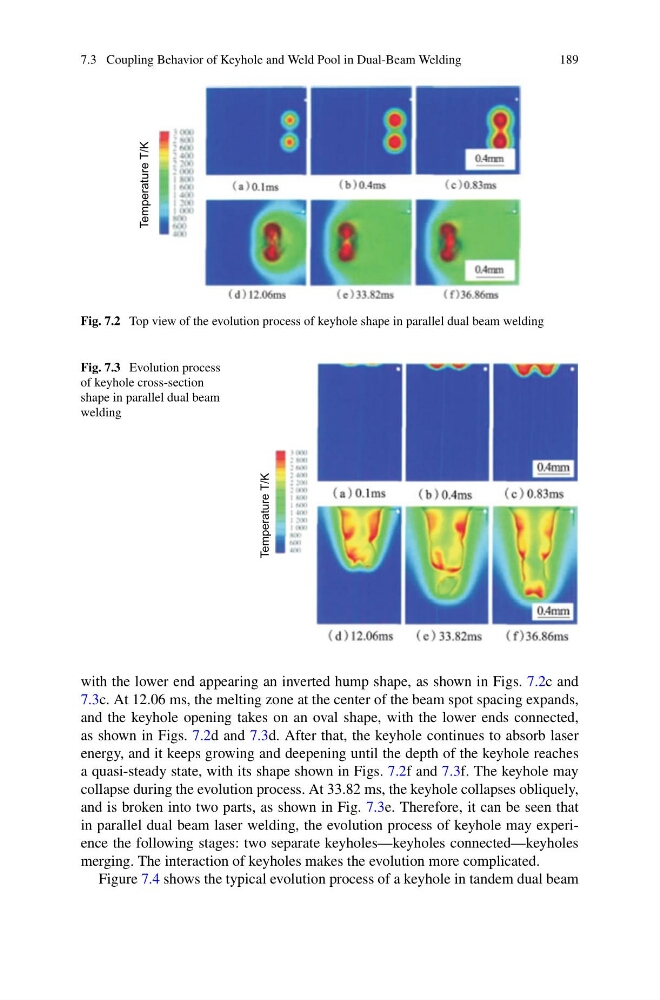
Fig. 7.2 Top view of the evolution process of keyhole shape in parallel dual beam welding
Fig. 7.3 Evolution process
of keyhole cross-section
shape in parallel dual beam
welding
Temperature T/K
with the lower end appearing an inverted hump shape, as shown in Figs. 7.2c and
7.3c. At 12.06 ms, the melting zone at the center of the beam spot spacing expands,
and the keyhole opening takes on an oval shape, with the lower ends connected,
as shown in Figs. 7.2d and 7.3d. After that, the keyhole continues to absorb laser
energy, and it keeps growing and deepening until the depth of the keyhole reaches
a quasi-steady state, with its shape shown in Figs. 7.2f and 7.3f. The keyhole may
collapse during the evolution process. At 33.82 ms, the keyhole collapses obliquely,
and is broken into two parts, as shown in Fig. 7.3e. Therefore, it can be seen that
in parallel dual beam laser welding, the evolution process of keyhole may experience the following stages: two separate keyholes—keyholes connected—keyholes
merging. The interaction of keyholes makes the evolution more complicated.
Figure 7.4 shows the typical evolution process of a keyhole in tandem dual beam
189
Temperature T/K
Fig. 7.2 Top view of the evolution process of keyhole shape in parallel dual beam welding
Fig. 7.3 Evolution process
of keyhole cross-section
shape in parallel dual beam
welding
Temperature T/K
with the lower end appearing an inverted hump shape, as shown in Figs. 7.2c and
7.3c. At 12.06 ms, the melting zone at the center of the beam spot spacing expands,
and the keyhole opening takes on an oval shape, with the lower ends connected,
as shown in Figs. 7.2d and 7.3d. After that, the keyhole continues to absorb laser
energy, and it keeps growing and deepening until the depth of the keyhole reaches
a quasi-steady state, with its shape shown in Figs. 7.2f and 7.3f. The keyhole may
collapse during the evolution process. At 33.82 ms, the keyhole collapses obliquely,
and is broken into two parts, as shown in Fig. 7.3e. Therefore, it can be seen that
in parallel dual beam laser welding, the evolution process of keyhole may experience the following stages: two separate keyholes—keyholes connected—keyholes
merging. The interaction of keyholes makes the evolution more complicated.
Figure 7.4 shows the typical evolution process of a keyhole in tandem dual beam