

4
1 Laser Welding Basics
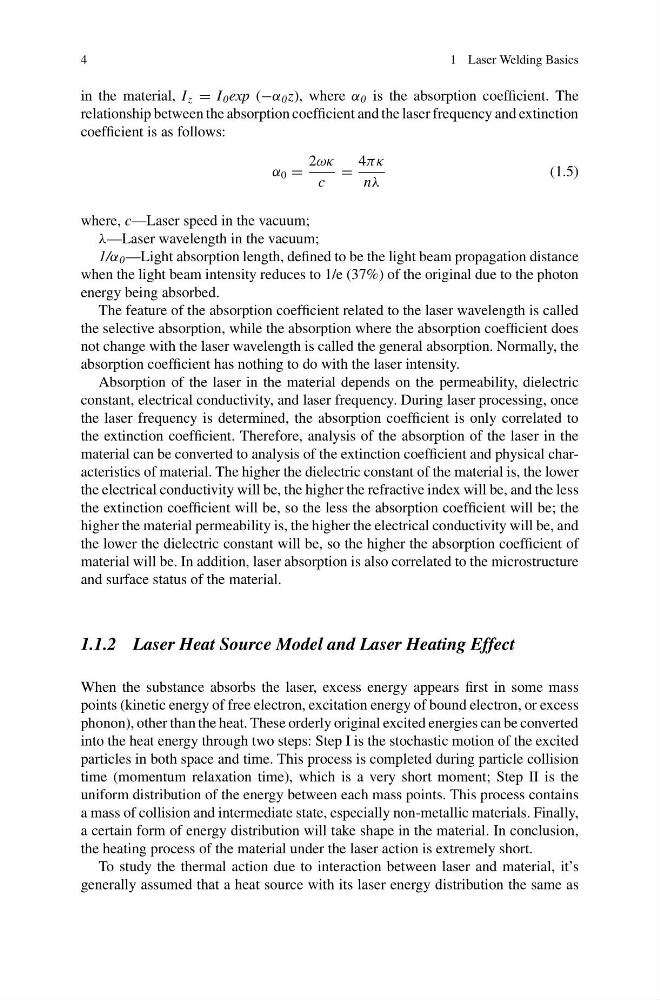
in the material, I z = I 0 exp (−α 0 z), where α 0 is the absorption coefficient. The
relationship between the absorption coefficient and the laser frequency and extinction
coefficient is as follows:
α 0 =
2ωκ
c
=
4πκ
nλ
(1.5)
where, c—Laser speed in the vacuum;
λ—Laser wavelength in the vacuum;
1/α 0 —Light absorption length, defined to be the light beam propagation distance
when the light beam intensity reduces to 1/e (37%) of the original due to the photon
energy being absorbed.
The feature of the absorption coefficient related to the laser wavelength is called
the selective absorption, while the absorption where the absorption coefficient does
not change with the laser wavelength is called the general absorption. Normally, the
absorption coefficient has nothing to do with the laser intensity.
Absorption of the laser in the material depends on the permeability, dielectric
constant, electrical conductivity, and laser frequency. During laser processing, once
the laser frequency is determined, the absorption coefficient is only correlated to
the extinction coefficient. Therefore, analysis of the absorption of the laser in the
material can be converted to analysis of the extinction coefficient and physical characteristics of material. The higher the dielectric constant of the material is, the lower
the electrical conductivity will be, the higher the refractive index will be, and the less
the extinction coefficient will be, so the less the absorption coefficient will be; the
higher the material permeability is, the higher the electrical conductivity will be, and
the lower the dielectric constant will be, so the higher the absorption coefficient of
material will be. In addition, laser absorption is also correlated to the microstructure
and surface status of the material.
1.1.2 Laser Heat Source Model and Laser Heating Effect
When the substance absorbs the laser, excess energy appears first in some mass
points (kinetic energy of free electron, excitation energy of bound electron, or excess
phonon), other than the heat. These orderly original excited energies can be converted
into the heat energy through two steps: Step I is the stochastic motion of the excited
particles in both space and time. This process is completed during particle collision
time (momentum relaxation time), which is a very short moment; Step II is the
uniform distribution of the energy between each mass points. This process contains
a mass of collision and intermediate state, especially non-metallic materials. Finally,
a certain form of energy distribution will take shape in the material. In conclusion,
the heating process of the material under the laser action is extremely short.
To study the thermal action due to interaction between laser and material, it’s
generally assumed that a heat source with its laser energy distribution the same as
1 Laser Welding Basics
in the material, I z = I 0 exp (−α 0 z), where α 0 is the absorption coefficient. The
relationship between the absorption coefficient and the laser frequency and extinction
coefficient is as follows:
α 0 =
2ωκ
c
=
4πκ
nλ
(1.5)
where, c—Laser speed in the vacuum;
λ—Laser wavelength in the vacuum;
1/α 0 —Light absorption length, defined to be the light beam propagation distance
when the light beam intensity reduces to 1/e (37%) of the original due to the photon
energy being absorbed.
The feature of the absorption coefficient related to the laser wavelength is called
the selective absorption, while the absorption where the absorption coefficient does
not change with the laser wavelength is called the general absorption. Normally, the
absorption coefficient has nothing to do with the laser intensity.
Absorption of the laser in the material depends on the permeability, dielectric
constant, electrical conductivity, and laser frequency. During laser processing, once
the laser frequency is determined, the absorption coefficient is only correlated to
the extinction coefficient. Therefore, analysis of the absorption of the laser in the
material can be converted to analysis of the extinction coefficient and physical characteristics of material. The higher the dielectric constant of the material is, the lower
the electrical conductivity will be, the higher the refractive index will be, and the less
the extinction coefficient will be, so the less the absorption coefficient will be; the
higher the material permeability is, the higher the electrical conductivity will be, and
the lower the dielectric constant will be, so the higher the absorption coefficient of
material will be. In addition, laser absorption is also correlated to the microstructure
and surface status of the material.
1.1.2 Laser Heat Source Model and Laser Heating Effect
When the substance absorbs the laser, excess energy appears first in some mass
points (kinetic energy of free electron, excitation energy of bound electron, or excess
phonon), other than the heat. These orderly original excited energies can be converted
into the heat energy through two steps: Step I is the stochastic motion of the excited
particles in both space and time. This process is completed during particle collision
time (momentum relaxation time), which is a very short moment; Step II is the
uniform distribution of the energy between each mass points. This process contains
a mass of collision and intermediate state, especially non-metallic materials. Finally,
a certain form of energy distribution will take shape in the material. In conclusion,
the heating process of the material under the laser action is extremely short.
To study the thermal action due to interaction between laser and material, it’s
generally assumed that a heat source with its laser energy distribution the same as