

1.1 Interaction of Lasers and Materials
3
minimum value, and k value monotonically decreases. Therefore, the laser can be
absorbed well when the laser frequency is near the plasma frequency; when the laser
frequency continues to go up and far more than the plasma frequency, n is quickly
approaching 1, and k quickly becomes 0, in which case, the metal is transparent. The
plasma frequency of the metallic material is between ultraviolet and near-infrared
band, so the laser from near-infrared, visible, to ultraviolet band is relatively favorable
to metal processing; the far-infrared laser is almost reflected by the metal. For the
infrared light with low photon energy, the light frequency electromagnetic wave
only works on the free electrons in the metal, while for the visible light or UV-light
with high photon energy, the optical frequency electromagnetic wave can also work
on the bound electrons in the metal as the inherent frequency of bound electrons
in the metal is within the visible or UV-light frequency band. Under the action of
the bound electrons, the reflecting capacity of the metal reduces, the transmitting
capacity increases, and the laser absorption capacity increases, indicating certain
non-metal optical property.
Due to interaction between the laser and the electrons, ions, lattice vibration, impurities, and defects in the material, the laser can be absorbed by the material. Therefore,
the optical properties of the material are closely correlated to laser absorption.
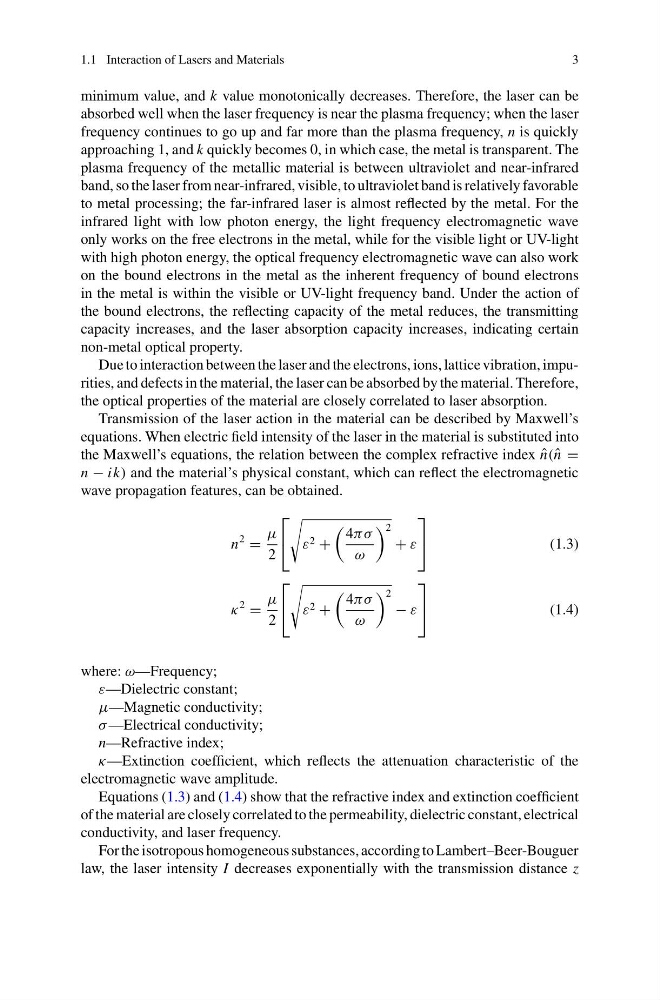
Transmission of the laser action in the material can be described by Maxwell’s
equations. When electric field intensity of the laser in the material is substituted into
the Maxwell’s equations, the relation between the complex refractive index ˆ
n( ˆ
n =
n − ik) and the material’s physical constant, which can reflect the electromagnetic
wave propagation features, can be obtained.
n
2
=
μ
2
⎡
⎣
ε 2 +
4πσ
ω
2
+ ε
⎤
⎦
(1.3)
κ
2
=
μ
2
⎡
⎣
ε 2 +
4πσ
ω
2
− ε
⎤
⎦
(1.4)
where: ω—Frequency;
ε—Dielectric constant;
μ—Magnetic conductivity;
σ —Electrical conductivity;
n—Refractive index;
κ—Extinction coefficient, which reflects the attenuation characteristic of the
electromagnetic wave amplitude.
Equations (1.3) and (1.4) show that the refractive index and extinction coefficient
of the material are closely correlated to the permeability, dielectric constant, electrical
conductivity, and laser frequency.
For the isotropous homogeneous substances, according to Lambert–Beer-Bouguer
law, the laser intensity I decreases exponentially with the transmission distance z
3
minimum value, and k value monotonically decreases. Therefore, the laser can be
absorbed well when the laser frequency is near the plasma frequency; when the laser
frequency continues to go up and far more than the plasma frequency, n is quickly
approaching 1, and k quickly becomes 0, in which case, the metal is transparent. The
plasma frequency of the metallic material is between ultraviolet and near-infrared
band, so the laser from near-infrared, visible, to ultraviolet band is relatively favorable
to metal processing; the far-infrared laser is almost reflected by the metal. For the
infrared light with low photon energy, the light frequency electromagnetic wave
only works on the free electrons in the metal, while for the visible light or UV-light
with high photon energy, the optical frequency electromagnetic wave can also work
on the bound electrons in the metal as the inherent frequency of bound electrons
in the metal is within the visible or UV-light frequency band. Under the action of
the bound electrons, the reflecting capacity of the metal reduces, the transmitting
capacity increases, and the laser absorption capacity increases, indicating certain
non-metal optical property.
Due to interaction between the laser and the electrons, ions, lattice vibration, impurities, and defects in the material, the laser can be absorbed by the material. Therefore,
the optical properties of the material are closely correlated to laser absorption.
Transmission of the laser action in the material can be described by Maxwell’s
equations. When electric field intensity of the laser in the material is substituted into
the Maxwell’s equations, the relation between the complex refractive index ˆ
n( ˆ
n =
n − ik) and the material’s physical constant, which can reflect the electromagnetic
wave propagation features, can be obtained.
n
2
=
μ
2
⎡
⎣
ε 2 +
4πσ
ω
2
+ ε
⎤
⎦
(1.3)
κ
2
=
μ
2
⎡
⎣
ε 2 +
4πσ
ω
2
− ε
⎤
⎦
(1.4)
where: ω—Frequency;
ε—Dielectric constant;
μ—Magnetic conductivity;
σ —Electrical conductivity;
n—Refractive index;
κ—Extinction coefficient, which reflects the attenuation characteristic of the
electromagnetic wave amplitude.
Equations (1.3) and (1.4) show that the refractive index and extinction coefficient
of the material are closely correlated to the permeability, dielectric constant, electrical
conductivity, and laser frequency.
For the isotropous homogeneous substances, according to Lambert–Beer-Bouguer
law, the laser intensity I decreases exponentially with the transmission distance z