

160
5 Dynamic Behaviors of Metal Vapor/Plasma Plume …
(a)
(b)
(c)
(d)
(e)
(f)
(g)
(h)
(i)
(j)
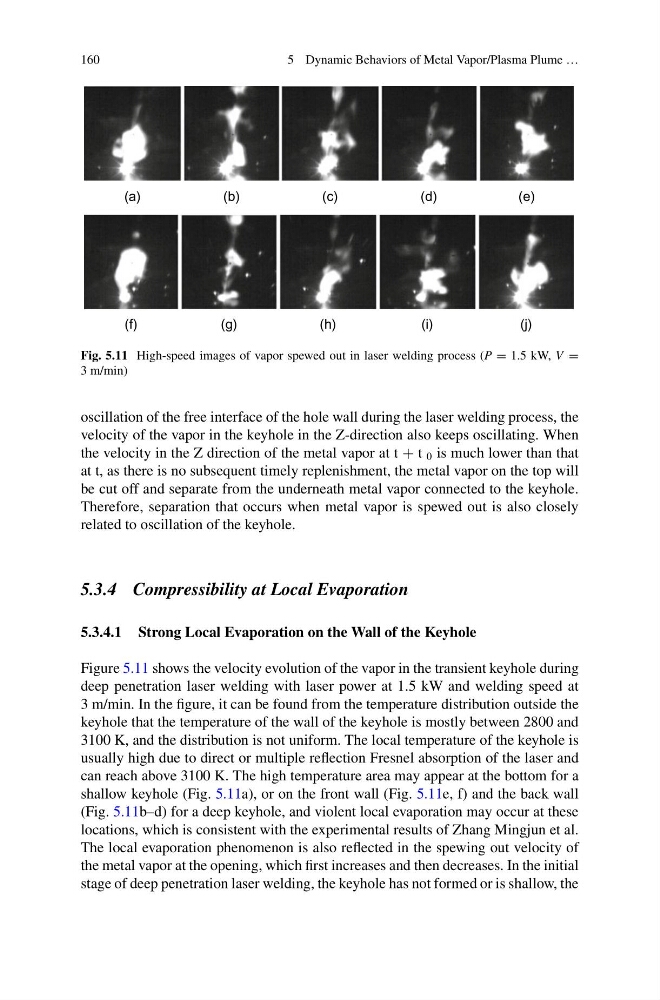
Fig. 5.11 High-speed images of vapor spewed out in laser welding process (P = 1.5 kW, V =
3 m/min)
oscillation of the free interface of the hole wall during the laser welding process, the
velocity of the vapor in the keyhole in the Z-direction also keeps oscillating. When
the velocity in the Z direction of the metal vapor at t + t 0 is much lower than that
at t, as there is no subsequent timely replenishment, the metal vapor on the top will
be cut off and separate from the underneath metal vapor connected to the keyhole.
Therefore, separation that occurs when metal vapor is spewed out is also closely
related to oscillation of the keyhole.
5.3.4 Compressibility at Local Evaporation
5.3.4.1 Strong Local Evaporation on the Wall of the Keyhole
Figure 5.11 shows the velocity evolution of the vapor in the transient keyhole during
deep penetration laser welding with laser power at 1.5 kW and welding speed at
3 m/min. In the figure, it can be found from the temperature distribution outside the
keyhole that the temperature of the wall of the keyhole is mostly between 2800 and
3100 K, and the distribution is not uniform. The local temperature of the keyhole is
usually high due to direct or multiple reflection Fresnel absorption of the laser and
can reach above 3100 K. The high temperature area may appear at the bottom for a
shallow keyhole (Fig. 5.11a), or on the front wall (Fig. 5.11e, f) and the back wall
(Fig. 5.11b–d) for a deep keyhole, and violent local evaporation may occur at these
locations, which is consistent with the experimental results of Zhang Mingjun et al.
The local evaporation phenomenon is also reflected in the spewing out velocity of
the metal vapor at the opening, which first increases and then decreases. In the initial
stage of deep penetration laser welding, the keyhole has not formed or is shallow, the
5 Dynamic Behaviors of Metal Vapor/Plasma Plume …
(a)
(b)
(c)
(d)
(e)
(f)
(g)
(h)
(i)
(j)
Fig. 5.11 High-speed images of vapor spewed out in laser welding process (P = 1.5 kW, V =
3 m/min)
oscillation of the free interface of the hole wall during the laser welding process, the
velocity of the vapor in the keyhole in the Z-direction also keeps oscillating. When
the velocity in the Z direction of the metal vapor at t + t 0 is much lower than that
at t, as there is no subsequent timely replenishment, the metal vapor on the top will
be cut off and separate from the underneath metal vapor connected to the keyhole.
Therefore, separation that occurs when metal vapor is spewed out is also closely
related to oscillation of the keyhole.
5.3.4 Compressibility at Local Evaporation
5.3.4.1 Strong Local Evaporation on the Wall of the Keyhole
Figure 5.11 shows the velocity evolution of the vapor in the transient keyhole during
deep penetration laser welding with laser power at 1.5 kW and welding speed at
3 m/min. In the figure, it can be found from the temperature distribution outside the
keyhole that the temperature of the wall of the keyhole is mostly between 2800 and
3100 K, and the distribution is not uniform. The local temperature of the keyhole is
usually high due to direct or multiple reflection Fresnel absorption of the laser and
can reach above 3100 K. The high temperature area may appear at the bottom for a
shallow keyhole (Fig. 5.11a), or on the front wall (Fig. 5.11e, f) and the back wall
(Fig. 5.11b–d) for a deep keyhole, and violent local evaporation may occur at these
locations, which is consistent with the experimental results of Zhang Mingjun et al.
The local evaporation phenomenon is also reflected in the spewing out velocity of
the metal vapor at the opening, which first increases and then decreases. In the initial
stage of deep penetration laser welding, the keyhole has not formed or is shallow, the