

5.2 Dynamic Model of Metal Vapor/Plasma in Transient Keyhole
143
ρ l (
∂
− →
U l
∂t
+ (
− →
U l · ∇)
− →
U l ) = ∇ · (μ l ∇
− →
U l ) − ∇ p l −
μ l
K
− →
U l −
c p
√
K
− →
U l
− →
U l + ρ l
− → g β(T l − T re f )
(5.2)
ρ l c p (
∂ T l
∂t
+ (
− →
U l · ∇)T l ) = ∇ · (k l ∇T l )
(5.3)
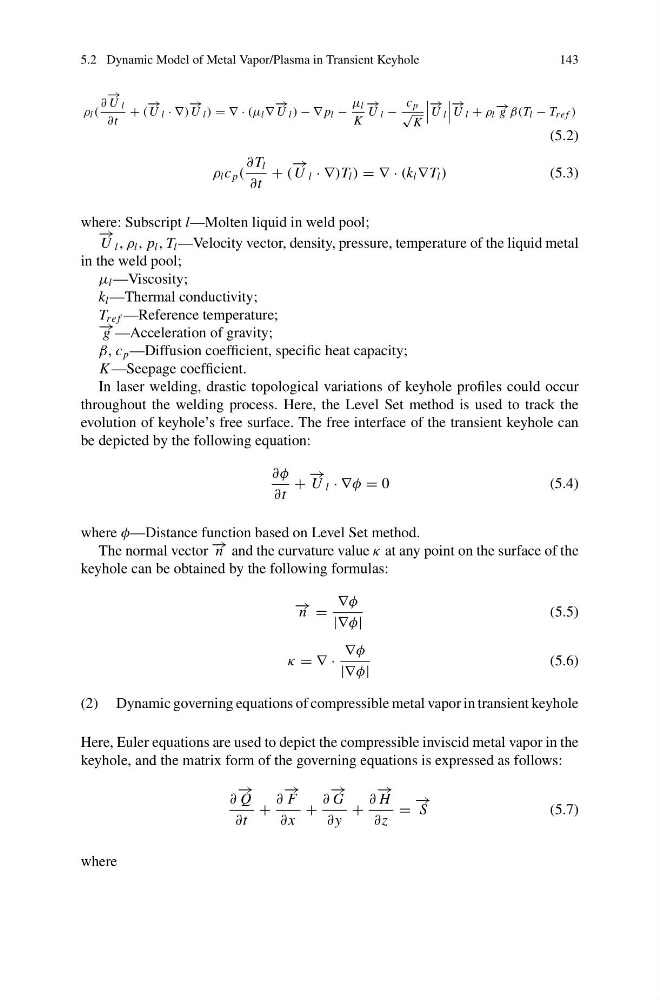
where: Subscript l—Molten liquid in weld pool;
− →
U l , ρ l , p l , T l —Velocity vector, density, pressure, temperature of the liquid metal
in the weld pool;
μ l —Viscosity;
k l —Thermal conductivity;
T re f —Reference temperature;
− → g —Acceleration of gravity;
β, c p —Diffusion coefficient, specific heat capacity;
K —Seepage coefficient.
In laser welding, drastic topological variations of keyhole profiles could occur
throughout the welding process. Here, the Level Set method is used to track the
evolution of keyhole’s free surface. The free interface of the transient keyhole can
be depicted by the following equation:
∂φ
∂t
+
− →
U l · ∇φ = 0
( 5 . 4 )
where φ—Distance function based on Level Set method.
The normal vector − → n and the curvature value κ at any point on the surface of the
keyhole can be obtained by the following formulas:
− → n =
∇φ
|∇φ|
(5.5)
κ = ∇ ·
∇φ
|∇φ|
(5.6)
(2) Dynamic governing equations of compressible metal vapor in transient keyhole
Here, Euler equations are used to depict the compressible inviscid metal vapor in the
keyhole, and the matrix form of the governing equations is expressed as follows:
∂
− →
Q
∂t
+
∂
− →
F
∂ x
+
∂
− →
G
∂ y
+
∂
− →
H
∂z
=
− →
S
(5.7)
where
143
ρ l (
∂
− →
U l
∂t
+ (
− →
U l · ∇)
− →
U l ) = ∇ · (μ l ∇
− →
U l ) − ∇ p l −
μ l
K
− →
U l −
c p
√
K
− →
U l
− →
U l + ρ l
− → g β(T l − T re f )
(5.2)
ρ l c p (
∂ T l
∂t
+ (
− →
U l · ∇)T l ) = ∇ · (k l ∇T l )
(5.3)
where: Subscript l—Molten liquid in weld pool;
− →
U l , ρ l , p l , T l —Velocity vector, density, pressure, temperature of the liquid metal
in the weld pool;
μ l —Viscosity;
k l —Thermal conductivity;
T re f —Reference temperature;
− → g —Acceleration of gravity;
β, c p —Diffusion coefficient, specific heat capacity;
K —Seepage coefficient.
In laser welding, drastic topological variations of keyhole profiles could occur
throughout the welding process. Here, the Level Set method is used to track the
evolution of keyhole’s free surface. The free interface of the transient keyhole can
be depicted by the following equation:
∂φ
∂t
+
− →
U l · ∇φ = 0
( 5 . 4 )
where φ—Distance function based on Level Set method.
The normal vector − → n and the curvature value κ at any point on the surface of the
keyhole can be obtained by the following formulas:
− → n =
∇φ
|∇φ|
(5.5)
κ = ∇ ·
∇φ
|∇φ|
(5.6)
(2) Dynamic governing equations of compressible metal vapor in transient keyhole
Here, Euler equations are used to depict the compressible inviscid metal vapor in the
keyhole, and the matrix form of the governing equations is expressed as follows:
∂
− →
Q
∂t
+
∂
− →
F
∂ x
+
∂
− →
G
∂ y
+
∂
− →
H
∂z
=
− →
S
(5.7)
where