

4.3 Effects of Physical Factors on the Coupling Behavior
123
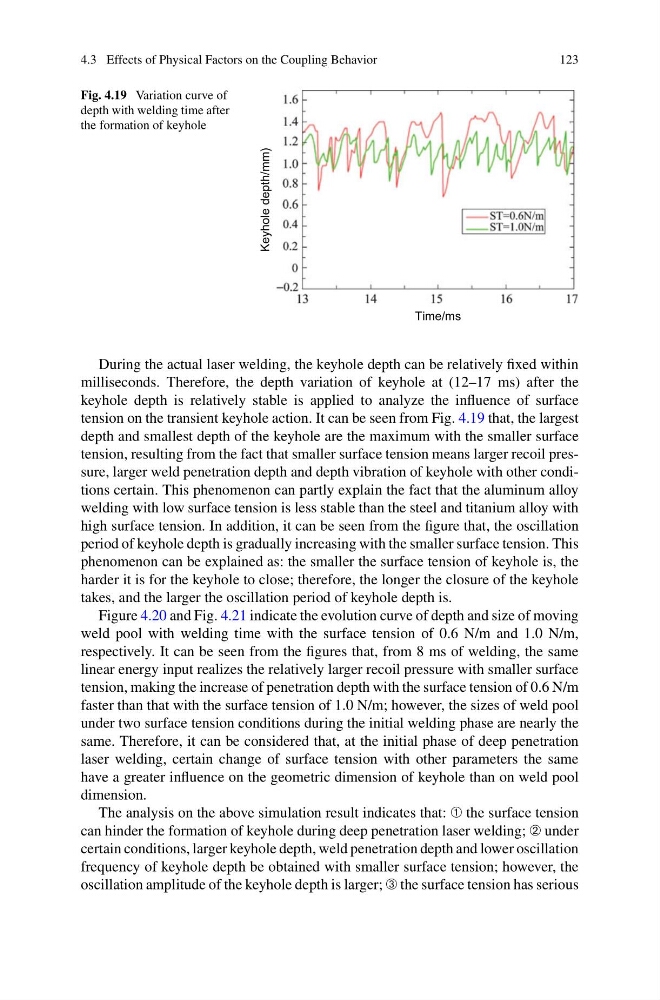
Fig. 4.19 Variation curve of
depth with welding time after
the formation of keyhole
Time/ms
Keyhole depth/mm)
During the actual laser welding, the keyhole depth can be relatively fixed within
milliseconds. Therefore, the depth variation of keyhole at (12–17 ms) after the
keyhole depth is relatively stable is applied to analyze the influence of surface
tension on the transient keyhole action. It can be seen from Fig. 4.19 that, the largest
depth and smallest depth of the keyhole are the maximum with the smaller surface
tension, resulting from the fact that smaller surface tension means larger recoil pressure, larger weld penetration depth and depth vibration of keyhole with other conditions certain. This phenomenon can partly explain the fact that the aluminum alloy
welding with low surface tension is less stable than the steel and titanium alloy with
high surface tension. In addition, it can be seen from the figure that, the oscillation
period of keyhole depth is gradually increasing with the smaller surface tension. This
phenomenon can be explained as: the smaller the surface tension of keyhole is, the
harder it is for the keyhole to close; therefore, the longer the closure of the keyhole
takes, and the larger the oscillation period of keyhole depth is.
Figure 4.20 and Fig. 4.21 indicate the evolution curve of depth and size of moving
weld pool with welding time with the surface tension of 0.6 N/m and 1.0 N/m,
respectively. It can be seen from the figures that, from 8 ms of welding, the same
linear energy input realizes the relatively larger recoil pressure with smaller surface
tension, making the increase of penetration depth with the surface tension of 0.6 N/m
faster than that with the surface tension of 1.0 N/m; however, the sizes of weld pool
under two surface tension conditions during the initial welding phase are nearly the
same. Therefore, it can be considered that, at the initial phase of deep penetration
laser welding, certain change of surface tension with other parameters the same
have a greater influence on the geometric dimension of keyhole than on weld pool
dimension.
The analysis on the above simulation result indicates that: ➀ the surface tension
can hinder the formation of keyhole during deep penetration laser welding; ➁ under
certain conditions, larger keyhole depth, weld penetration depth and lower oscillation
frequency of keyhole depth be obtained with smaller surface tension; however, the
oscillation amplitude of the keyhole depth is larger; ➂ the surface tension has serious
123
Fig. 4.19 Variation curve of
depth with welding time after
the formation of keyhole
Time/ms
Keyhole depth/mm)
During the actual laser welding, the keyhole depth can be relatively fixed within
milliseconds. Therefore, the depth variation of keyhole at (12–17 ms) after the
keyhole depth is relatively stable is applied to analyze the influence of surface
tension on the transient keyhole action. It can be seen from Fig. 4.19 that, the largest
depth and smallest depth of the keyhole are the maximum with the smaller surface
tension, resulting from the fact that smaller surface tension means larger recoil pressure, larger weld penetration depth and depth vibration of keyhole with other conditions certain. This phenomenon can partly explain the fact that the aluminum alloy
welding with low surface tension is less stable than the steel and titanium alloy with
high surface tension. In addition, it can be seen from the figure that, the oscillation
period of keyhole depth is gradually increasing with the smaller surface tension. This
phenomenon can be explained as: the smaller the surface tension of keyhole is, the
harder it is for the keyhole to close; therefore, the longer the closure of the keyhole
takes, and the larger the oscillation period of keyhole depth is.
Figure 4.20 and Fig. 4.21 indicate the evolution curve of depth and size of moving
weld pool with welding time with the surface tension of 0.6 N/m and 1.0 N/m,
respectively. It can be seen from the figures that, from 8 ms of welding, the same
linear energy input realizes the relatively larger recoil pressure with smaller surface
tension, making the increase of penetration depth with the surface tension of 0.6 N/m
faster than that with the surface tension of 1.0 N/m; however, the sizes of weld pool
under two surface tension conditions during the initial welding phase are nearly the
same. Therefore, it can be considered that, at the initial phase of deep penetration
laser welding, certain change of surface tension with other parameters the same
have a greater influence on the geometric dimension of keyhole than on weld pool
dimension.
The analysis on the above simulation result indicates that: ➀ the surface tension
can hinder the formation of keyhole during deep penetration laser welding; ➁ under
certain conditions, larger keyhole depth, weld penetration depth and lower oscillation
frequency of keyhole depth be obtained with smaller surface tension; however, the
oscillation amplitude of the keyhole depth is larger; ➂ the surface tension has serious