

3.9 Eigenmodes of Anisotropic Media
79
from this host would be anomalies that would be gridded by themselves, without
the need to grid the host anisotropy. Furthermore, one may be interested in other
problems of electromagnetic scattering from composite materials, without reference
to nondestructive evaluation. For these reasons, we will outline the development of a
Green’s function for aniostropic planar layered media, that follows closely the spirit
of [111, Chapter 2].
We will consider plane-parallel bodies of infinite extent in the (x, y) plane, which
are made up of layers of homogeneous, anisotropic material. To be specific, we
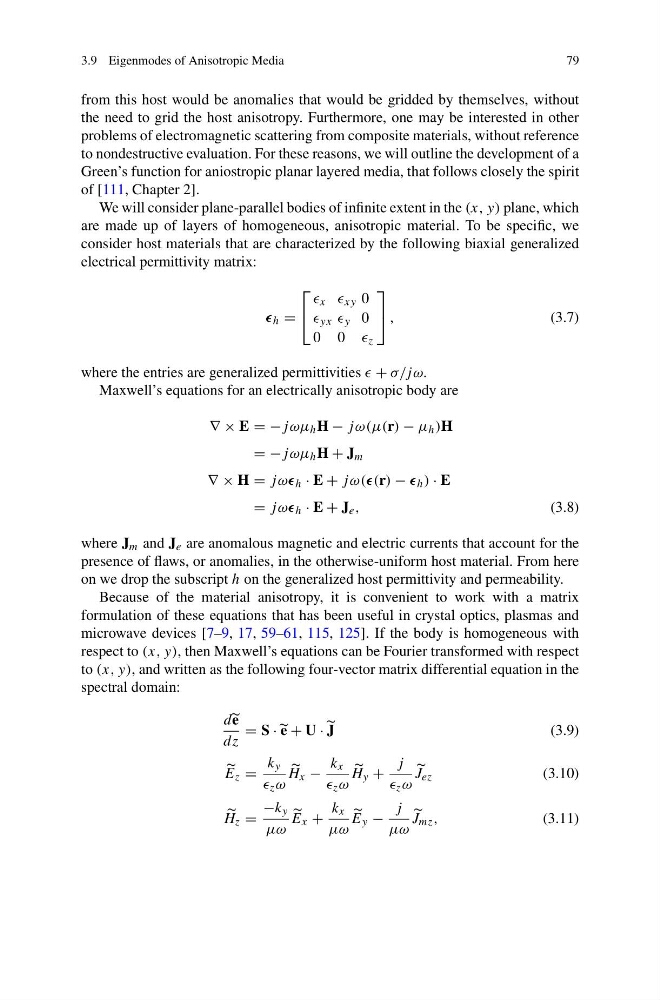
consider host materials that are characterized by the following biaxial generalized
electrical permittivity matrix:
h =
⎡
⎣
x xy 0
yx y 0
0 0 z
⎤
⎦ ,
(3.7)
where the entries are generalized permittivities + σ/j ω.
Maxwell’s equations for an electrically anisotropic body are
∇ × E = −jωμ h H − jω(μ(r) − μ h )H
= −jωμ h H + J m
∇ × H = jω h · E + jω((r) − h ) · E
= jω h · E + J e ,
(3.8)
where J m and J e are anomalous magnetic and electric currents that account for the
presence of flaws, or anomalies, in the otherwise-uniform host material. From here
on we drop the subscript h on the generalized host permittivity and permeability.
Because of the material anisotropy, it is convenient to work with a matrix
formulation of these equations that has been useful in crystal optics, plasmas and
microwave devices [7–9, 17, 59–61, 115, 125]. If the body is homogeneous with
respect to (x, y), then Maxwell’s equations can be Fourier transformed with respect
to (x, y), and written as the following four-vector matrix differential equation in the
spectral domain:
d e
dz
= S · e + U · J
(3.9)
E z =
k y
z ω
H x −
k x
z ω
H y +
j
z ω
J ez
(3.10)
H z =
−k y
μω
E x +
k x
μω
E y −
j
μω
J mz ,
(3.11)
79
from this host would be anomalies that would be gridded by themselves, without
the need to grid the host anisotropy. Furthermore, one may be interested in other
problems of electromagnetic scattering from composite materials, without reference
to nondestructive evaluation. For these reasons, we will outline the development of a
Green’s function for aniostropic planar layered media, that follows closely the spirit
of [111, Chapter 2].
We will consider plane-parallel bodies of infinite extent in the (x, y) plane, which
are made up of layers of homogeneous, anisotropic material. To be specific, we
consider host materials that are characterized by the following biaxial generalized
electrical permittivity matrix:
h =
⎡
⎣
x xy 0
yx y 0
0 0 z
⎤
⎦ ,
(3.7)
where the entries are generalized permittivities + σ/j ω.
Maxwell’s equations for an electrically anisotropic body are
∇ × E = −jωμ h H − jω(μ(r) − μ h )H
= −jωμ h H + J m
∇ × H = jω h · E + jω((r) − h ) · E
= jω h · E + J e ,
(3.8)
where J m and J e are anomalous magnetic and electric currents that account for the
presence of flaws, or anomalies, in the otherwise-uniform host material. From here
on we drop the subscript h on the generalized host permittivity and permeability.
Because of the material anisotropy, it is convenient to work with a matrix
formulation of these equations that has been useful in crystal optics, plasmas and
microwave devices [7–9, 17, 59–61, 115, 125]. If the body is homogeneous with
respect to (x, y), then Maxwell’s equations can be Fourier transformed with respect
to (x, y), and written as the following four-vector matrix differential equation in the
spectral domain:
d e
dz
= S · e + U · J
(3.9)
E z =
k y
z ω
H x −
k x
z ω
H y +
j
z ω
J ez
(3.10)
H z =
−k y
μω
E x +
k x
μω
E y −
j
μω
J mz ,
(3.11)