

330
12 Carbon-Nanotube Reinforced Polymers
-4800
-4790
-4780
-4770
-4760
-4750
-4740
-4730
-4720
-4710
0
2
4
6
8
10
Frequency (GHz)
H (kgauss)
Spectrum for Exchange Interaction
1
2
3
4
4740
4745
4750
4755
4760
4765
4770
0
2
4
6
8
10
Frequency (GHz)
H (kgauss)
Spectrum for Exchange Interaction
7,8
5,6
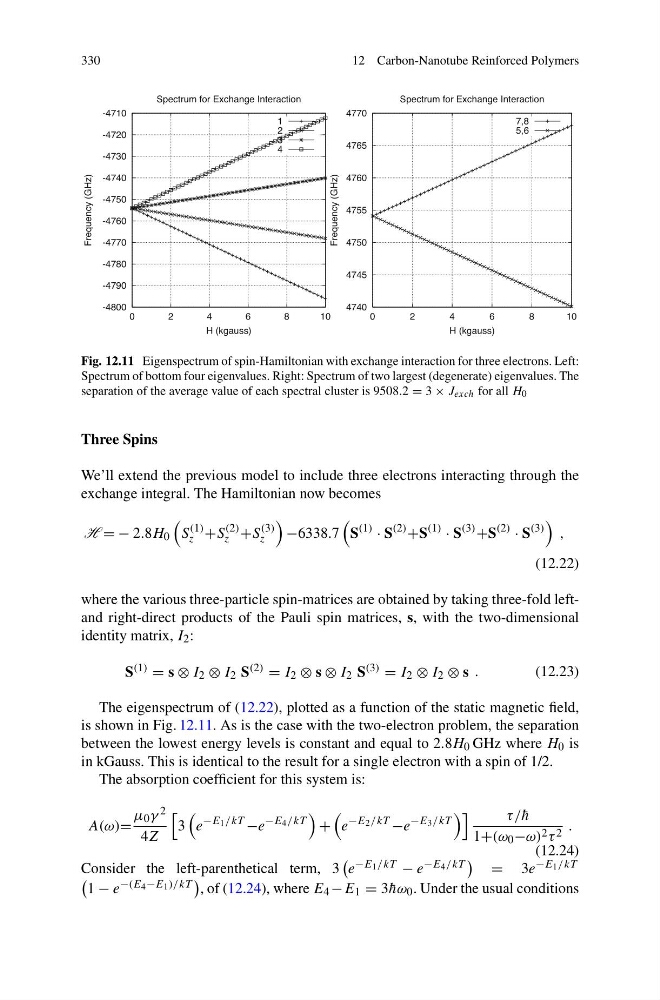
Fig. 12.11 Eigenspectrum of spin-Hamiltonian with exchange interaction for three electrons. Left:
Spectrum of bottom four eigenvalues. Right: Spectrum of two largest (degenerate) eigenvalues. The
separation of the average value of each spectral cluster is 9508.2 = 3 × J exch for all H 0
Three Spins
We’ll extend the previous model to include three electrons interacting through the
exchange integral. The Hamiltonian now becomes
H = − 2.8H 0
S
(1)
z +S
(2)
z +S
(3)
z
−6338.7
S
(1)
· S
(2)
+S
(1)
· S
(3)
+S
(2)
· S
(3)
,
(12.22)
where the various three-particle spin-matrices are obtained by taking three-fold leftand right-direct products of the Pauli spin matrices, s, with the two-dimensional
identity matrix, I 2 :
S (1) = s ⊗ I 2 ⊗ I 2 S (2) = I 2 ⊗ s ⊗ I 2 S (3) = I 2 ⊗ I 2 ⊗ s .
(12.23)
The eigenspectrum of (12.22), plotted as a function of the static magnetic field,
is shown in Fig. 12.11. As is the case with the two-electron problem, the separation
between the lowest energy levels is constant and equal to 2.8H 0 GHz where H 0 is
in kGauss. This is identical to the result for a single electron with a spin of 1/2.
The absorption coefficient for this system is:
A(ω)=
μ 0 γ 2
4Z
3
e
−E 1 /kT
−e
−E 4 /kT
+
e
−E 2 /kT
−e
−E 3 /kT
τ/ ¯
h
1+(ω 0 −ω) 2 τ 2 .
(12.24)
Consider the left-parenthetical term, 3
e −E 1 /kT − e −E 4 /kT = 3e −E 1 /kT
1 − e −(E 4 −E 1 )/kT
, of (12.24), where E 4 −E 1 = 3 ¯
hω 0 . Under the usual conditions
12 Carbon-Nanotube Reinforced Polymers
-4800
-4790
-4780
-4770
-4760
-4750
-4740
-4730
-4720
-4710
0
2
4
6
8
10
Frequency (GHz)
H (kgauss)
Spectrum for Exchange Interaction
1
2
3
4
4740
4745
4750
4755
4760
4765
4770
0
2
4
6
8
10
Frequency (GHz)
H (kgauss)
Spectrum for Exchange Interaction
7,8
5,6
Fig. 12.11 Eigenspectrum of spin-Hamiltonian with exchange interaction for three electrons. Left:
Spectrum of bottom four eigenvalues. Right: Spectrum of two largest (degenerate) eigenvalues. The
separation of the average value of each spectral cluster is 9508.2 = 3 × J exch for all H 0
Three Spins
We’ll extend the previous model to include three electrons interacting through the
exchange integral. The Hamiltonian now becomes
H = − 2.8H 0
S
(1)
z +S
(2)
z +S
(3)
z
−6338.7
S
(1)
· S
(2)
+S
(1)
· S
(3)
+S
(2)
· S
(3)
,
(12.22)
where the various three-particle spin-matrices are obtained by taking three-fold leftand right-direct products of the Pauli spin matrices, s, with the two-dimensional
identity matrix, I 2 :
S (1) = s ⊗ I 2 ⊗ I 2 S (2) = I 2 ⊗ s ⊗ I 2 S (3) = I 2 ⊗ I 2 ⊗ s .
(12.23)
The eigenspectrum of (12.22), plotted as a function of the static magnetic field,
is shown in Fig. 12.11. As is the case with the two-electron problem, the separation
between the lowest energy levels is constant and equal to 2.8H 0 GHz where H 0 is
in kGauss. This is identical to the result for a single electron with a spin of 1/2.
The absorption coefficient for this system is:
A(ω)=
μ 0 γ 2
4Z
3
e
−E 1 /kT
−e
−E 4 /kT
+
e
−E 2 /kT
−e
−E 3 /kT
τ/ ¯
h
1+(ω 0 −ω) 2 τ 2 .
(12.24)
Consider the left-parenthetical term, 3
e −E 1 /kT − e −E 4 /kT = 3e −E 1 /kT
1 − e −(E 4 −E 1 )/kT
, of (12.24), where E 4 −E 1 = 3 ¯
hω 0 . Under the usual conditions