

316
12 Carbon-Nanotube Reinforced Polymers
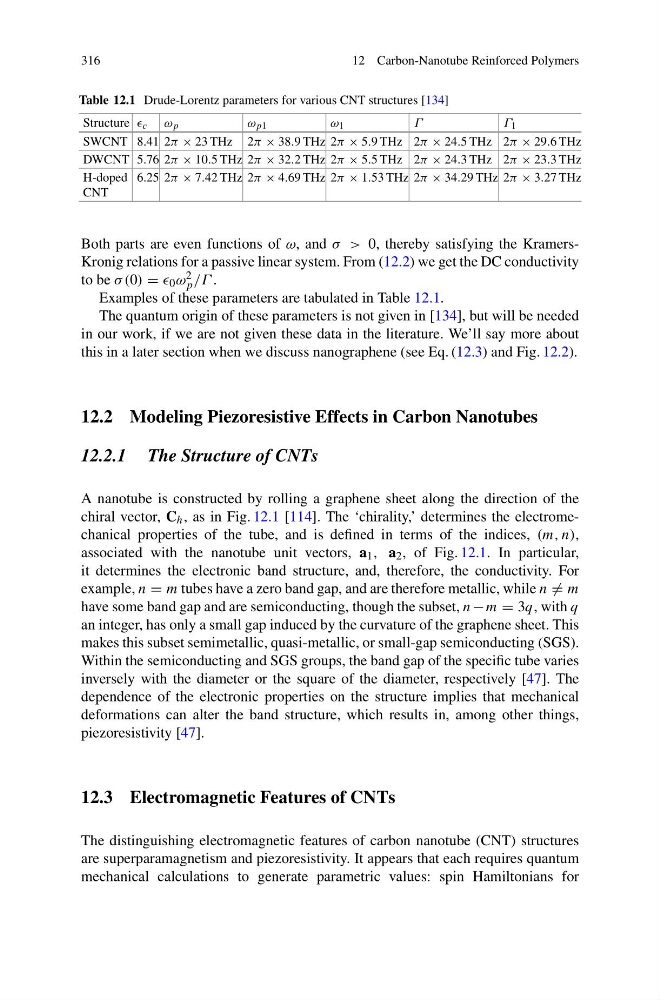
Table 12.1 Drude-Lorentz parameters for various CNT structures [134]
Structure c ω p
ω p1
ω 1
Γ
Γ 1
SWCNT 8.41 2π × 23 THz 2π × 38.9 THz 2π × 5.9 THz 2π × 24.5 THz 2π × 29.6 THz
DWCNT 5.76 2π × 10.5 THz 2π × 32.2 THz 2π × 5.5 THz 2π × 24.3 THz 2π × 23.3 THz
H-doped
CNT
6.25 2π × 7.42 THz 2π × 4.69 THz 2π × 1.53 THz 2π × 34.29 THz 2π × 3.27 THz
Both parts are even functions of ω, and σ > 0, thereby satisfying the KramersKronig relations for a passive linear system. From (12.2) we get the DC conductivity
to be σ (0) = 0 ω 2
p /Γ .
Examples of these parameters are tabulated in Table 12.1.
The quantum origin of these parameters is not given in [134], but will be needed
in our work, if we are not given these data in the literature. We’ll say more about
this in a later section when we discuss nanographene (see Eq. (12.3) and Fig. 12.2).
12.2 Modeling Piezoresistive Effects in Carbon Nanotubes
12.2.1 The Structure of CNTs
A nanotube is constructed by rolling a graphene sheet along the direction of the
chiral vector, C h , as in Fig. 12.1 [114]. The ‘chirality,’ determines the electromechanical properties of the tube, and is defined in terms of the indices, (m, n),
associated with the nanotube unit vectors, a 1 , a 2 , of Fig. 12.1. In particular,
it determines the electronic band structure, and, therefore, the conductivity. For
example, n = m tubes have a zero band gap, and are therefore metallic, while n = m
have some band gap and are semiconducting, though the subset, n − m = 3q, with q
an integer, has only a small gap induced by the curvature of the graphene sheet. This
makes this subset semimetallic, quasi-metallic, or small-gap semiconducting (SGS).
Within the semiconducting and SGS groups, the band gap of the specific tube varies
inversely with the diameter or the square of the diameter, respectively [47]. The
dependence of the electronic properties on the structure implies that mechanical
deformations can alter the band structure, which results in, among other things,
piezoresistivity [47].
12.3 Electromagnetic Features of CNTs
The distinguishing electromagnetic features of carbon nanotube (CNT) structures
are superparamagnetism and piezoresistivity. It appears that each requires quantum
mechanical calculations to generate parametric values: spin Hamiltonians for
12 Carbon-Nanotube Reinforced Polymers
Table 12.1 Drude-Lorentz parameters for various CNT structures [134]
Structure c ω p
ω p1
ω 1
Γ
Γ 1
SWCNT 8.41 2π × 23 THz 2π × 38.9 THz 2π × 5.9 THz 2π × 24.5 THz 2π × 29.6 THz
DWCNT 5.76 2π × 10.5 THz 2π × 32.2 THz 2π × 5.5 THz 2π × 24.3 THz 2π × 23.3 THz
H-doped
CNT
6.25 2π × 7.42 THz 2π × 4.69 THz 2π × 1.53 THz 2π × 34.29 THz 2π × 3.27 THz
Both parts are even functions of ω, and σ > 0, thereby satisfying the KramersKronig relations for a passive linear system. From (12.2) we get the DC conductivity
to be σ (0) = 0 ω 2
p /Γ .
Examples of these parameters are tabulated in Table 12.1.
The quantum origin of these parameters is not given in [134], but will be needed
in our work, if we are not given these data in the literature. We’ll say more about
this in a later section when we discuss nanographene (see Eq. (12.3) and Fig. 12.2).
12.2 Modeling Piezoresistive Effects in Carbon Nanotubes
12.2.1 The Structure of CNTs
A nanotube is constructed by rolling a graphene sheet along the direction of the
chiral vector, C h , as in Fig. 12.1 [114]. The ‘chirality,’ determines the electromechanical properties of the tube, and is defined in terms of the indices, (m, n),
associated with the nanotube unit vectors, a 1 , a 2 , of Fig. 12.1. In particular,
it determines the electronic band structure, and, therefore, the conductivity. For
example, n = m tubes have a zero band gap, and are therefore metallic, while n = m
have some band gap and are semiconducting, though the subset, n − m = 3q, with q
an integer, has only a small gap induced by the curvature of the graphene sheet. This
makes this subset semimetallic, quasi-metallic, or small-gap semiconducting (SGS).
Within the semiconducting and SGS groups, the band gap of the specific tube varies
inversely with the diameter or the square of the diameter, respectively [47]. The
dependence of the electronic properties on the structure implies that mechanical
deformations can alter the band structure, which results in, among other things,
piezoresistivity [47].
12.3 Electromagnetic Features of CNTs
The distinguishing electromagnetic features of carbon nanotube (CNT) structures
are superparamagnetism and piezoresistivity. It appears that each requires quantum
mechanical calculations to generate parametric values: spin Hamiltonians for