

11.6 Static Interaction Energy of Two Magnetic Moments
311
48910
48920
48930
48940
48950
48960
48970
48980
0
2
4
6
8
10
Frequency (GHz)
H (kgauss)
Spectrum for Exchange Interaction
1
2
3
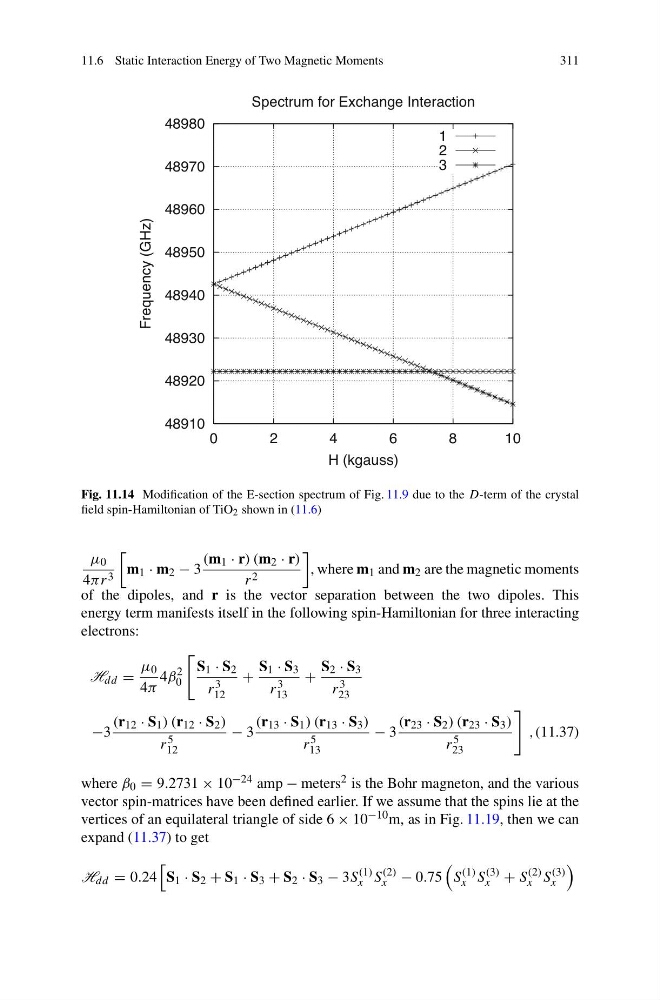
Fig. 11.14 Modification of the E-section spectrum of Fig. 11.9 due to the D-term of the crystal
field spin-Hamiltonian of TiO 2 shown in (11.6)
μ 0
4πr 3
m 1 · m 2 − 3
(m 1 · r) (m 2 · r)
r 2
, where m 1 and m 2 are the magnetic moments
of the dipoles, and r is the vector separation between the two dipoles. This
energy term manifests itself in the following spin-Hamiltonian for three interacting
electrons:
H dd =
μ 0
4π
4β
2
0
S 1 · S 2
r 3
12
+
S 1 · S 3
r 3
13
+
S 2 · S 3
r 3
23
−3
(r 12 · S 1 ) (r 12 · S 2 )
r 5
12
− 3
(r 13 · S 1 ) (r 13 · S 3 )
r 5
13
− 3
(r 23 · S 2 ) (r 23 · S 3 )
r 5
23
,(11.37)
where β 0 = 9.2731 × 10 −24 amp − meters 2 is the Bohr magneton, and the various
vector spin-matrices have been defined earlier. If we assume that the spins lie at the
vertices of an equilateral triangle of side 6 × 10 −10 m, as in Fig. 11.19, then we can
expand (11.37) to get
H dd = 0.24
S 1 · S 2 + S 1 · S 3 + S 2 · S 3 − 3S
(1)
x S
(2)
x − 0.75
S
(1)
x S
(3)
x + S
(2)
x S
(3)
x
311
48910
48920
48930
48940
48950
48960
48970
48980
0
2
4
6
8
10
Frequency (GHz)
H (kgauss)
Spectrum for Exchange Interaction
1
2
3
Fig. 11.14 Modification of the E-section spectrum of Fig. 11.9 due to the D-term of the crystal
field spin-Hamiltonian of TiO 2 shown in (11.6)
μ 0
4πr 3
m 1 · m 2 − 3
(m 1 · r) (m 2 · r)
r 2
, where m 1 and m 2 are the magnetic moments
of the dipoles, and r is the vector separation between the two dipoles. This
energy term manifests itself in the following spin-Hamiltonian for three interacting
electrons:
H dd =
μ 0
4π
4β
2
0
S 1 · S 2
r 3
12
+
S 1 · S 3
r 3
13
+
S 2 · S 3
r 3
23
−3
(r 12 · S 1 ) (r 12 · S 2 )
r 5
12
− 3
(r 13 · S 1 ) (r 13 · S 3 )
r 5
13
− 3
(r 23 · S 2 ) (r 23 · S 3 )
r 5
23
,(11.37)
where β 0 = 9.2731 × 10 −24 amp − meters 2 is the Bohr magneton, and the various
vector spin-matrices have been defined earlier. If we assume that the spins lie at the
vertices of an equilateral triangle of side 6 × 10 −10 m, as in Fig. 11.19, then we can
expand (11.37) to get
H dd = 0.24
S 1 · S 2 + S 1 · S 3 + S 2 · S 3 − 3S
(1)
x S
(2)
x − 0.75
S
(1)
x S
(3)
x + S
(2)
x S
(3)
x