

296
11 Spintronics
S
(2)
· S
(3)
=
1
4
⎡
⎢
⎢
⎢
⎢
⎢
⎢
⎢
⎢
⎢
⎢
⎢
⎣
1 0 0 0 0 0 0 0
0 −1 2 0 0 0 0 0
0 2 −1 0 0 0 0 0
0 0 0 1 0 0 0 0
0 0 0 0 1 0 0 0
0 0 0 0 0 −1 2 0
0 0 0 0 0 2 −1 0
0 0 0 0 0 0 0 1
⎤
⎥
⎥
⎥
⎥
⎥
⎥
⎥
⎥
⎥
⎥
⎥
⎦
,
(11.26)
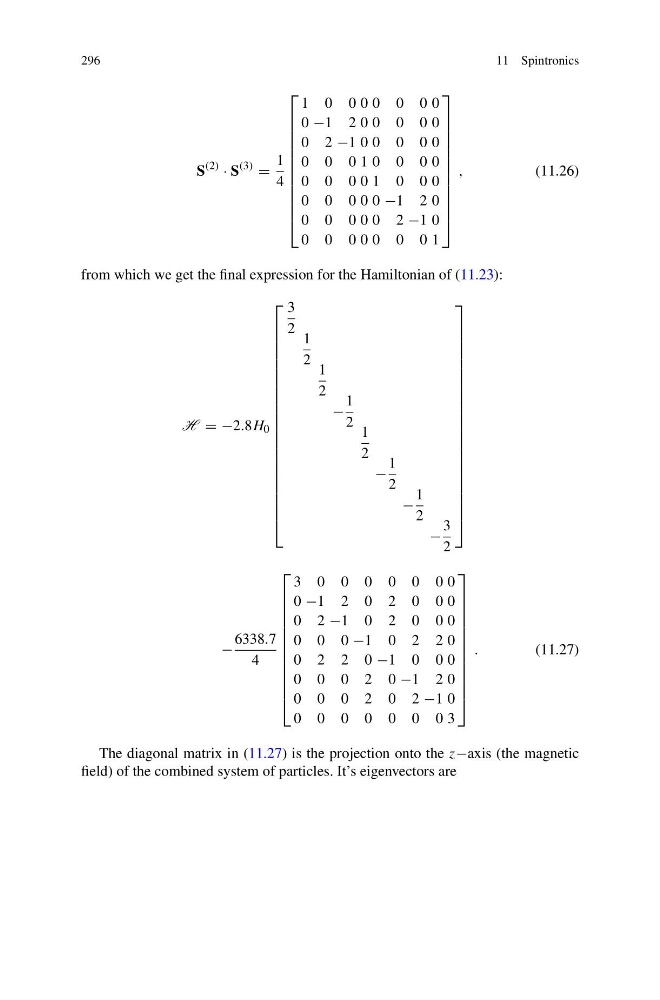
from which we get the final expression for the Hamiltonian of (11.23):
H = −2.8H 0
⎡
⎢
⎢
⎢
⎢
⎢
⎢
⎢
⎢
⎢
⎢
⎢
⎢
⎢
⎢
⎢
⎢
⎢
⎢
⎢
⎢
⎢
⎣
3
2 1
2 1
2
−
1
2 1
2
−
1
2
−
1
2
−
3
2
⎤
⎥
⎥
⎥
⎥
⎥
⎥
⎥
⎥
⎥
⎥
⎥
⎥
⎥
⎥
⎥
⎥
⎥
⎥
⎥
⎥
⎥
⎦
−
6338.7
4
⎡
⎢
⎢
⎢
⎢
⎢
⎢
⎢
⎢
⎢
⎢
⎢
⎣
3 0 0 0 0 0 0 0
0 −1 2 0 2 0 0 0
0 2 −1 0 2 0 0 0
0 0 0 −1 0 2 2 0
0 2 2 0 −1 0 0 0
0 0 0 2 0 −1 2 0
0 0 0 2 0 2 −1 0
0 0 0 0 0 0 0 3
⎤
⎥
⎥
⎥
⎥
⎥
⎥
⎥
⎥
⎥
⎥
⎥
⎦
.
(11.27)
The diagonal matrix in (11.27) is the projection onto the z−axis (the magnetic
field) of the combined system of particles. It’s eigenvectors are
11 Spintronics
S
(2)
· S
(3)
=
1
4
⎡
⎢
⎢
⎢
⎢
⎢
⎢
⎢
⎢
⎢
⎢
⎢
⎣
1 0 0 0 0 0 0 0
0 −1 2 0 0 0 0 0
0 2 −1 0 0 0 0 0
0 0 0 1 0 0 0 0
0 0 0 0 1 0 0 0
0 0 0 0 0 −1 2 0
0 0 0 0 0 2 −1 0
0 0 0 0 0 0 0 1
⎤
⎥
⎥
⎥
⎥
⎥
⎥
⎥
⎥
⎥
⎥
⎥
⎦
,
(11.26)
from which we get the final expression for the Hamiltonian of (11.23):
H = −2.8H 0
⎡
⎢
⎢
⎢
⎢
⎢
⎢
⎢
⎢
⎢
⎢
⎢
⎢
⎢
⎢
⎢
⎢
⎢
⎢
⎢
⎢
⎢
⎣
3
2 1
2 1
2
−
1
2 1
2
−
1
2
−
1
2
−
3
2
⎤
⎥
⎥
⎥
⎥
⎥
⎥
⎥
⎥
⎥
⎥
⎥
⎥
⎥
⎥
⎥
⎥
⎥
⎥
⎥
⎥
⎥
⎦
−
6338.7
4
⎡
⎢
⎢
⎢
⎢
⎢
⎢
⎢
⎢
⎢
⎢
⎢
⎣
3 0 0 0 0 0 0 0
0 −1 2 0 2 0 0 0
0 2 −1 0 2 0 0 0
0 0 0 −1 0 2 2 0
0 2 2 0 −1 0 0 0
0 0 0 2 0 −1 2 0
0 0 0 2 0 2 −1 0
0 0 0 0 0 0 0 3
⎤
⎥
⎥
⎥
⎥
⎥
⎥
⎥
⎥
⎥
⎥
⎥
⎦
.
(11.27)
The diagonal matrix in (11.27) is the projection onto the z−axis (the magnetic
field) of the combined system of particles. It’s eigenvectors are