

9.2 Mathematical Structure of the Problem
217
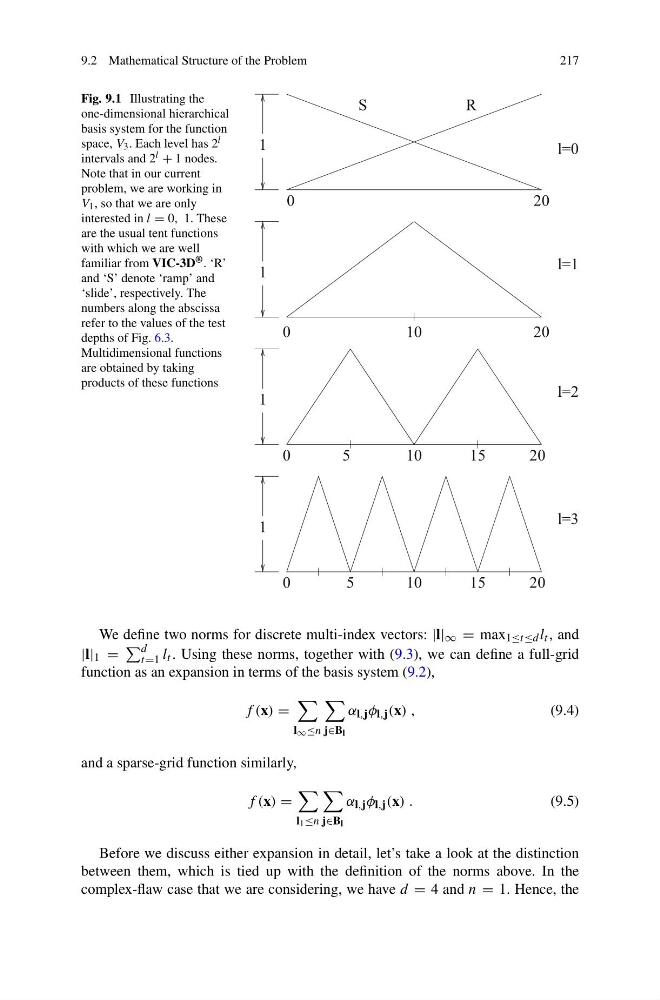
Fig. 9.1 Illustrating the
one-dimensional hierarchical
basis system for the function
space, V 3 . Each level has 2 l
intervals and 2 l + 1 nodes.
Note that in our current
problem, we are working in
V 1 , so that we are only
interested in l = 0, 1. These
are the usual tent functions
with which we are well
familiar from VIC-3D ® . ‘R’
and ‘S’ denote ‘ramp’ and
‘slide’, respectively. The
numbers along the abscissa
refer to the values of the test
depths of Fig. 6.3.
Multidimensional functions
are obtained by taking
products of these functions
0
2 0
S
R
l=0
10
0
2 0
l=1
0
5
10
15
20
l=2
0
5
10
5
1
0
2
l=3
1
1
1
1
We define two norms for discrete multi-index vectors: |l| ∞ = max 1≤t≤d l t , and
|l| 1 =
d
t=1 l t . Using these norms, together with (9.3), we can define a full-grid
function as an expansion in terms of the basis system (9.2),
f (x) =
l ∞ ≤n
j∈B l
α l,j φ l,j (x) ,
(9.4)
and a sparse-grid function similarly,
f (x) =
l 1 ≤n
j∈B l
α l,j φ l,j (x) .
(9.5)
Before we discuss either expansion in detail, let’s take a look at the distinction
between them, which is tied up with the definition of the norms above. In the
complex-flaw case that we are considering, we have d = 4 and n = 1. Hence, the
217
Fig. 9.1 Illustrating the
one-dimensional hierarchical
basis system for the function
space, V 3 . Each level has 2 l
intervals and 2 l + 1 nodes.
Note that in our current
problem, we are working in
V 1 , so that we are only
interested in l = 0, 1. These
are the usual tent functions
with which we are well
familiar from VIC-3D ® . ‘R’
and ‘S’ denote ‘ramp’ and
‘slide’, respectively. The
numbers along the abscissa
refer to the values of the test
depths of Fig. 6.3.
Multidimensional functions
are obtained by taking
products of these functions
0
2 0
S
R
l=0
10
0
2 0
l=1
0
5
10
15
20
l=2
0
5
10
5
1
0
2
l=3
1
1
1
1
We define two norms for discrete multi-index vectors: |l| ∞ = max 1≤t≤d l t , and
|l| 1 =
d
t=1 l t . Using these norms, together with (9.3), we can define a full-grid
function as an expansion in terms of the basis system (9.2),
f (x) =
l ∞ ≤n
j∈B l
α l,j φ l,j (x) ,
(9.4)
and a sparse-grid function similarly,
f (x) =
l 1 ≤n
j∈B l
α l,j φ l,j (x) .
(9.5)
Before we discuss either expansion in detail, let’s take a look at the distinction
between them, which is tied up with the definition of the norms above. In the
complex-flaw case that we are considering, we have d = 4 and n = 1. Hence, the