

7.4 A One-Dimensional Random Surface
163
Note that this system is also orthogonal.
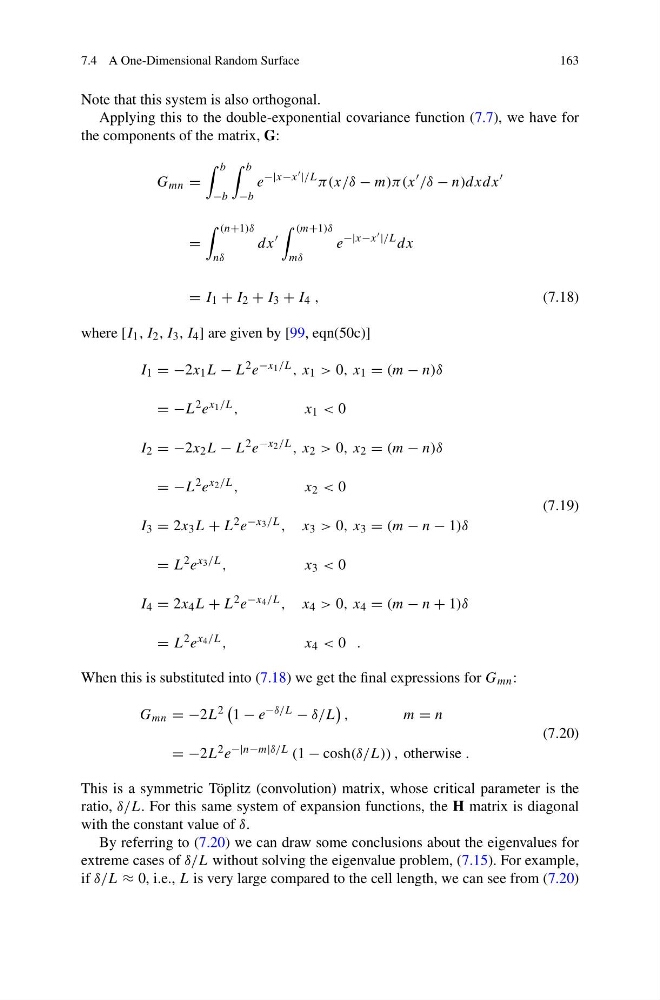
Applying this to the double-exponential covariance function (7.7), we have for
the components of the matrix, G:
G mn =
b
−b
b
−b
e
−|x−x |/L π(x/δ − m)π(x
/δ − n)dxdx
=
(n+1)δ
nδ
dx
(m+1)δ
mδ
e
−|x−x |/L dx
= I 1 + I 2 + I 3 + I 4 ,
(7.18)
where [I 1 , I 2 , I 3 , I 4 ] are given by [99, eqn(50c)]
I 1 = −2x 1 L − L 2 e −x 1 /L , x 1 > 0, x 1 = (m − n)δ
= −L 2 e x 1 /L ,
x 1 < 0
I 2 = −2x 2 L − L 2 e −x 2 /L , x 2 > 0, x 2 = (m − n)δ
= −L 2 e x 2 /L ,
x 2 < 0
I 3 = 2x 3 L + L 2 e −x 3 /L , x 3 > 0, x 3 = (m − n − 1)δ
= L 2 e x 3 /L ,
x 3 < 0
I 4 = 2x 4 L + L 2 e −x 4 /L , x 4 > 0, x 4 = (m − n + 1)δ
= L 2 e x 4 /L ,
x 4 < 0 .
(7.19)
When this is substituted into (7.18) we get the final expressions for G mn :
G mn = −2L 2
1 − e −δ/L − δ/L
,
m= n
= −2L 2 e −|n−m|δ/L (1 − cosh(δ/L)) , otherwise .
(7.20)
This is a symmetric Töplitz (convolution) matrix, whose critical parameter is the
ratio, δ/L. For this same system of expansion functions, the H matrix is diagonal
with the constant value of δ.
By referring to (7.20) we can draw some conclusions about the eigenvalues for
extreme cases of δ/L without solving the eigenvalue problem, (7.15). For example,
if δ/L ≈ 0, i.e., L is very large compared to the cell length, we can see from (7.20)
163
Note that this system is also orthogonal.
Applying this to the double-exponential covariance function (7.7), we have for
the components of the matrix, G:
G mn =
b
−b
b
−b
e
−|x−x |/L π(x/δ − m)π(x
/δ − n)dxdx
=
(n+1)δ
nδ
dx
(m+1)δ
mδ
e
−|x−x |/L dx
= I 1 + I 2 + I 3 + I 4 ,
(7.18)
where [I 1 , I 2 , I 3 , I 4 ] are given by [99, eqn(50c)]
I 1 = −2x 1 L − L 2 e −x 1 /L , x 1 > 0, x 1 = (m − n)δ
= −L 2 e x 1 /L ,
x 1 < 0
I 2 = −2x 2 L − L 2 e −x 2 /L , x 2 > 0, x 2 = (m − n)δ
= −L 2 e x 2 /L ,
x 2 < 0
I 3 = 2x 3 L + L 2 e −x 3 /L , x 3 > 0, x 3 = (m − n − 1)δ
= L 2 e x 3 /L ,
x 3 < 0
I 4 = 2x 4 L + L 2 e −x 4 /L , x 4 > 0, x 4 = (m − n + 1)δ
= L 2 e x 4 /L ,
x 4 < 0 .
(7.19)
When this is substituted into (7.18) we get the final expressions for G mn :
G mn = −2L 2
1 − e −δ/L − δ/L
,
m= n
= −2L 2 e −|n−m|δ/L (1 − cosh(δ/L)) , otherwise .
(7.20)
This is a symmetric Töplitz (convolution) matrix, whose critical parameter is the
ratio, δ/L. For this same system of expansion functions, the H matrix is diagonal
with the constant value of δ.
By referring to (7.20) we can draw some conclusions about the eigenvalues for
extreme cases of δ/L without solving the eigenvalue problem, (7.15). For example,
if δ/L ≈ 0, i.e., L is very large compared to the cell length, we can see from (7.20)