

160
7 Integration of Functionals, PCM and Stochastic IntegralEquations
The significance of this expansion is that it is a method for reducing the
infinite-dimensional random process, X(t), to a finite-dimensional one, {ξ n }, n =
1, · · · , M. This is another way of transforming expressions such as (7.1) into
(7.2), except that the appropriate joint probability density, p(σ 1 , · · · , σ N ), becomes
π(ξ 1 , · · · , ξ M ), where we expect that M << N. The joint density, π , yields the
PCM quadrature points.
7.4 A One-Dimensional Random Surface
The text, [143, pp. 47–50], contains a discussion of the Karhunen-Loève expansion
as it applies to the double-exponential covariance function. We will apply this theory
to the problem posed in [145], in which the authors postulate a pseudorandom realization of a surface by using the spectral method of S. O. Rice, and then attempting
to fit it to the correlation function shown in Fig. 7.1. In this problem, we are given
the correlation function, and will use the K-L expansion to derive the realization
of the surface. We will be in a better position to look at numerical questions of
convergence of the approximations, as well as stability of computations.
The double-exponential correlation function shown in Fig. 7.1 is given by
C(x, x
) = exp(−|x − x
|/L) ,
(7.7)
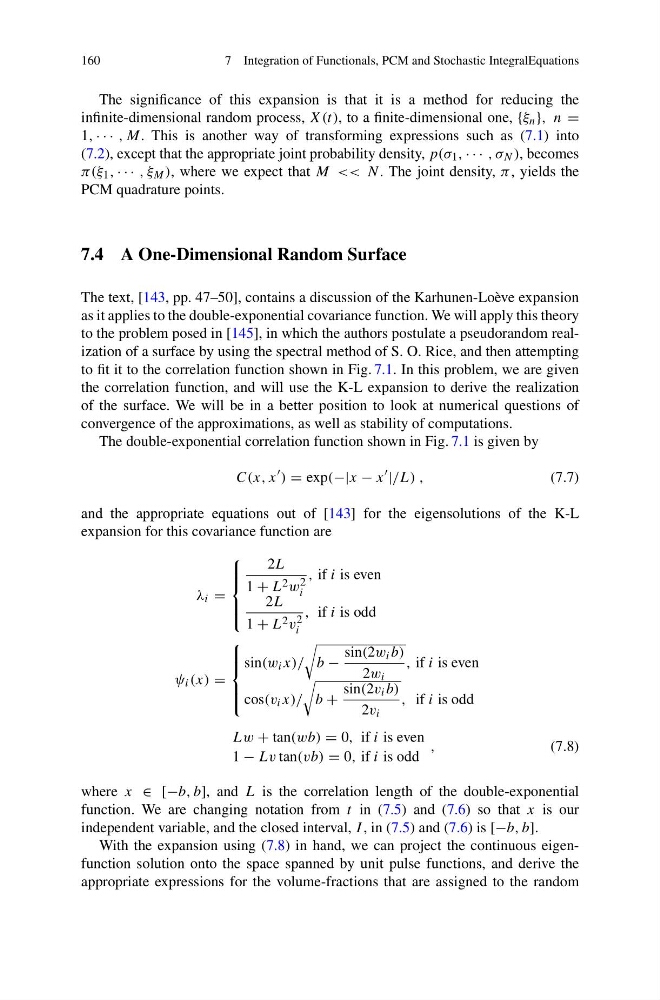
and the appropriate equations out of [143] for the eigensolutions of the K-L
expansion for this covariance function are
λ i =
⎧
⎪ ⎪ ⎨
⎪ ⎪ ⎩
2L
1 + L 2 w 2
i
, if i is even
2L
1 + L 2 v 2
i
, if i is odd
ψ i (x) =
⎧
⎪ ⎪ ⎨
⎪ ⎪ ⎩
sin(w i x)/
b −
sin(2w i b)
2w i
, if i is even
cos(v i x)/
b +
sin(2v i b)
2v i
, if i is odd
Lw + tan(wb) = 0, if i is even
1 − Lv tan(vb) = 0, if i is odd
,
(7.8)
where x ∈ [−b, b], and L is the correlation length of the double-exponential
function. We are changing notation from t in (7.5) and (7.6) so that x is our
independent variable, and the closed interval, I , in (7.5) and (7.6) is [−b, b].
With the expansion using (7.8) in hand, we can project the continuous eigenfunction solution onto the space spanned by unit pulse functions, and derive the
appropriate expressions for the volume-fractions that are assigned to the random
7 Integration of Functionals, PCM and Stochastic IntegralEquations
The significance of this expansion is that it is a method for reducing the
infinite-dimensional random process, X(t), to a finite-dimensional one, {ξ n }, n =
1, · · · , M. This is another way of transforming expressions such as (7.1) into
(7.2), except that the appropriate joint probability density, p(σ 1 , · · · , σ N ), becomes
π(ξ 1 , · · · , ξ M ), where we expect that M << N. The joint density, π , yields the
PCM quadrature points.
7.4 A One-Dimensional Random Surface
The text, [143, pp. 47–50], contains a discussion of the Karhunen-Loève expansion
as it applies to the double-exponential covariance function. We will apply this theory
to the problem posed in [145], in which the authors postulate a pseudorandom realization of a surface by using the spectral method of S. O. Rice, and then attempting
to fit it to the correlation function shown in Fig. 7.1. In this problem, we are given
the correlation function, and will use the K-L expansion to derive the realization
of the surface. We will be in a better position to look at numerical questions of
convergence of the approximations, as well as stability of computations.
The double-exponential correlation function shown in Fig. 7.1 is given by
C(x, x
) = exp(−|x − x
|/L) ,
(7.7)
and the appropriate equations out of [143] for the eigensolutions of the K-L
expansion for this covariance function are
λ i =
⎧
⎪ ⎪ ⎨
⎪ ⎪ ⎩
2L
1 + L 2 w 2
i
, if i is even
2L
1 + L 2 v 2
i
, if i is odd
ψ i (x) =
⎧
⎪ ⎪ ⎨
⎪ ⎪ ⎩
sin(w i x)/
b −
sin(2w i b)
2w i
, if i is even
cos(v i x)/
b +
sin(2v i b)
2v i
, if i is odd
Lw + tan(wb) = 0, if i is even
1 − Lv tan(vb) = 0, if i is odd
,
(7.8)
where x ∈ [−b, b], and L is the correlation length of the double-exponential
function. We are changing notation from t in (7.5) and (7.6) so that x is our
independent variable, and the closed interval, I , in (7.5) and (7.6) is [−b, b].
With the expansion using (7.8) in hand, we can project the continuous eigenfunction solution onto the space spanned by unit pulse functions, and derive the
appropriate expressions for the volume-fractions that are assigned to the random