

132
5 An Electromagnetic Model for Anisotropic Media: Green’s Dyad for Plane-. . .
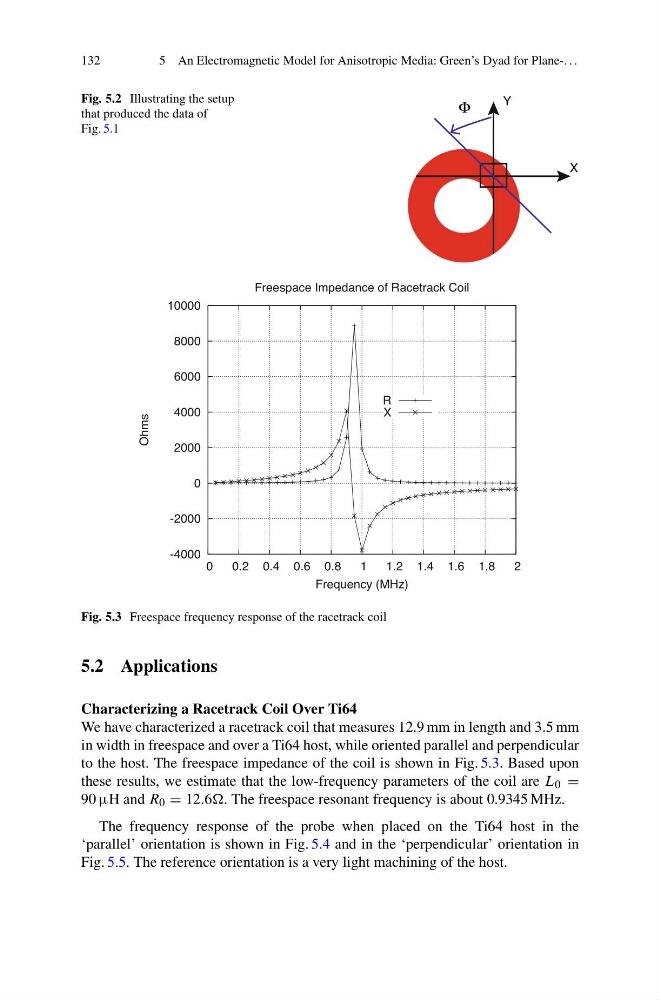
Fig. 5.2 Illustrating the setup
that produced the data of
Fig. 5.1
Y
Φ
X
-4000
-2000
0
2000
4000
6000
8000
10000
0
0.2 0.4 0.6 0.8
1
1.2 1.4 1.6 1.8
2
Ohms
Frequency (MHz)
Freespace Impedance of Racetrack Coil
R
X
Fig. 5.3 Freespace frequency response of the racetrack coil
5.2 Applications
Characterizing a Racetrack Coil Over Ti64
We have characterized a racetrack coil that measures 12.9 mm in length and 3.5 mm
in width in freespace and over a Ti64 host, while oriented parallel and perpendicular
to the host. The freespace impedance of the coil is shown in Fig. 5.3. Based upon
these results, we estimate that the low-frequency parameters of the coil are L 0 =
90 µH and R 0 = 12.6. The freespace resonant frequency is about 0.9345 MHz.
The frequency response of the probe when placed on the Ti64 host in the
‘parallel’ orientation is shown in Fig. 5.4 and in the ‘perpendicular’ orientation in
Fig. 5.5. The reference orientation is a very light machining of the host.
5 An Electromagnetic Model for Anisotropic Media: Green’s Dyad for Plane-. . .
Fig. 5.2 Illustrating the setup
that produced the data of
Fig. 5.1
Y
Φ
X
-4000
-2000
0
2000
4000
6000
8000
10000
0
0.2 0.4 0.6 0.8
1
1.2 1.4 1.6 1.8
2
Ohms
Frequency (MHz)
Freespace Impedance of Racetrack Coil
R
X
Fig. 5.3 Freespace frequency response of the racetrack coil
5.2 Applications
Characterizing a Racetrack Coil Over Ti64
We have characterized a racetrack coil that measures 12.9 mm in length and 3.5 mm
in width in freespace and over a Ti64 host, while oriented parallel and perpendicular
to the host. The freespace impedance of the coil is shown in Fig. 5.3. Based upon
these results, we estimate that the low-frequency parameters of the coil are L 0 =
90 µH and R 0 = 12.6. The freespace resonant frequency is about 0.9345 MHz.
The frequency response of the probe when placed on the Ti64 host in the
‘parallel’ orientation is shown in Fig. 5.4 and in the ‘perpendicular’ orientation in
Fig. 5.5. The reference orientation is a very light machining of the host.