

23
interval between the winter and summer solstices, i.e., the day midway between the
solstices and not the true equinox (González-García & Belmonte, 2006).
In order to check whether those ancient criteria were really present in other
spheres of Roman life, and also to reinforce the idea of a likely relationship between
Roman city planning and the sky, an analysis of the orientation patterns of Roman
cities in general has been performed (Rodríguez-Antón, 2017). This highlights the
integration of important dates of the Roman or pre-Roman calendars into urbanism.
That is, if beliefs or even political ideology were embodied within city plans.
Eastern—aka ‘equinoctial’—orientations are not unusual within the Roman world.
However, they became standard in the Era of Augustus when they were related
(together with those to the winter solstice) to the hagiography of the Princeps (see
Espinosa-Espinosa & González-García, 2017).
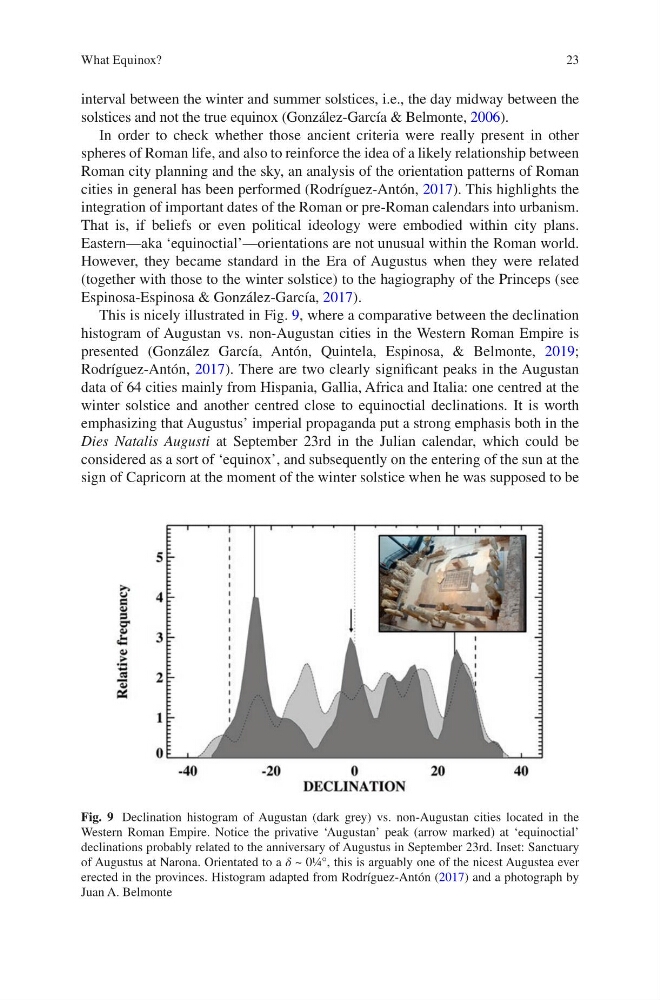
This is nicely illustrated in Fig. 9, where a comparative between the declination
histogram of Augustan vs. non-Augustan cities in the Western Roman Empire is
presented (González García, Antón, Quintela, Espinosa, & Belmonte, 2019;
Rodríguez-Antón, 2017). There are two clearly significant peaks in the Augustan
data of 64 cities mainly from Hispania, Gallia, Africa and Italia: one centred at the
winter solstice and another centred close to equinoctial declinations. It is worth
emphasizing that Augustus’ imperial propaganda put a strong emphasis both in the
Dies Natalis Augusti at September 23rd in the Julian calendar, which could be
considered as a sort of ‘equinox’, and subsequently on the entering of the sun at the
sign of Capricorn at the moment of the winter solstice when he was supposed to be
Fig. 9 Declination histogram of Augustan (dark grey) vs. non-Augustan cities located in the
Western Roman Empire. Notice the privative ‘Augustan’ peak (arrow marked) at ‘equinoctial’
declinations probably related to the anniversary of Augustus in September 23rd. Inset: Sanctuary
of Augustus at Narona. Orientated to a δ ~ 0¼°, this is arguably one of the nicest Augustea ever
erected in the provinces. Histogram adapted from Rodríguez-Antón (2017) and a photograph by
Juan A. Belmonte
What Equinox?
interval between the winter and summer solstices, i.e., the day midway between the
solstices and not the true equinox (González-García & Belmonte, 2006).
In order to check whether those ancient criteria were really present in other
spheres of Roman life, and also to reinforce the idea of a likely relationship between
Roman city planning and the sky, an analysis of the orientation patterns of Roman
cities in general has been performed (Rodríguez-Antón, 2017). This highlights the
integration of important dates of the Roman or pre-Roman calendars into urbanism.
That is, if beliefs or even political ideology were embodied within city plans.
Eastern—aka ‘equinoctial’—orientations are not unusual within the Roman world.
However, they became standard in the Era of Augustus when they were related
(together with those to the winter solstice) to the hagiography of the Princeps (see
Espinosa-Espinosa & González-García, 2017).
This is nicely illustrated in Fig. 9, where a comparative between the declination
histogram of Augustan vs. non-Augustan cities in the Western Roman Empire is
presented (González García, Antón, Quintela, Espinosa, & Belmonte, 2019;
Rodríguez-Antón, 2017). There are two clearly significant peaks in the Augustan
data of 64 cities mainly from Hispania, Gallia, Africa and Italia: one centred at the
winter solstice and another centred close to equinoctial declinations. It is worth
emphasizing that Augustus’ imperial propaganda put a strong emphasis both in the
Dies Natalis Augusti at September 23rd in the Julian calendar, which could be
considered as a sort of ‘equinox’, and subsequently on the entering of the sun at the
sign of Capricorn at the moment of the winter solstice when he was supposed to be
Fig. 9 Declination histogram of Augustan (dark grey) vs. non-Augustan cities located in the
Western Roman Empire. Notice the privative ‘Augustan’ peak (arrow marked) at ‘equinoctial’
declinations probably related to the anniversary of Augustus in September 23rd. Inset: Sanctuary
of Augustus at Narona. Orientated to a δ ~ 0¼°, this is arguably one of the nicest Augustea ever
erected in the provinces. Histogram adapted from Rodríguez-Antón (2017) and a photograph by
Juan A. Belmonte
What Equinox?