

294
from Eastern America to the Ural mountains, using standard instruments, standard
procedures and observations at fixed local times, the so-called “Mannheim hours”.
Very famous is also the “Astronomical Tower” of the Jesuit College “Clementinum”
in Prague (1725), which was crowned with a statue of an Atlas (2.4-m high) carrying the celestial sphere on his shoulders with a golden Sun in the middle.
4
In 1753,
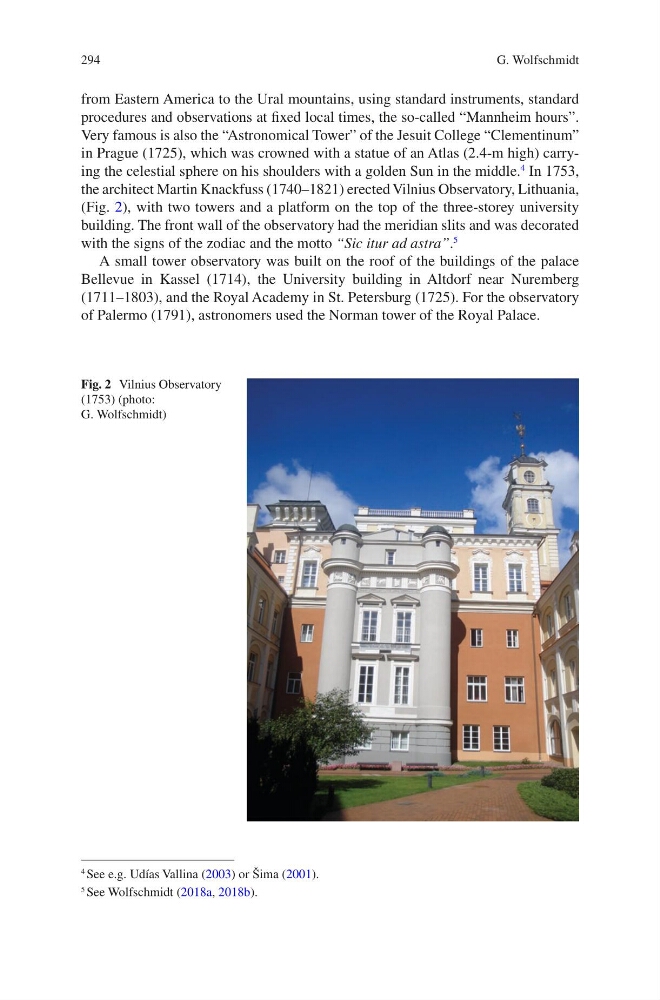
the architect Martin Knackfuss (1740–1821) erected Vilnius Observatory, Lithuania,
(Fig. 2), with two towers and a platform on the top of the three-storey university
building. The front wall of the observatory had the meridian slits and was decorated
with the signs of the zodiac and the motto “Sic itur ad astra”.
5
A small tower observatory was built on the roof of the buildings of the palace
Bellevue in Kassel (1714), the University building in Altdorf near Nuremberg
(1711–1803), and the Royal Academy in St. Petersburg (1725). For the observatory
of Palermo (1791), astronomers used the Norman tower of the Royal Palace.
4 See e.g. Udías Vallina (2003) or Šima (2001).
5 See Wolfschmidt (2018a, 2018b).
Fig. 2 Vilnius Observatory
(1753) (photo:
G. Wolfschmidt)
G. Wolfschmidt
from Eastern America to the Ural mountains, using standard instruments, standard
procedures and observations at fixed local times, the so-called “Mannheim hours”.
Very famous is also the “Astronomical Tower” of the Jesuit College “Clementinum”
in Prague (1725), which was crowned with a statue of an Atlas (2.4-m high) carrying the celestial sphere on his shoulders with a golden Sun in the middle.
4
In 1753,
the architect Martin Knackfuss (1740–1821) erected Vilnius Observatory, Lithuania,
(Fig. 2), with two towers and a platform on the top of the three-storey university
building. The front wall of the observatory had the meridian slits and was decorated
with the signs of the zodiac and the motto “Sic itur ad astra”.
5
A small tower observatory was built on the roof of the buildings of the palace
Bellevue in Kassel (1714), the University building in Altdorf near Nuremberg
(1711–1803), and the Royal Academy in St. Petersburg (1725). For the observatory
of Palermo (1791), astronomers used the Norman tower of the Royal Palace.
4 See e.g. Udías Vallina (2003) or Šima (2001).
5 See Wolfschmidt (2018a, 2018b).
Fig. 2 Vilnius Observatory
(1753) (photo:
G. Wolfschmidt)
G. Wolfschmidt