

293
Smeetoren served as Utrecht’s observatory. In 1853 the Sterrenwacht Sonnenborgh
was erected on the bastion Sonnenborgh (since 1987 astronomical museum). In
Jena, an observatory was built in 1697 on top of the gatehouse of the university
“Collegium Jenense”.
2
In Cambridge, in 1704, the first observatory was founded on
top of the gatehouse of Trinity College.
In the Baltic region exist several old universities like Rostock (1419), Greifswald
(1456) and Kiel (1665); they added observatories in the baroque era (Wolfschmidt,
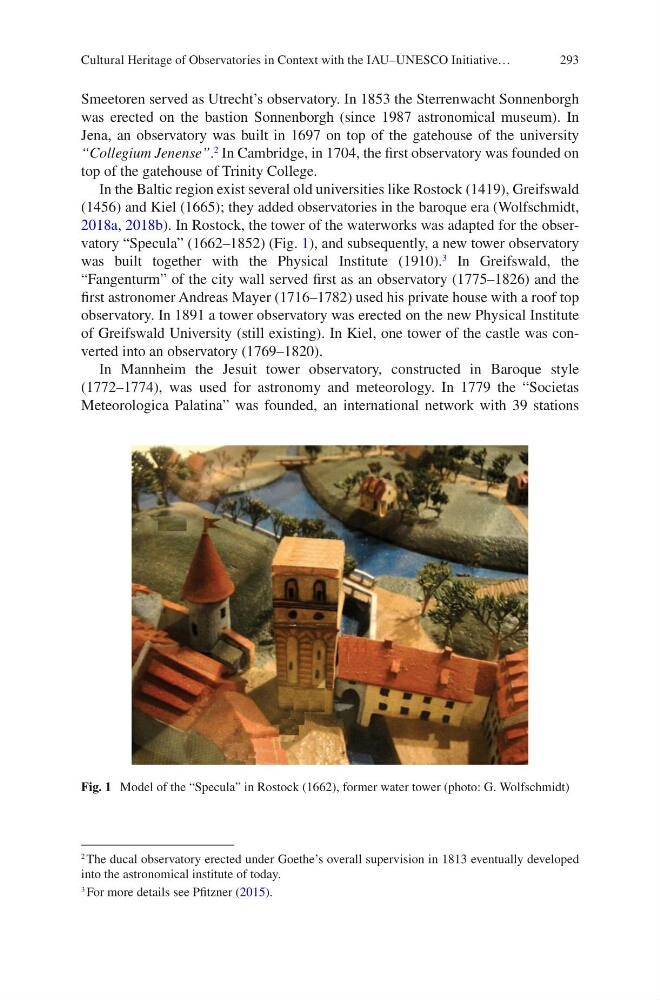
2018a, 2018b). In Rostock, the tower of the waterworks was adapted for the observatory “Specula” (1662–1852) (Fig. 1), and subsequently, a new tower observatory
was built together with the Physical Institute (1910).
3
In Greifswald, the
“Fangenturm” of the city wall served first as an observatory (1775–1826) and the
first astronomer Andreas Mayer (1716–1782) used his private house with a roof top
observatory. In 1891 a tower observatory was erected on the new Physical Institute
of Greifswald University (still existing). In Kiel, one tower of the castle was converted into an observatory (1769–1820).
In Mannheim the Jesuit tower observatory, constructed in Baroque style
(1772–1774), was used for astronomy and meteorology. In 1779 the “Societas
Meteorologica Palatina” was founded, an international network with 39 stations
2 The ducal observatory erected under Goethe’s overall supervision in 1813 eventually developed
into the astronomical institute of today.
3 For more details see Pfitzner (2015).
Fig. 1 Model of the “Specula” in Rostock (1662), former water tower (photo: G. Wolfschmidt)
Cultural Heritage of Observatories in Context with the IAU–UNESCO Initiative…
Smeetoren served as Utrecht’s observatory. In 1853 the Sterrenwacht Sonnenborgh
was erected on the bastion Sonnenborgh (since 1987 astronomical museum). In
Jena, an observatory was built in 1697 on top of the gatehouse of the university
“Collegium Jenense”.
2
In Cambridge, in 1704, the first observatory was founded on
top of the gatehouse of Trinity College.
In the Baltic region exist several old universities like Rostock (1419), Greifswald
(1456) and Kiel (1665); they added observatories in the baroque era (Wolfschmidt,
2018a, 2018b). In Rostock, the tower of the waterworks was adapted for the observatory “Specula” (1662–1852) (Fig. 1), and subsequently, a new tower observatory
was built together with the Physical Institute (1910).
3
In Greifswald, the
“Fangenturm” of the city wall served first as an observatory (1775–1826) and the
first astronomer Andreas Mayer (1716–1782) used his private house with a roof top
observatory. In 1891 a tower observatory was erected on the new Physical Institute
of Greifswald University (still existing). In Kiel, one tower of the castle was converted into an observatory (1769–1820).
In Mannheim the Jesuit tower observatory, constructed in Baroque style
(1772–1774), was used for astronomy and meteorology. In 1779 the “Societas
Meteorologica Palatina” was founded, an international network with 39 stations
2 The ducal observatory erected under Goethe’s overall supervision in 1813 eventually developed
into the astronomical institute of today.
3 For more details see Pfitzner (2015).
Fig. 1 Model of the “Specula” in Rostock (1662), former water tower (photo: G. Wolfschmidt)
Cultural Heritage of Observatories in Context with the IAU–UNESCO Initiative…