

204
Doric temples are predominantly oriented towards the east (67%), whereas Ionic
temples are less commonly oriented in this direction (40.6%).
The distribution of Doric and Ionic temples reveals a small difference in the orientations close to the sun’s positions near the time of the equinoxes, whereas we
observe a distinct peak and clustering of orientations between −2° and –7° in the
Doric sample (Fig. 1). This data cluster is also present in the larger study of 237
orientations (Boutsikas, 2020: 36–70), but is absent in the group of Ionic orientations (Fig. 2). The orientations within this latter group are evenly distributed. If a
trend is observed, this is a general clustering of the declinations falling within the
solar range in general, with a few orientations at declinations +1° and +8° to +11°.
The larger study of 237 orientation revealed these two peaks also. The data clusters
observed in the current analysis could be interpreted as ‘equinoctial’, but (as is also
the case in the larger study) data peaks are observed near the sun’s position within a
week from the equinoxes and not within ±2° of declination 0°, which is within a
couple of days of the sun’s position at the equinoxes. Similarly, the declinations of
the sun’s position on dates that approximate to the solstices show very little data
concentration.
The concept of an equinoctial orientation assumes that the sun is observed from
the structure, at sunrise, or sunset, since these are the moments when the sun’s position will be due east and due west respectively. Since the orientations have been
converted to declinations in the graphs presented here, the height of the local horizon is accounted for in the graphs, thus the peaks indicate the precise declinations
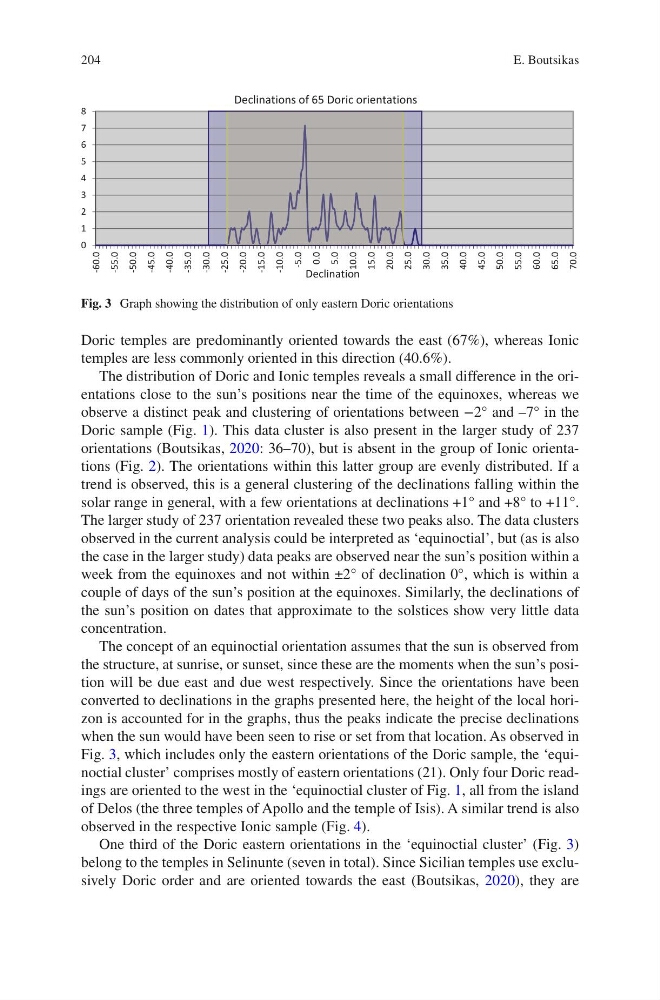
when the sun would have been seen to rise or set from that location. As observed in
Fig. 3, which includes only the eastern orientations of the Doric sample, the ‘equinoctial cluster’ comprises mostly of eastern orientations (21). Only four Doric readings are oriented to the west in the ‘equinoctial cluster of Fig. 1, all from the island
of Delos (the three temples of Apollo and the temple of Isis). A similar trend is also
observed in the respective Ionic sample (Fig. 4).
One third of the Doric eastern orientations in the ‘equinoctial cluster’ (Fig. 3)
belong to the temples in Selinunte (seven in total). Since Sicilian temples use exclusively Doric order and are oriented towards the east (Boutsikas, 2020), they are
0
1
2
3
4
5
6
7
8
-60.0
-55.0
-50.0
-45.0
-40.0
-35.0
-30.0
-25.0
-20.0
-15.0
-10.0
-5.0
0.0
5.0
10.0
15.0
20.0
25.0
30.0
35.0
40.0
45.0
50.0
55.0
60.0
65.0
70.0
Declination
Declinations of 65 Doric orientations
Fig. 3 Graph showing the distribution of only eastern Doric orientations
E. Boutsikas
Doric temples are predominantly oriented towards the east (67%), whereas Ionic
temples are less commonly oriented in this direction (40.6%).
The distribution of Doric and Ionic temples reveals a small difference in the orientations close to the sun’s positions near the time of the equinoxes, whereas we
observe a distinct peak and clustering of orientations between −2° and –7° in the
Doric sample (Fig. 1). This data cluster is also present in the larger study of 237
orientations (Boutsikas, 2020: 36–70), but is absent in the group of Ionic orientations (Fig. 2). The orientations within this latter group are evenly distributed. If a
trend is observed, this is a general clustering of the declinations falling within the
solar range in general, with a few orientations at declinations +1° and +8° to +11°.
The larger study of 237 orientation revealed these two peaks also. The data clusters
observed in the current analysis could be interpreted as ‘equinoctial’, but (as is also
the case in the larger study) data peaks are observed near the sun’s position within a
week from the equinoxes and not within ±2° of declination 0°, which is within a
couple of days of the sun’s position at the equinoxes. Similarly, the declinations of
the sun’s position on dates that approximate to the solstices show very little data
concentration.
The concept of an equinoctial orientation assumes that the sun is observed from
the structure, at sunrise, or sunset, since these are the moments when the sun’s position will be due east and due west respectively. Since the orientations have been
converted to declinations in the graphs presented here, the height of the local horizon is accounted for in the graphs, thus the peaks indicate the precise declinations
when the sun would have been seen to rise or set from that location. As observed in
Fig. 3, which includes only the eastern orientations of the Doric sample, the ‘equinoctial cluster’ comprises mostly of eastern orientations (21). Only four Doric readings are oriented to the west in the ‘equinoctial cluster of Fig. 1, all from the island
of Delos (the three temples of Apollo and the temple of Isis). A similar trend is also
observed in the respective Ionic sample (Fig. 4).
One third of the Doric eastern orientations in the ‘equinoctial cluster’ (Fig. 3)
belong to the temples in Selinunte (seven in total). Since Sicilian temples use exclusively Doric order and are oriented towards the east (Boutsikas, 2020), they are
0
1
2
3
4
5
6
7
8
-60.0
-55.0
-50.0
-45.0
-40.0
-35.0
-30.0
-25.0
-20.0
-15.0
-10.0
-5.0
0.0
5.0
10.0
15.0
20.0
25.0
30.0
35.0
40.0
45.0
50.0
55.0
60.0
65.0
70.0
Declination
Declinations of 65 Doric orientations
Fig. 3 Graph showing the distribution of only eastern Doric orientations
E. Boutsikas