

180
Basque Country or Navarra also tend to systematically present orientations towards
the east (see Fig. 6).
Finally, the dolmens in the Pyrenees are a cumbersome group. Those in Huesca
(Spanish Central Pyrenees) present mostly orientations within the solar range,
although there are a number of examples that have orientations to azimuths far to
the south, given their locations within the Pyrenees’ valleys, the altitude of the horizon renders the declinations perfectly compatible with the luni-solar range
(Belmonte & González-García, 2012). A similar situation is present in the Cerdagna
valleys, of the Catalonian Pyrenees (Hoskin, 2001). We have to move to the
Catalonian coast to find several groups with orientations similar to those found in
Hechicera or the Ebro valley, well outside the solar range.
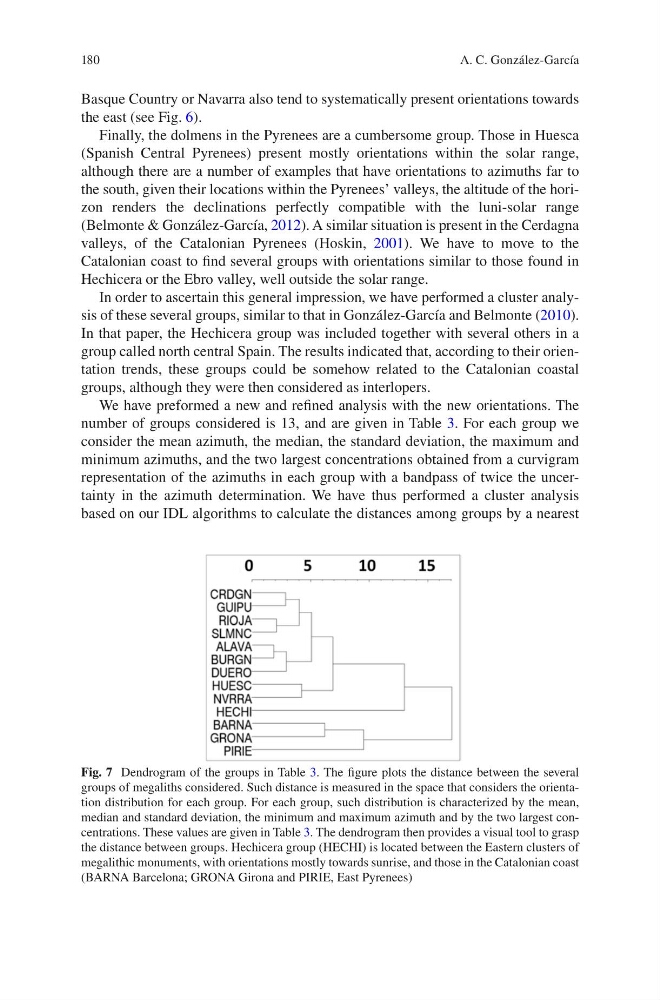
In order to ascertain this general impression, we have performed a cluster analysis of these several groups, similar to that in González-García and Belmonte (2010).
In that paper, the Hechicera group was included together with several others in a
group called north central Spain. The results indicated that, according to their orientation trends, these groups could be somehow related to the Catalonian coastal
groups, although they were then considered as interlopers.
We have preformed a new and refined analysis with the new orientations. The
number of groups considered is 13, and are given in Table 3. For each group we
consider the mean azimuth, the median, the standard deviation, the maximum and
minimum azimuths, and the two largest concentrations obtained from a curvigram
representation of the azimuths in each group with a bandpass of twice the uncertainty in the azimuth determination. We have thus performed a cluster analysis
based on our IDL algorithms to calculate the distances among groups by a nearest
Fig. 7 Dendrogram of the groups in Table 3. The figure plots the distance between the several
groups of megaliths considered. Such distance is measured in the space that considers the orientation distribution for each group. For each group, such distribution is characterized by the mean,
median and standard deviation, the minimum and maximum azimuth and by the two largest concentrations. These values are given in Table 3. The dendrogram then provides a visual tool to grasp
the distance between groups. Hechicera group (HECHI) is located between the Eastern clusters of
megalithic monuments, with orientations mostly towards sunrise, and those in the Catalonian coast
(BARNA Barcelona; GRONA Girona and PIRIE, East Pyrenees)
A. C. González-García
Basque Country or Navarra also tend to systematically present orientations towards
the east (see Fig. 6).
Finally, the dolmens in the Pyrenees are a cumbersome group. Those in Huesca
(Spanish Central Pyrenees) present mostly orientations within the solar range,
although there are a number of examples that have orientations to azimuths far to
the south, given their locations within the Pyrenees’ valleys, the altitude of the horizon renders the declinations perfectly compatible with the luni-solar range
(Belmonte & González-García, 2012). A similar situation is present in the Cerdagna
valleys, of the Catalonian Pyrenees (Hoskin, 2001). We have to move to the
Catalonian coast to find several groups with orientations similar to those found in
Hechicera or the Ebro valley, well outside the solar range.
In order to ascertain this general impression, we have performed a cluster analysis of these several groups, similar to that in González-García and Belmonte (2010).
In that paper, the Hechicera group was included together with several others in a
group called north central Spain. The results indicated that, according to their orientation trends, these groups could be somehow related to the Catalonian coastal
groups, although they were then considered as interlopers.
We have preformed a new and refined analysis with the new orientations. The
number of groups considered is 13, and are given in Table 3. For each group we
consider the mean azimuth, the median, the standard deviation, the maximum and
minimum azimuths, and the two largest concentrations obtained from a curvigram
representation of the azimuths in each group with a bandpass of twice the uncertainty in the azimuth determination. We have thus performed a cluster analysis
based on our IDL algorithms to calculate the distances among groups by a nearest
Fig. 7 Dendrogram of the groups in Table 3. The figure plots the distance between the several
groups of megaliths considered. Such distance is measured in the space that considers the orientation distribution for each group. For each group, such distribution is characterized by the mean,
median and standard deviation, the minimum and maximum azimuth and by the two largest concentrations. These values are given in Table 3. The dendrogram then provides a visual tool to grasp
the distance between groups. Hechicera group (HECHI) is located between the Eastern clusters of
megalithic monuments, with orientations mostly towards sunrise, and those in the Catalonian coast
(BARNA Barcelona; GRONA Girona and PIRIE, East Pyrenees)
A. C. González-García