

178
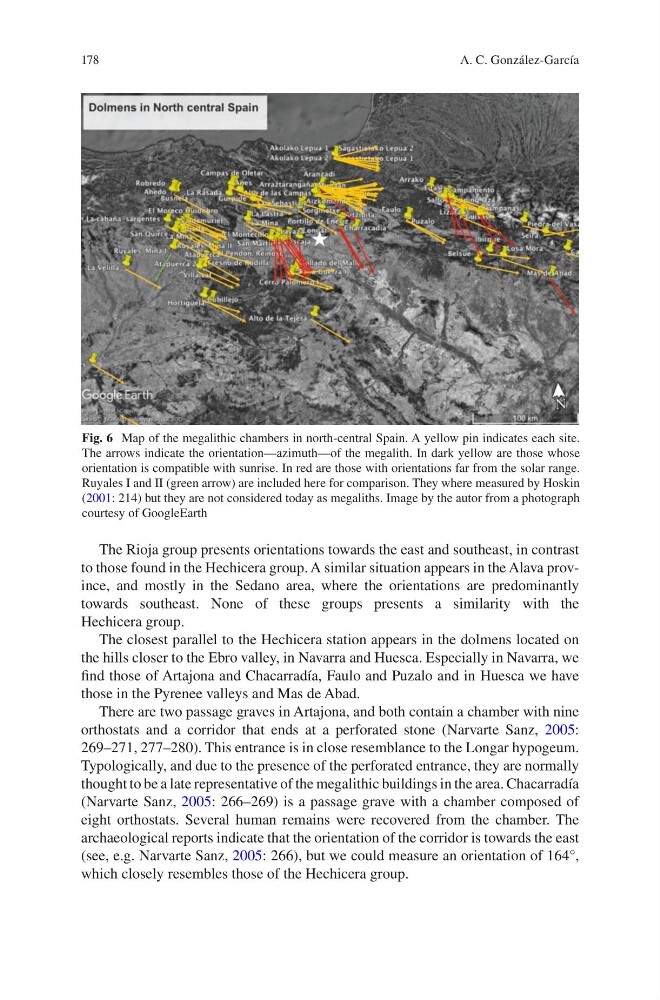
The Rioja group presents orientations towards the east and southeast, in contrast
to those found in the Hechicera group. A similar situation appears in the Alava province, and mostly in the Sedano area, where the orientations are predominantly
towards southeast. None of these groups presents a similarity with the
Hechicera group.
The closest parallel to the Hechicera station appears in the dolmens located on
the hills closer to the Ebro valley, in Navarra and Huesca. Especially in Navarra, we
find those of Artajona and Chacarradía, Faulo and Puzalo and in Huesca we have
those in the Pyrenee valleys and Mas de Abad.
There are two passage graves in Artajona, and both contain a chamber with nine
orthostats and a corridor that ends at a perforated stone (Narvarte Sanz, 2005:
269–271, 277–280). This entrance is in close resemblance to the Longar hypogeum.
Typologically, and due to the presence of the perforated entrance, they are normally
thought to be a late representative of the megalithic buildings in the area. Chacarradía
(Narvarte Sanz, 2005: 266–269) is a passage grave with a chamber composed of
eight orthostats. Several human remains were recovered from the chamber. The
archaeological reports indicate that the orientation of the corridor is towards the east
(see, e.g. Narvarte Sanz, 2005: 266), but we could measure an orientation of 164°,
which closely resembles those of the Hechicera group.
Fig. 6 Map of the megalithic chambers in north-central Spain. A yellow pin indicates each site.
The arrows indicate the orientation—azimuth—of the megalith. In dark yellow are those whose
orientation is compatible with sunrise. In red are those with orientations far from the solar range.
Ruyales I and II (green arrow) are included here for comparison. They where measured by Hoskin
(2001: 214) but they are not considered today as megaliths. Image by the autor from a photograph
courtesy of GoogleEarth
A. C. González-García
The Rioja group presents orientations towards the east and southeast, in contrast
to those found in the Hechicera group. A similar situation appears in the Alava province, and mostly in the Sedano area, where the orientations are predominantly
towards southeast. None of these groups presents a similarity with the
Hechicera group.
The closest parallel to the Hechicera station appears in the dolmens located on
the hills closer to the Ebro valley, in Navarra and Huesca. Especially in Navarra, we
find those of Artajona and Chacarradía, Faulo and Puzalo and in Huesca we have
those in the Pyrenee valleys and Mas de Abad.
There are two passage graves in Artajona, and both contain a chamber with nine
orthostats and a corridor that ends at a perforated stone (Narvarte Sanz, 2005:
269–271, 277–280). This entrance is in close resemblance to the Longar hypogeum.
Typologically, and due to the presence of the perforated entrance, they are normally
thought to be a late representative of the megalithic buildings in the area. Chacarradía
(Narvarte Sanz, 2005: 266–269) is a passage grave with a chamber composed of
eight orthostats. Several human remains were recovered from the chamber. The
archaeological reports indicate that the orientation of the corridor is towards the east
(see, e.g. Narvarte Sanz, 2005: 266), but we could measure an orientation of 164°,
which closely resembles those of the Hechicera group.
Fig. 6 Map of the megalithic chambers in north-central Spain. A yellow pin indicates each site.
The arrows indicate the orientation—azimuth—of the megalith. In dark yellow are those whose
orientation is compatible with sunrise. In red are those with orientations far from the solar range.
Ruyales I and II (green arrow) are included here for comparison. They where measured by Hoskin
(2001: 214) but they are not considered today as megaliths. Image by the autor from a photograph
courtesy of GoogleEarth
A. C. González-García