

156
distribution being symmetrically centred about true or geographical north (0° azimuth). Interpretatively, this pattern of increase broadly coincides with three
astronomically distinctive regions in the northern sky. Each are closely correlated in
terms of their angular width and direction and would be obvious to any observer
with an interest or purpose in naked-eye watching of the cyclical movements of
prominent celestial bodies on or above the horizon, now or in prehistory. These are
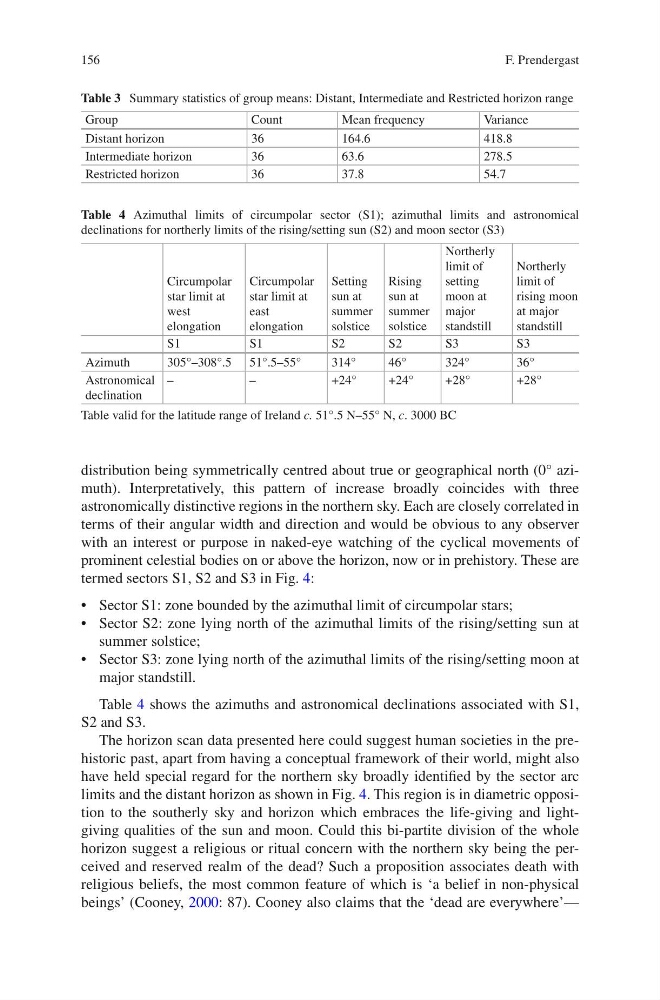
termed sectors S1, S2 and S3 in Fig. 4:
• Sector S1: zone bounded by the azimuthal limit of circumpolar stars;
• Sector S2: zone lying north of the azimuthal limits of the rising/setting sun at
summer solstice;
• Sector S3: zone lying north of the azimuthal limits of the rising/setting moon at
major standstill.
Table 4 shows the azimuths and astronomical declinations associated with S1,
S2 and S3.
The horizon scan data presented here could suggest human societies in the prehistoric past, apart from having a conceptual framework of their world, might also
have held special regard for the northern sky broadly identified by the sector arc
limits and the distant horizon as shown in Fig. 4. This region is in diametric opposition to the southerly sky and horizon which embraces the life-giving and lightgiving qualities of the sun and moon. Could this bi-partite division of the whole
horizon suggest a religious or ritual concern with the northern sky being the perceived and reserved realm of the dead? Such a proposition associates death with
religious beliefs, the most common feature of which is ‘a belief in non-physical
beings’ (Cooney, 2000: 87). Cooney also claims that the ‘dead are everywhere’—
Table 3 Summary statistics of group means: Distant, Intermediate and Restricted horizon range
Group
Count
Mean frequency
Variance
Distant horizon
36
164.6
418.8
Intermediate horizon
36
63.6
278.5
Restricted horizon
36
37.8
54.7
Table 4 Azimuthal limits of circumpolar sector (S1); azimuthal limits and astronomical
declinations for northerly limits of the rising/setting sun (S2) and moon sector (S3)
Circumpolar
star limit at
west
elongation
Circumpolar
star limit at
east
elongation
Setting
sun at
summer
solstice
Rising
sun at
summer
solstice
Northerly
limit of
setting
moon at
major
standstill
Northerly
limit of
rising moon
at major
standstill
S1
S1
S2
S2
S3
S3
Azimuth
305°–308°.5 51°.5–55°
314°
46°
324°
36°
Astronomical
declination
–
–
+24°
+24°
+28°
+28°
Table valid for the latitude range of Ireland c. 51°.5 N–55° N, c. 3000 BC
F. Prendergast
distribution being symmetrically centred about true or geographical north (0° azimuth). Interpretatively, this pattern of increase broadly coincides with three
astronomically distinctive regions in the northern sky. Each are closely correlated in
terms of their angular width and direction and would be obvious to any observer
with an interest or purpose in naked-eye watching of the cyclical movements of
prominent celestial bodies on or above the horizon, now or in prehistory. These are
termed sectors S1, S2 and S3 in Fig. 4:
• Sector S1: zone bounded by the azimuthal limit of circumpolar stars;
• Sector S2: zone lying north of the azimuthal limits of the rising/setting sun at
summer solstice;
• Sector S3: zone lying north of the azimuthal limits of the rising/setting moon at
major standstill.
Table 4 shows the azimuths and astronomical declinations associated with S1,
S2 and S3.
The horizon scan data presented here could suggest human societies in the prehistoric past, apart from having a conceptual framework of their world, might also
have held special regard for the northern sky broadly identified by the sector arc
limits and the distant horizon as shown in Fig. 4. This region is in diametric opposition to the southerly sky and horizon which embraces the life-giving and lightgiving qualities of the sun and moon. Could this bi-partite division of the whole
horizon suggest a religious or ritual concern with the northern sky being the perceived and reserved realm of the dead? Such a proposition associates death with
religious beliefs, the most common feature of which is ‘a belief in non-physical
beings’ (Cooney, 2000: 87). Cooney also claims that the ‘dead are everywhere’—
Table 3 Summary statistics of group means: Distant, Intermediate and Restricted horizon range
Group
Count
Mean frequency
Variance
Distant horizon
36
164.6
418.8
Intermediate horizon
36
63.6
278.5
Restricted horizon
36
37.8
54.7
Table 4 Azimuthal limits of circumpolar sector (S1); azimuthal limits and astronomical
declinations for northerly limits of the rising/setting sun (S2) and moon sector (S3)
Circumpolar
star limit at
west
elongation
Circumpolar
star limit at
east
elongation
Setting
sun at
summer
solstice
Rising
sun at
summer
solstice
Northerly
limit of
setting
moon at
major
standstill
Northerly
limit of
rising moon
at major
standstill
S1
S1
S2
S2
S3
S3
Azimuth
305°–308°.5 51°.5–55°
314°
46°
324°
36°
Astronomical
declination
–
–
+24°
+24°
+28°
+28°
Table valid for the latitude range of Ireland c. 51°.5 N–55° N, c. 3000 BC
F. Prendergast