

95
11 Señas and Luck
Since beginning of our fieldwork we have noticed that meteorites occupy a central
role in the culture of the Southwestern Chaco Moqoit communities. This is partly
because the renowned meteoric dispersion of Campo del Cielo is located in this
region, and a great number of metallic meteoric fragments are frequently found
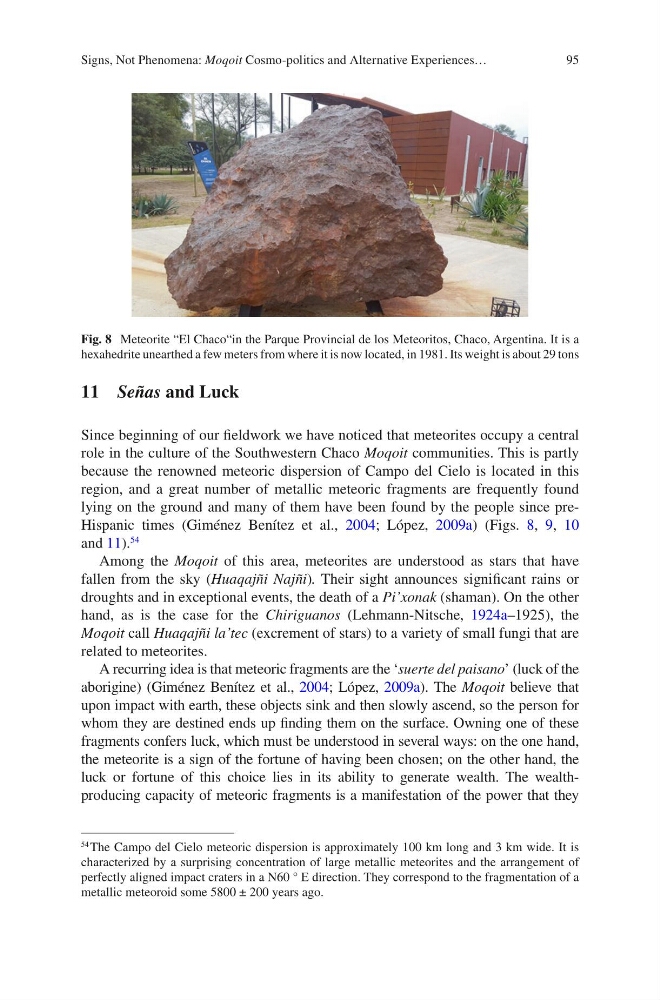
lying on the ground and many of them have been found by the people since preHispanic times (Giménez Benítez et al., 2004; López, 2009a) (Figs. 8, 9, 10
and 11).
54
Among the Moqoit of this area, meteorites are understood as stars that have
fallen from the sky (Huaqajñi Najñi). Their sight announces significant rains or
droughts and in exceptional events, the death of a Pi’xonak (shaman). On the other
hand, as is the case for the Chiriguanos (Lehmann-Nitsche, 1924a–1925), the
Moqoit call Huaqajñi la’tec (excrement of stars) to a variety of small fungi that are
related to meteorites.
A recurring idea is that meteoric fragments are the ‘suerte del paisano’ (luck of the
aborigine) (Giménez Benítez et al., 2004; López, 2009a). The Moqoit believe that
upon impact with earth, these objects sink and then slowly ascend, so the person for
whom they are destined ends up finding them on the surface. Owning one of these
fragments confers luck, which must be understood in several ways: on the one hand,
the meteorite is a sign of the fortune of having been chosen; on the other hand, the
luck or fortune of this choice lies in its ability to generate wealth. The wealthproducing capacity of meteoric fragments is a manifestation of the power that they
54 The Campo del Cielo meteoric dispersion is approximately 100 km long and 3 km wide. It is
characterized by a surprising concentration of large metallic meteorites and the arrangement of
perfectly aligned impact craters in a N60 ° E direction. They correspond to the fragmentation of a
metallic meteoroid some 5800 ± 200 years ago.
Fig. 8 Meteorite “El Chaco“in the Parque Provincial de los Meteoritos, Chaco, Argentina. It is a
hexahedrite unearthed a few meters from where it is now located, in 1981. Its weight is about 29 tons
Signs, Not Phenomena: Moqoit Cosmo-politics and Alternative Experiences…
11 Señas and Luck
Since beginning of our fieldwork we have noticed that meteorites occupy a central
role in the culture of the Southwestern Chaco Moqoit communities. This is partly
because the renowned meteoric dispersion of Campo del Cielo is located in this
region, and a great number of metallic meteoric fragments are frequently found
lying on the ground and many of them have been found by the people since preHispanic times (Giménez Benítez et al., 2004; López, 2009a) (Figs. 8, 9, 10
and 11).
54
Among the Moqoit of this area, meteorites are understood as stars that have
fallen from the sky (Huaqajñi Najñi). Their sight announces significant rains or
droughts and in exceptional events, the death of a Pi’xonak (shaman). On the other
hand, as is the case for the Chiriguanos (Lehmann-Nitsche, 1924a–1925), the
Moqoit call Huaqajñi la’tec (excrement of stars) to a variety of small fungi that are
related to meteorites.
A recurring idea is that meteoric fragments are the ‘suerte del paisano’ (luck of the
aborigine) (Giménez Benítez et al., 2004; López, 2009a). The Moqoit believe that
upon impact with earth, these objects sink and then slowly ascend, so the person for
whom they are destined ends up finding them on the surface. Owning one of these
fragments confers luck, which must be understood in several ways: on the one hand,
the meteorite is a sign of the fortune of having been chosen; on the other hand, the
luck or fortune of this choice lies in its ability to generate wealth. The wealthproducing capacity of meteoric fragments is a manifestation of the power that they
54 The Campo del Cielo meteoric dispersion is approximately 100 km long and 3 km wide. It is
characterized by a surprising concentration of large metallic meteorites and the arrangement of
perfectly aligned impact craters in a N60 ° E direction. They correspond to the fragmentation of a
metallic meteoroid some 5800 ± 200 years ago.
Fig. 8 Meteorite “El Chaco“in the Parque Provincial de los Meteoritos, Chaco, Argentina. It is a
hexahedrite unearthed a few meters from where it is now located, in 1981. Its weight is about 29 tons
Signs, Not Phenomena: Moqoit Cosmo-politics and Alternative Experiences…