

94
The stars and sun are generally referred to as señas of the ancients in the sky,
which allowed them to foresee storms and helped them find their way. The asterism
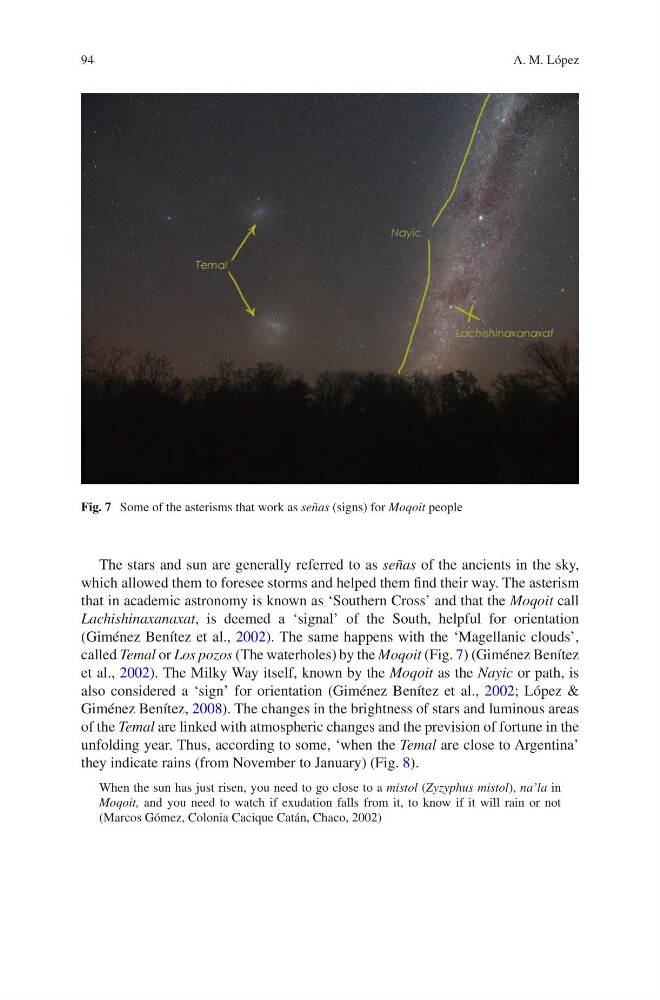
that in academic astronomy is known as ‘Southern Cross’ and that the Moqoit call
Lachishinaxanaxat, is deemed a ‘signal’ of the South, helpful for orientation
(Giménez Benítez et al., 2002). The same happens with the ‘Magellanic clouds’,
called Temal or Los pozos (The waterholes) by the Moqoit (Fig. 7) (Giménez Benítez
et al., 2002). The Milky Way itself, known by the Moqoit as the Nayic or path, is
also considered a ‘sign’ for orientation (Giménez Benítez et al., 2002; López &
Giménez Benítez, 2008). The changes in the brightness of stars and luminous areas
of the Temal are linked with atmospheric changes and the prevision of fortune in the
unfolding year. Thus, according to some, ‘when the Temal are close to Argentina’
they indicate rains (from November to January) (Fig. 8).
When the sun has just risen, you need to go close to a mistol (Zyzyphus mistol), na’la in
Moqoit, and you need to watch if exudation falls from it, to know if it will rain or not
(Marcos Gómez, Colonia Cacique Catán, Chaco, 2002)
Fig. 7 Some of the asterisms that work as señas (signs) for Moqoit people
A. M. López
The stars and sun are generally referred to as señas of the ancients in the sky,
which allowed them to foresee storms and helped them find their way. The asterism
that in academic astronomy is known as ‘Southern Cross’ and that the Moqoit call
Lachishinaxanaxat, is deemed a ‘signal’ of the South, helpful for orientation
(Giménez Benítez et al., 2002). The same happens with the ‘Magellanic clouds’,
called Temal or Los pozos (The waterholes) by the Moqoit (Fig. 7) (Giménez Benítez
et al., 2002). The Milky Way itself, known by the Moqoit as the Nayic or path, is
also considered a ‘sign’ for orientation (Giménez Benítez et al., 2002; López &
Giménez Benítez, 2008). The changes in the brightness of stars and luminous areas
of the Temal are linked with atmospheric changes and the prevision of fortune in the
unfolding year. Thus, according to some, ‘when the Temal are close to Argentina’
they indicate rains (from November to January) (Fig. 8).
When the sun has just risen, you need to go close to a mistol (Zyzyphus mistol), na’la in
Moqoit, and you need to watch if exudation falls from it, to know if it will rain or not
(Marcos Gómez, Colonia Cacique Catán, Chaco, 2002)
Fig. 7 Some of the asterisms that work as señas (signs) for Moqoit people
A. M. López