

79
improving their knowledge and communication skills, such as better consensus
building, facilitation and English skills, etc. Nonetheless, the frustration itself
should be considered one of achievements. They experienced the complexity of
real-world environmental issues and tried to approach them in new ways, which
would have improved diverse, balanced and integrated understanding. This is what
we had aimed as the most important purpose of the leadership program, and in that
sense, the Thailand Unit’s educational challenge bore fruit.
4.5 Concluding Remarks
This chapter showed how the Thailand Unit was developed and implemented year
by year, by comparing the two cases on sustainable solid waste management in 2009
and sustainable urban water use and management in 2011. Successful group work
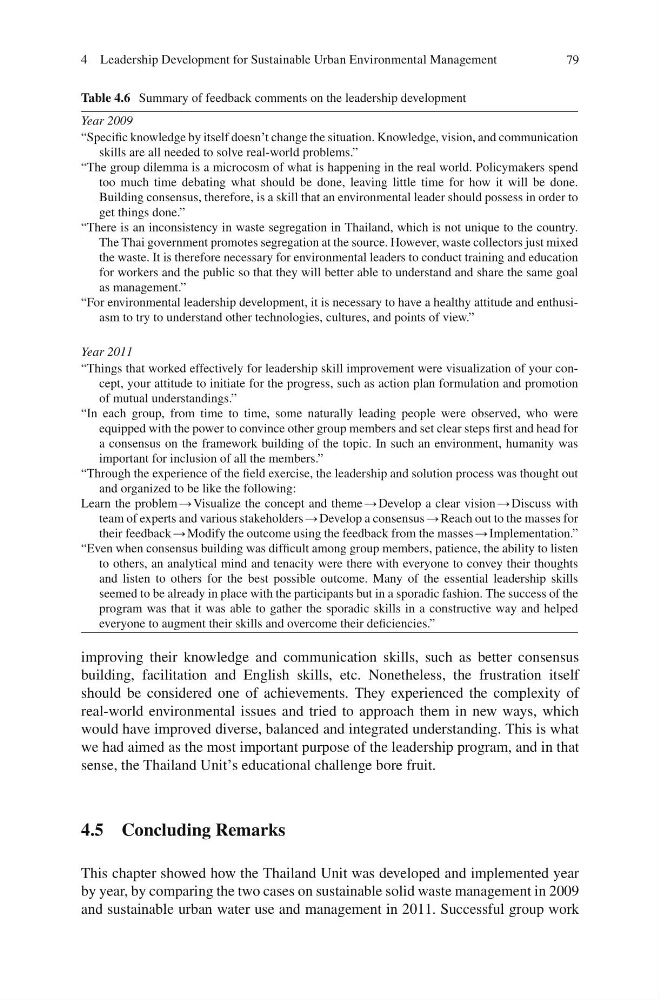
Table 4.6 Summary of feedback comments on the leadership development
Year 2009
“Specifi c knowledge by itself doesn’t change the situation. Knowledge, vision, and communication
skills are all needed to solve real-world problems.”
“The group dilemma is a microcosm of what is happening in the real world. Policymakers spend
too much time debating what should be done, leaving little time for how it will be done.
Building consensus, therefore, is a skill that an environmental leader should possess in order to
get things done.”
“There is an inconsistency in waste segregation in Thailand, which is not unique to the country.
The Thai government promotes segregation at the source. However, waste collectors just mixed
the waste. It is therefore necessary for environmental leaders to conduct training and education
for workers and the public so that they will better able to understand and share the same goal
as management.”
“For environmental leadership development, it is necessary to have a healthy attitude and enthusiasm to try to understand other technologies, cultures, and points of view.”
Year 2011
“Things that worked effectively for leadership skill improvement were visualization of your concept, your attitude to initiate for the progress, such as action plan formulation and promotion
of mutual understandings.”
“In each group, from time to time, some naturally leading people were observed, who were
equipped with the power to convince other group members and set clear steps fi rst and head for
a consensus on the framework building of the topic. In such an environment, humanity was
important for inclusion of all the members.”
“Through the experience of the fi eld exercise, the leadership and solution process was thought out
and organized to be like the following:
Learn the problem → Visualize the concept and theme → Develop a clear vision → Discuss with
team of experts and various stakeholders → Develop a consensus → Reach out to the masses for
their feedback → Modify the outcome using the feedback from the masses → Implementation.”
“Even when consensus building was diffi cult among group members, patience, the ability to listen
to others, an analytical mind and tenacity were there with everyone to convey their thoughts
and listen to others for the best possible outcome. Many of the essential leadership skills
seemed to be already in place with the participants but in a sporadic fashion. The success of the
program was that it was able to gather the sporadic skills in a constructive way and helped
everyone to augment their skills and overcome their defi ciencies.”
4 Leadership Development for Sustainable Urban Environmental Management
improving their knowledge and communication skills, such as better consensus
building, facilitation and English skills, etc. Nonetheless, the frustration itself
should be considered one of achievements. They experienced the complexity of
real-world environmental issues and tried to approach them in new ways, which
would have improved diverse, balanced and integrated understanding. This is what
we had aimed as the most important purpose of the leadership program, and in that
sense, the Thailand Unit’s educational challenge bore fruit.
4.5 Concluding Remarks
This chapter showed how the Thailand Unit was developed and implemented year
by year, by comparing the two cases on sustainable solid waste management in 2009
and sustainable urban water use and management in 2011. Successful group work
Table 4.6 Summary of feedback comments on the leadership development
Year 2009
“Specifi c knowledge by itself doesn’t change the situation. Knowledge, vision, and communication
skills are all needed to solve real-world problems.”
“The group dilemma is a microcosm of what is happening in the real world. Policymakers spend
too much time debating what should be done, leaving little time for how it will be done.
Building consensus, therefore, is a skill that an environmental leader should possess in order to
get things done.”
“There is an inconsistency in waste segregation in Thailand, which is not unique to the country.
The Thai government promotes segregation at the source. However, waste collectors just mixed
the waste. It is therefore necessary for environmental leaders to conduct training and education
for workers and the public so that they will better able to understand and share the same goal
as management.”
“For environmental leadership development, it is necessary to have a healthy attitude and enthusiasm to try to understand other technologies, cultures, and points of view.”
Year 2011
“Things that worked effectively for leadership skill improvement were visualization of your concept, your attitude to initiate for the progress, such as action plan formulation and promotion
of mutual understandings.”
“In each group, from time to time, some naturally leading people were observed, who were
equipped with the power to convince other group members and set clear steps fi rst and head for
a consensus on the framework building of the topic. In such an environment, humanity was
important for inclusion of all the members.”
“Through the experience of the fi eld exercise, the leadership and solution process was thought out
and organized to be like the following:
Learn the problem → Visualize the concept and theme → Develop a clear vision → Discuss with
team of experts and various stakeholders → Develop a consensus → Reach out to the masses for
their feedback → Modify the outcome using the feedback from the masses → Implementation.”
“Even when consensus building was diffi cult among group members, patience, the ability to listen
to others, an analytical mind and tenacity were there with everyone to convey their thoughts
and listen to others for the best possible outcome. Many of the essential leadership skills
seemed to be already in place with the participants but in a sporadic fashion. The success of the
program was that it was able to gather the sporadic skills in a constructive way and helped
everyone to augment their skills and overcome their defi ciencies.”
4 Leadership Development for Sustainable Urban Environmental Management