

78
4.4.3 Environmental Leadership Development in Students
To examine the effects of the unit on the leadership development in individual students, their feedback comments are summarized in Table 4.6 . From the comments,
it is observed that the unit had a large impact on their attitude toward leadership
development. The impact varied from one student to the other. Setting the clear
short-term goal to encourage SEAWE conference presentations on the results of the
fi eld exercise was also effective to boost their motivation and ability to produce
concrete outcomes as well as for high-level academic communication.
During the group work projects, many students showed frustration, becoming
aware of their current limitations to solve real-world problems and a need for
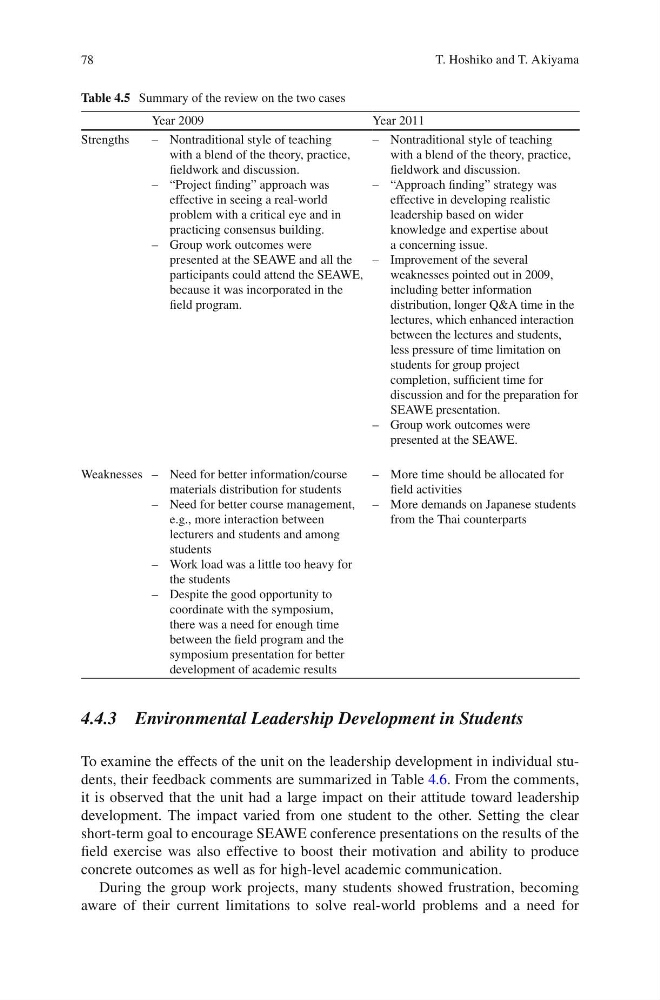
Table 4.5 Summary of the review on the two cases
Year 2009
Year 2011
Strengths
– Nontraditional style of teaching
with a blend of the theory, practice,
fi eldwork and discussion.
– “Project fi nding” approach was
effective in seeing a real-world
problem with a critical eye and in
practicing consensus building.
– Group work outcomes were
presented at the SEAWE and all the
participants could attend the SEAWE,
because it was incorporated in the
fi eld program.
– Nontraditional style of teaching
with a blend of the theory, practice,
fi eldwork and discussion.
– “Approach fi nding” strategy was
effective in developing realistic
leadership based on wider
knowledge and expertise about
a concerning issue.
– Improvement of the several
weaknesses pointed out in 2009,
including better information
distribution, longer Q&A time in the
lectures, which enhanced interaction
between the lectures and students,
less pressure of time limitation on
students for group project
completion, suffi cient time for
discussion and for the preparation for
SEAWE presentation.
– Group work outcomes were
presented at the SEAWE.
Weaknesses – Need for better information/course
materials distribution for students
– Need for better course management,
e.g., more interaction between
lecturers and students and among
students
– Work load was a little too heavy for
the students
– Despite the good opportunity to
coordinate with the symposium,
there was a need for enough time
between the fi eld program and the
symposium presentation for better
development of academic results
– More time should be allocated for
fi eld activities
– More demands on Japanese students
from the Thai counterparts
T. Hoshiko and T. Akiyama
4.4.3 Environmental Leadership Development in Students
To examine the effects of the unit on the leadership development in individual students, their feedback comments are summarized in Table 4.6 . From the comments,
it is observed that the unit had a large impact on their attitude toward leadership
development. The impact varied from one student to the other. Setting the clear
short-term goal to encourage SEAWE conference presentations on the results of the
fi eld exercise was also effective to boost their motivation and ability to produce
concrete outcomes as well as for high-level academic communication.
During the group work projects, many students showed frustration, becoming
aware of their current limitations to solve real-world problems and a need for
Table 4.5 Summary of the review on the two cases
Year 2009
Year 2011
Strengths
– Nontraditional style of teaching
with a blend of the theory, practice,
fi eldwork and discussion.
– “Project fi nding” approach was
effective in seeing a real-world
problem with a critical eye and in
practicing consensus building.
– Group work outcomes were
presented at the SEAWE and all the
participants could attend the SEAWE,
because it was incorporated in the
fi eld program.
– Nontraditional style of teaching
with a blend of the theory, practice,
fi eldwork and discussion.
– “Approach fi nding” strategy was
effective in developing realistic
leadership based on wider
knowledge and expertise about
a concerning issue.
– Improvement of the several
weaknesses pointed out in 2009,
including better information
distribution, longer Q&A time in the
lectures, which enhanced interaction
between the lectures and students,
less pressure of time limitation on
students for group project
completion, suffi cient time for
discussion and for the preparation for
SEAWE presentation.
– Group work outcomes were
presented at the SEAWE.
Weaknesses – Need for better information/course
materials distribution for students
– Need for better course management,
e.g., more interaction between
lecturers and students and among
students
– Work load was a little too heavy for
the students
– Despite the good opportunity to
coordinate with the symposium,
there was a need for enough time
between the fi eld program and the
symposium presentation for better
development of academic results
– More time should be allocated for
fi eld activities
– More demands on Japanese students
from the Thai counterparts
T. Hoshiko and T. Akiyama