

70
from other departments in addition to the Department of Environmental Engineering
at KU, which was actually effective in the process of the proposal development in
the group work from wider views.
4.3.2 Program Schedule of the Unit
4.3.2.1 Thailand Unit 2009
In 2009, prior to the fi eld program, preliminary assignments were given to the students as follows: a literature review and an exercise on lifecycle assessment (LCA)
of solid waste management to learn an analytical tool. One group actually applied
this tool for their group project based on this preliminary assignment.
Figure 4.3 shows the program schedule in the fi eld of the Thailand Unit in 2009.
The program contained ten lectures, three classroom exercises, four fi eldwork
trips—Fig. 4.4 shows scenes of the fi eld activities—and group work at the students’
initiative almost every day, followed by the symposium and presentations. This
unit was held in conjunction with the 7th SEAWE, October 28–30, 2009, at AIT,
where student posters were presented on the outcomes of the fi eld exercise. After
the fi eld program, summary reports were submitted and wrap-up presentations
were given at UT.
4.3.2.2 Thailand Unit 2011
In 2011, prior to the fi eld program, students were given preliminary assignments as
follows: a literature review and proposal development exercise for water problems
in Asian countries.
The program schedule in the fi eld of the Thailand Unit in 2011 is shown in
Fig. 4.5 . It included eight lectures, two classroom exercises, and two full days of
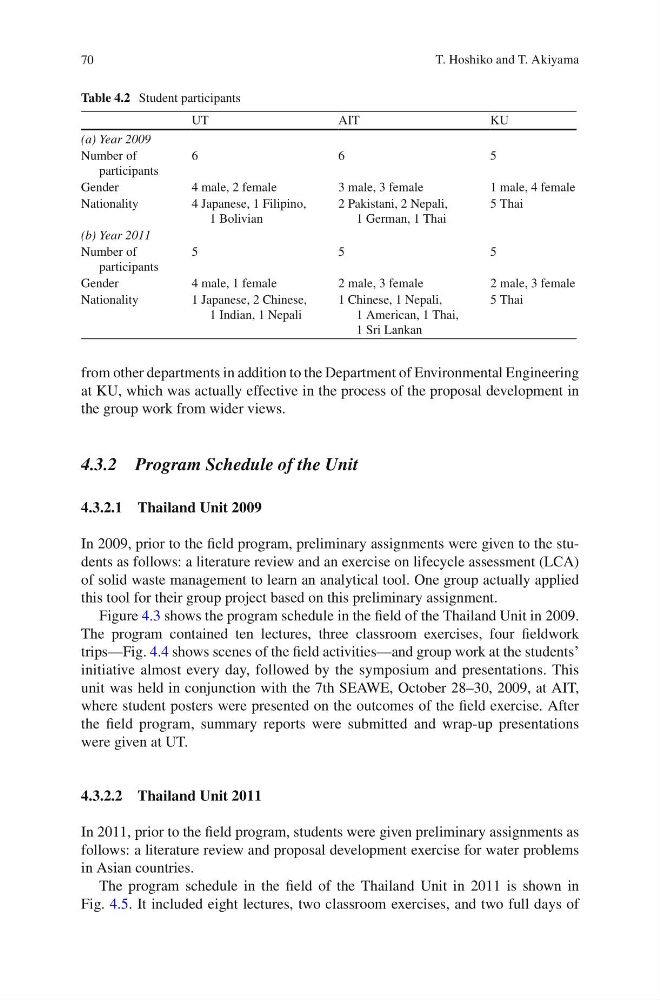
Table 4.2 Student participants
UT
AIT
KU
(a) Year 2009
Number of
participants
6
6
5
Gender
4 male, 2 female
3 male, 3 female
1 male, 4 female
Nationality
4 Japanese, 1 Filipino,
1 Bolivian
2 Pakistani, 2 Nepali,
1 German, 1 Thai
5 Thai
(b) Year 2011
Number of
participants
5
5
5
Gender
4 male, 1 female
2 male, 3 female
2 male, 3 female
Nationality
1 Japanese, 2 Chinese,
1 Indian, 1 Nepali
1 Chinese, 1 Nepali,
1 American, 1 Thai,
1 Sri Lankan
5 Thai
T. Hoshiko and T. Akiyama
from other departments in addition to the Department of Environmental Engineering
at KU, which was actually effective in the process of the proposal development in
the group work from wider views.
4.3.2 Program Schedule of the Unit
4.3.2.1 Thailand Unit 2009
In 2009, prior to the fi eld program, preliminary assignments were given to the students as follows: a literature review and an exercise on lifecycle assessment (LCA)
of solid waste management to learn an analytical tool. One group actually applied
this tool for their group project based on this preliminary assignment.
Figure 4.3 shows the program schedule in the fi eld of the Thailand Unit in 2009.
The program contained ten lectures, three classroom exercises, four fi eldwork
trips—Fig. 4.4 shows scenes of the fi eld activities—and group work at the students’
initiative almost every day, followed by the symposium and presentations. This
unit was held in conjunction with the 7th SEAWE, October 28–30, 2009, at AIT,
where student posters were presented on the outcomes of the fi eld exercise. After
the fi eld program, summary reports were submitted and wrap-up presentations
were given at UT.
4.3.2.2 Thailand Unit 2011
In 2011, prior to the fi eld program, students were given preliminary assignments as
follows: a literature review and proposal development exercise for water problems
in Asian countries.
The program schedule in the fi eld of the Thailand Unit in 2011 is shown in
Fig. 4.5 . It included eight lectures, two classroom exercises, and two full days of
Table 4.2 Student participants
UT
AIT
KU
(a) Year 2009
Number of
participants
6
6
5
Gender
4 male, 2 female
3 male, 3 female
1 male, 4 female
Nationality
4 Japanese, 1 Filipino,
1 Bolivian
2 Pakistani, 2 Nepali,
1 German, 1 Thai
5 Thai
(b) Year 2011
Number of
participants
5
5
5
Gender
4 male, 1 female
2 male, 3 female
2 male, 3 female
Nationality
1 Japanese, 2 Chinese,
1 Indian, 1 Nepali
1 Chinese, 1 Nepali,
1 American, 1 Thai,
1 Sri Lankan
5 Thai
T. Hoshiko and T. Akiyama