

58
M. A. Espinosa-Hernandez et al.
2.4.2 Recent Advances of Colorimetric Detection
in Lab-On-Compact Disk (LOCD) Devices
A digital optical disc (DVD) was used by Li et al. (2014) as the platform for a
molecular diagnostic and quantitative pregnancy test. The analytes of interest were
human Chorionic Gonadotropin (hCG) identified from urine samples. A standard
DVD was prepared for signal readout. The polycarbonate surface was first activated by UV irradiation and then treated with 1-ethyl-3-(3-dimethylaminopropyl)
carbodiimide (EDC) and N-hydroxysuccinimide (NHS). Afterwards, a PDMS plate
with six embedded microfluidic channels was placed inside the DVD. Once activated,
anti-human Chorionic Gonadotropin Gα (anti-hCGα) monoclonal antibodies were
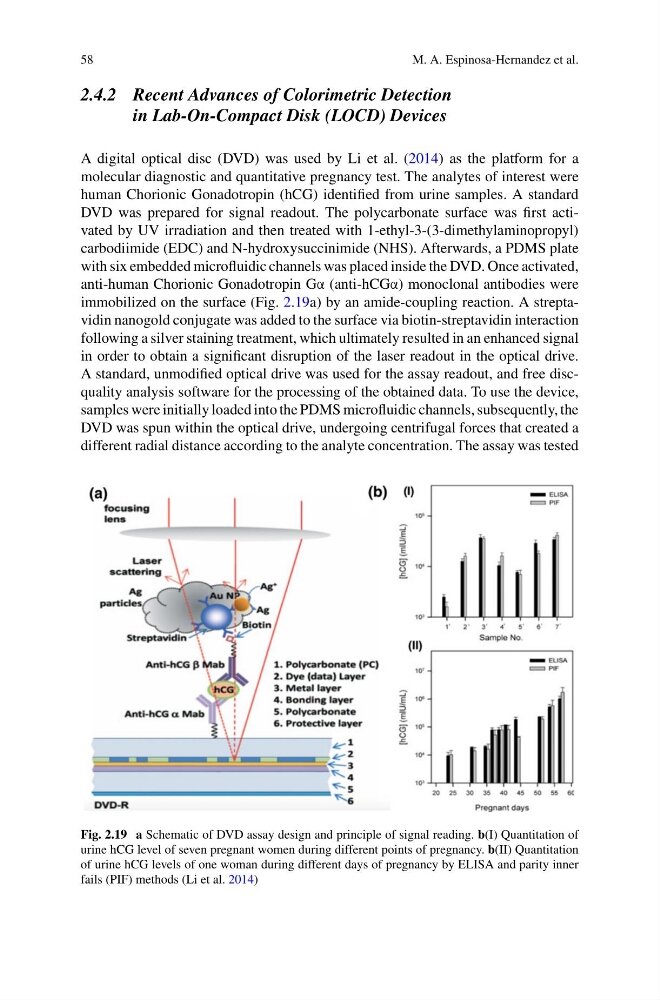
immobilized on the surface (Fig. 2.19a) by an amide-coupling reaction. A streptavidin nanogold conjugate was added to the surface via biotin-streptavidin interaction
following a silver staining treatment, which ultimately resulted in an enhanced signal
in order to obtain a significant disruption of the laser readout in the optical drive.
A standard, unmodified optical drive was used for the assay readout, and free discquality analysis software for the processing of the obtained data. To use the device,
samples were initially loaded into the PDMS microfluidic channels, subsequently, the
DVD was spun within the optical drive, undergoing centrifugal forces that created a
different radial distance according to the analyte concentration. The assay was tested
Fig. 2.19 a Schematic of DVD assay design and principle of signal reading. b(I) Quantitation of
urine hCG level of seven pregnant women during different points of pregnancy. b(II) Quantitation
of urine hCG levels of one woman during different days of pregnancy by ELISA and parity inner
fails (PIF) methods (Li et al. 2014)
M. A. Espinosa-Hernandez et al.
2.4.2 Recent Advances of Colorimetric Detection
in Lab-On-Compact Disk (LOCD) Devices
A digital optical disc (DVD) was used by Li et al. (2014) as the platform for a
molecular diagnostic and quantitative pregnancy test. The analytes of interest were
human Chorionic Gonadotropin (hCG) identified from urine samples. A standard
DVD was prepared for signal readout. The polycarbonate surface was first activated by UV irradiation and then treated with 1-ethyl-3-(3-dimethylaminopropyl)
carbodiimide (EDC) and N-hydroxysuccinimide (NHS). Afterwards, a PDMS plate
with six embedded microfluidic channels was placed inside the DVD. Once activated,
anti-human Chorionic Gonadotropin Gα (anti-hCGα) monoclonal antibodies were
immobilized on the surface (Fig. 2.19a) by an amide-coupling reaction. A streptavidin nanogold conjugate was added to the surface via biotin-streptavidin interaction
following a silver staining treatment, which ultimately resulted in an enhanced signal
in order to obtain a significant disruption of the laser readout in the optical drive.
A standard, unmodified optical drive was used for the assay readout, and free discquality analysis software for the processing of the obtained data. To use the device,
samples were initially loaded into the PDMS microfluidic channels, subsequently, the
DVD was spun within the optical drive, undergoing centrifugal forces that created a
different radial distance according to the analyte concentration. The assay was tested
Fig. 2.19 a Schematic of DVD assay design and principle of signal reading. b(I) Quantitation of
urine hCG level of seven pregnant women during different points of pregnancy. b(II) Quantitation
of urine hCG levels of one woman during different days of pregnancy by ELISA and parity inner
fails (PIF) methods (Li et al. 2014)