

2 Bio-microelectromechanical Systems (BioMEMS) …
41
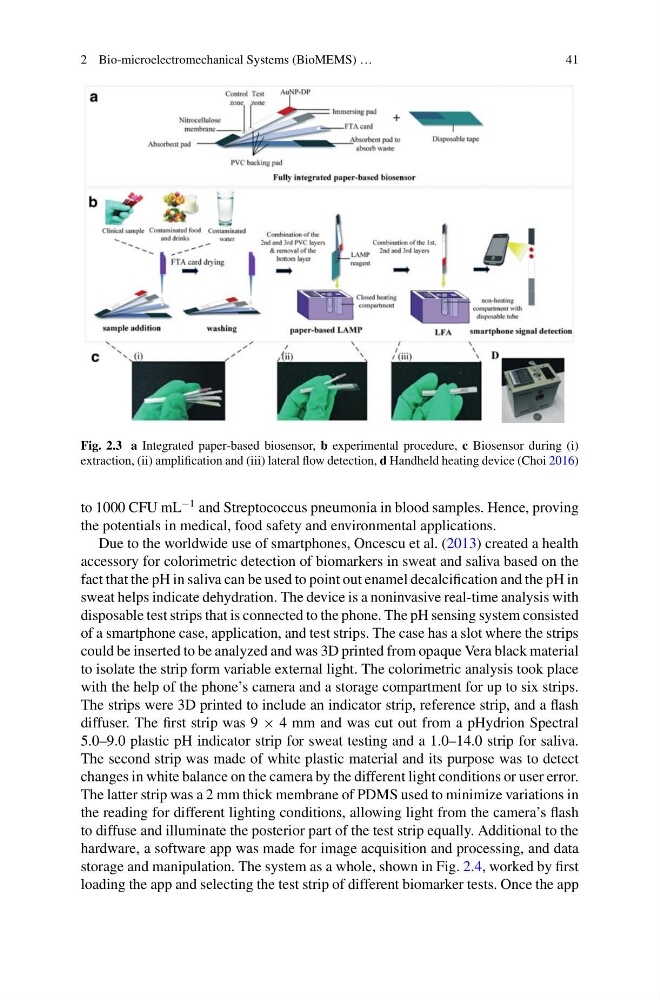
Fig. 2.3 a Integrated paper-based biosensor, b experimental procedure, c Biosensor during (i)
extraction, (ii) amplification and (iii) lateral flow detection, d Handheld heating device (Choi 2016)
to 1000 CFU mL
−1 and Streptococcus pneumonia in blood samples. Hence, proving
the potentials in medical, food safety and environmental applications.
Due to the worldwide use of smartphones, Oncescu et al. (2013) created a health
accessory for colorimetric detection of biomarkers in sweat and saliva based on the
fact that the pH in saliva can be used to point out enamel decalcification and the pH in
sweat helps indicate dehydration. The device is a noninvasive real-time analysis with
disposable test strips that is connected to the phone. The pH sensing system consisted
of a smartphone case, application, and test strips. The case has a slot where the strips
could be inserted to be analyzed and was 3D printed from opaque Vera black material
to isolate the strip form variable external light. The colorimetric analysis took place
with the help of the phone’s camera and a storage compartment for up to six strips.
The strips were 3D printed to include an indicator strip, reference strip, and a flash
diffuser. The first strip was 9 × 4 mm and was cut out from a pHydrion Spectral
5.0–9.0 plastic pH indicator strip for sweat testing and a 1.0–14.0 strip for saliva.
The second strip was made of white plastic material and its purpose was to detect
changes in white balance on the camera by the different light conditions or user error.
The latter strip was a 2 mm thick membrane of PDMS used to minimize variations in
the reading for different lighting conditions, allowing light from the camera’s flash
to diffuse and illuminate the posterior part of the test strip equally. Additional to the
hardware, a software app was made for image acquisition and processing, and data
storage and manipulation. The system as a whole, shown in Fig. 2.4, worked by first
loading the app and selecting the test strip of different biomarker tests. Once the app
41
Fig. 2.3 a Integrated paper-based biosensor, b experimental procedure, c Biosensor during (i)
extraction, (ii) amplification and (iii) lateral flow detection, d Handheld heating device (Choi 2016)
to 1000 CFU mL
−1 and Streptococcus pneumonia in blood samples. Hence, proving
the potentials in medical, food safety and environmental applications.
Due to the worldwide use of smartphones, Oncescu et al. (2013) created a health
accessory for colorimetric detection of biomarkers in sweat and saliva based on the
fact that the pH in saliva can be used to point out enamel decalcification and the pH in
sweat helps indicate dehydration. The device is a noninvasive real-time analysis with
disposable test strips that is connected to the phone. The pH sensing system consisted
of a smartphone case, application, and test strips. The case has a slot where the strips
could be inserted to be analyzed and was 3D printed from opaque Vera black material
to isolate the strip form variable external light. The colorimetric analysis took place
with the help of the phone’s camera and a storage compartment for up to six strips.
The strips were 3D printed to include an indicator strip, reference strip, and a flash
diffuser. The first strip was 9 × 4 mm and was cut out from a pHydrion Spectral
5.0–9.0 plastic pH indicator strip for sweat testing and a 1.0–14.0 strip for saliva.
The second strip was made of white plastic material and its purpose was to detect
changes in white balance on the camera by the different light conditions or user error.
The latter strip was a 2 mm thick membrane of PDMS used to minimize variations in
the reading for different lighting conditions, allowing light from the camera’s flash
to diffuse and illuminate the posterior part of the test strip equally. Additional to the
hardware, a software app was made for image acquisition and processing, and data
storage and manipulation. The system as a whole, shown in Fig. 2.4, worked by first
loading the app and selecting the test strip of different biomarker tests. Once the app