

12
R. Garcia-Ramirez and S. Hosseini
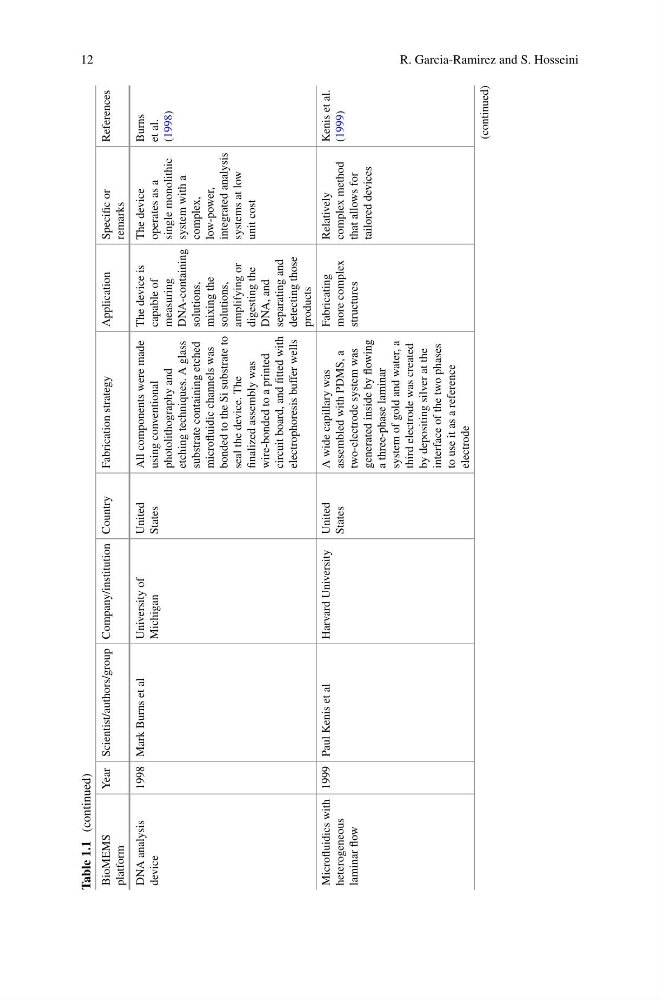
Table 1.1
(continued)
BioMEMS
platform
Year Scientist/authors/group Company/institution Country
Fabrication strategy
Application
Specific or
remarks
References
DNA analysis
device
1998 Mark Burns et al
University of
Michigan
United
States
All components were made
using conventional
photolithography and
etching techniques. A glass
substrate containing etched
microfluidic channels was
bonded to the Si substrate to
seal the device. The
finalized assembly was
wire-bonded to a printed
circuit board, and fitted with
electrophoresis buffer wells
The device is
capable of
measuring
DNA-containing
solutions,
mixing the
solutions,
amplifying or
digesting the
DNA, and
separating and
detecting those
products
The device
operates as a
single monolithic
system with a
complex,
low-power,
integrated analysis
systems at low
unit cost
Burns
et al.
(1998)
Microfluidics with
heterogeneous
laminar flow
1999 Paul Kenis et al
Harvard University United
States
A wide capillary was
assembled with PDMS, a
two-electrode system was
generated inside by flowing
a three-phase laminar
system of gold and water, a
third electrode was created
by depositing silver at the
interface of the two phases
to use it as a reference
electrode
Fabricating
more complex
structures
Relatively
complex method
that allows for
tailored devices
Kenis et al.
(1999)
(continued)
R. Garcia-Ramirez and S. Hosseini
Table 1.1
(continued)
BioMEMS
platform
Year Scientist/authors/group Company/institution Country
Fabrication strategy
Application
Specific or
remarks
References
DNA analysis
device
1998 Mark Burns et al
University of
Michigan
United
States
All components were made
using conventional
photolithography and
etching techniques. A glass
substrate containing etched
microfluidic channels was
bonded to the Si substrate to
seal the device. The
finalized assembly was
wire-bonded to a printed
circuit board, and fitted with
electrophoresis buffer wells
The device is
capable of
measuring
DNA-containing
solutions,
mixing the
solutions,
amplifying or
digesting the
DNA, and
separating and
detecting those
products
The device
operates as a
single monolithic
system with a
complex,
low-power,
integrated analysis
systems at low
unit cost
Burns
et al.
(1998)
Microfluidics with
heterogeneous
laminar flow
1999 Paul Kenis et al
Harvard University United
States
A wide capillary was
assembled with PDMS, a
two-electrode system was
generated inside by flowing
a three-phase laminar
system of gold and water, a
third electrode was created
by depositing silver at the
interface of the two phases
to use it as a reference
electrode
Fabricating
more complex
structures
Relatively
complex method
that allows for
tailored devices
Kenis et al.
(1999)
(continued)