

1 History of Bio-microelectromechanical Systems (BioMEMS)
5
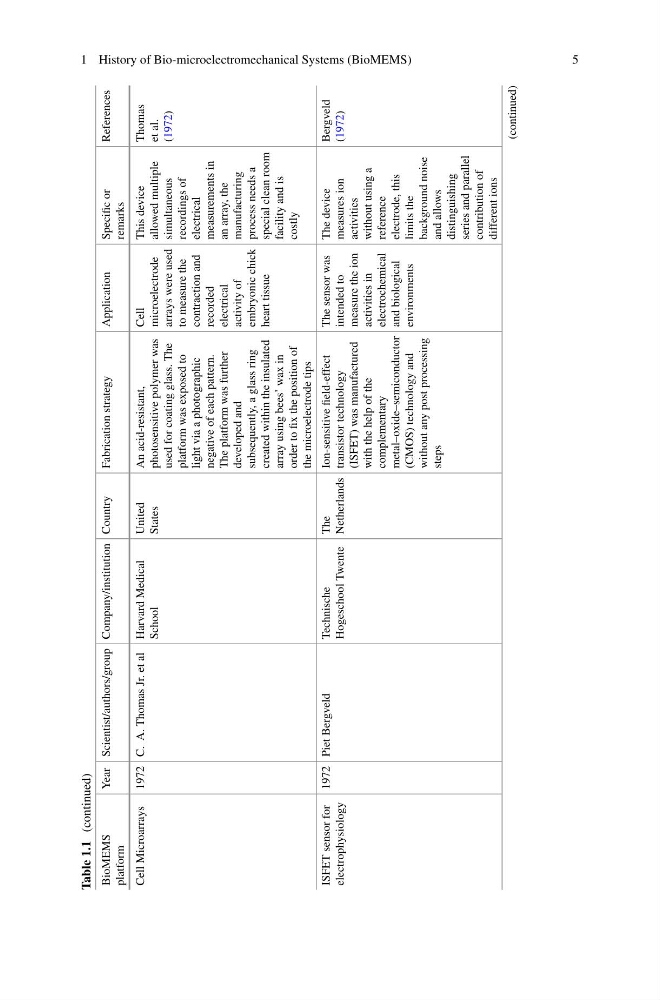
Table 1.1
(continued)
BioMEMS
platform
Year Scientist/authors/group Company/institution Country
Fabrication strategy
Application
Specific or
remarks
References
Cell Microarrays 1972 C. A. Thomas Jr. et al Harvard Medical
School
United
States
An acid-resistant,
photosensitive polymer was
used for coating glass. The
platform was exposed to
light via a photographic
negative of each pattern.
The platform was further
developed and
subsequently, a glass ring
created within the insulated
array using bees’ wax in
order to fix the position of
the microelectrode tips
Cell
microelectrode
arrays were used
to measure the
contraction and
recorded
electrical
activity of
embryonic chick
heart tissue
This device
allowed multiple
simultaneous
recordings of
electrical
measurements in
an array, the
manufacturing
process needs a
special clean room
facility and is
costly
Thomas
et al.
(1972)
ISFET sensor for
electrophysiology
1972 Piet Bergveld
Technische
Hogeschool Twente
The
Netherlands
Ion-sensitive field-effect
transistor technology
(ISFET) was manufactured
with the help of the
complementary
metal–oxide–semiconductor
(CMOS) technology and
without any post processing
steps
The sensor was
intended to
measure the ion
activities in
electrochemical
and biological
environments
The device
measures ion
activities
without using a
reference
electrode, this
limits the
background noise
and allows
distinguishing
series and parallel
contribution of
different ions
Bergveld
(1972)
(continued)
5
Table 1.1
(continued)
BioMEMS
platform
Year Scientist/authors/group Company/institution Country
Fabrication strategy
Application
Specific or
remarks
References
Cell Microarrays 1972 C. A. Thomas Jr. et al Harvard Medical
School
United
States
An acid-resistant,
photosensitive polymer was
used for coating glass. The
platform was exposed to
light via a photographic
negative of each pattern.
The platform was further
developed and
subsequently, a glass ring
created within the insulated
array using bees’ wax in
order to fix the position of
the microelectrode tips
Cell
microelectrode
arrays were used
to measure the
contraction and
recorded
electrical
activity of
embryonic chick
heart tissue
This device
allowed multiple
simultaneous
recordings of
electrical
measurements in
an array, the
manufacturing
process needs a
special clean room
facility and is
costly
Thomas
et al.
(1972)
ISFET sensor for
electrophysiology
1972 Piet Bergveld
Technische
Hogeschool Twente
The
Netherlands
Ion-sensitive field-effect
transistor technology
(ISFET) was manufactured
with the help of the
complementary
metal–oxide–semiconductor
(CMOS) technology and
without any post processing
steps
The sensor was
intended to
measure the ion
activities in
electrochemical
and biological
environments
The device
measures ion
activities
without using a
reference
electrode, this
limits the
background noise
and allows
distinguishing
series and parallel
contribution of
different ions
Bergveld
(1972)
(continued)