

8 Bio-microelectromechanical Systems (BioMEMS) …
175
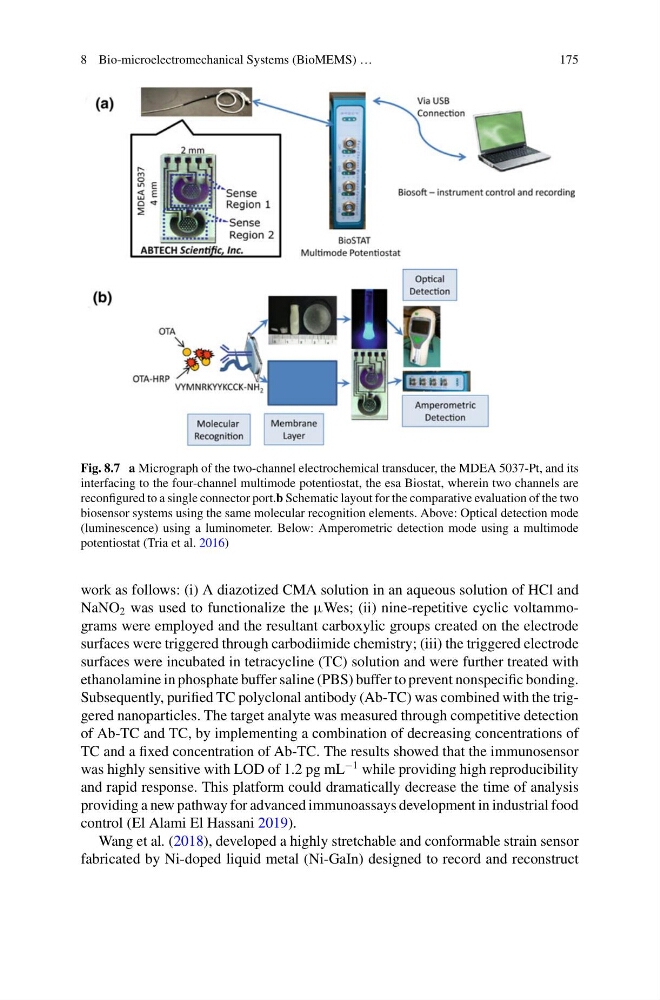
Fig. 8.7 a Micrograph of the two-channel electrochemical transducer, the MDEA 5037-Pt, and its
interfacing to the four-channel multimode potentiostat, the esa Biostat, wherein two channels are
reconfigured to a single connector port.b Schematic layout for the comparative evaluation of the two
biosensor systems using the same molecular recognition elements. Above: Optical detection mode
(luminescence) using a luminometer. Below: Amperometric detection mode using a multimode
potentiostat (Tria et al. 2016)
work as follows: (i) A diazotized CMA solution in an aqueous solution of HCl and
NaNO 2 was used to functionalize the µWes; (ii) nine-repetitive cyclic voltammograms were employed and the resultant carboxylic groups created on the electrode
surfaces were triggered through carbodiimide chemistry; (iii) the triggered electrode
surfaces were incubated in tetracycline (TC) solution and were further treated with
ethanolamine in phosphate buffer saline (PBS) buffer to prevent nonspecific bonding.
Subsequently, purified TC polyclonal antibody (Ab-TC) was combined with the triggered nanoparticles. The target analyte was measured through competitive detection
of Ab-TC and TC, by implementing a combination of decreasing concentrations of
TC and a fixed concentration of Ab-TC. The results showed that the immunosensor
was highly sensitive with LOD of 1.2 pg mL
−1 while providing high reproducibility
and rapid response. This platform could dramatically decrease the time of analysis
providing a new pathway for advanced immunoassays development in industrial food
control (El Alami El Hassani 2019).
Wang et al. (2018), developed a highly stretchable and conformable strain sensor
fabricated by Ni-doped liquid metal (Ni-GaIn) designed to record and reconstruct
175
Fig. 8.7 a Micrograph of the two-channel electrochemical transducer, the MDEA 5037-Pt, and its
interfacing to the four-channel multimode potentiostat, the esa Biostat, wherein two channels are
reconfigured to a single connector port.b Schematic layout for the comparative evaluation of the two
biosensor systems using the same molecular recognition elements. Above: Optical detection mode
(luminescence) using a luminometer. Below: Amperometric detection mode using a multimode
potentiostat (Tria et al. 2016)
work as follows: (i) A diazotized CMA solution in an aqueous solution of HCl and
NaNO 2 was used to functionalize the µWes; (ii) nine-repetitive cyclic voltammograms were employed and the resultant carboxylic groups created on the electrode
surfaces were triggered through carbodiimide chemistry; (iii) the triggered electrode
surfaces were incubated in tetracycline (TC) solution and were further treated with
ethanolamine in phosphate buffer saline (PBS) buffer to prevent nonspecific bonding.
Subsequently, purified TC polyclonal antibody (Ab-TC) was combined with the triggered nanoparticles. The target analyte was measured through competitive detection
of Ab-TC and TC, by implementing a combination of decreasing concentrations of
TC and a fixed concentration of Ab-TC. The results showed that the immunosensor
was highly sensitive with LOD of 1.2 pg mL
−1 while providing high reproducibility
and rapid response. This platform could dramatically decrease the time of analysis
providing a new pathway for advanced immunoassays development in industrial food
control (El Alami El Hassani 2019).
Wang et al. (2018), developed a highly stretchable and conformable strain sensor
fabricated by Ni-doped liquid metal (Ni-GaIn) designed to record and reconstruct