

146
A. S. Cerda-Kipper and S. Hosseini
and diagnosis at a lower cost and earlier phase to minimize the risk of diabetic
complications (Chang et al. 2015).
6.5 Alternative BioMEMS for Chemiluminescence
Detection
Shahvar et al. (2018), reported a low-cost, portable smartphone-based CL sensing
on a thin-layer chromatography (TLC) plate for the detection of morphine. The
device was fabricated using inexpensive materials and could measure the CL light’s
intensity radiated from the reaction between acidic potassium permanganate and
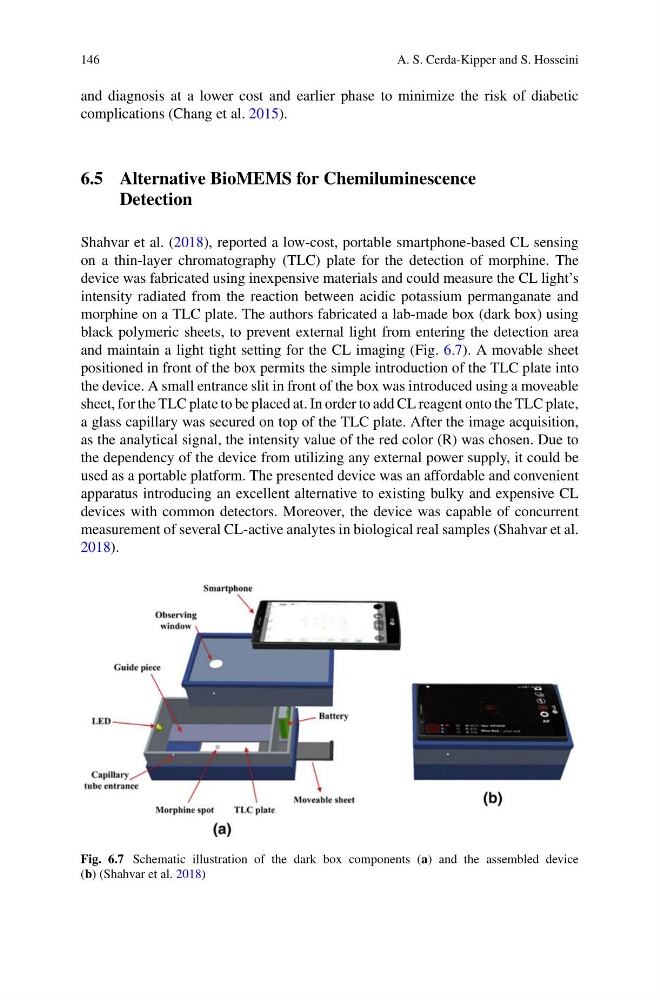
morphine on a TLC plate. The authors fabricated a lab-made box (dark box) using
black polymeric sheets, to prevent external light from entering the detection area
and maintain a light tight setting for the CL imaging (Fig. 6.7). A movable sheet
positioned in front of the box permits the simple introduction of the TLC plate into
the device. A small entrance slit in front of the box was introduced using a moveable
sheet, for the TLC plate to be placed at. In order to add CL reagent onto the TLC plate,
a glass capillary was secured on top of the TLC plate. After the image acquisition,
as the analytical signal, the intensity value of the red color (R) was chosen. Due to
the dependency of the device from utilizing any external power supply, it could be
used as a portable platform. The presented device was an affordable and convenient
apparatus introducing an excellent alternative to existing bulky and expensive CL
devices with common detectors. Moreover, the device was capable of concurrent
measurement of several CL-active analytes in biological real samples (Shahvar et al.
2018).
Fig. 6.7 Schematic illustration of the dark box components (a) and the assembled device
(b) (Shahvar et al. 2018)
A. S. Cerda-Kipper and S. Hosseini
and diagnosis at a lower cost and earlier phase to minimize the risk of diabetic
complications (Chang et al. 2015).
6.5 Alternative BioMEMS for Chemiluminescence
Detection
Shahvar et al. (2018), reported a low-cost, portable smartphone-based CL sensing
on a thin-layer chromatography (TLC) plate for the detection of morphine. The
device was fabricated using inexpensive materials and could measure the CL light’s
intensity radiated from the reaction between acidic potassium permanganate and
morphine on a TLC plate. The authors fabricated a lab-made box (dark box) using
black polymeric sheets, to prevent external light from entering the detection area
and maintain a light tight setting for the CL imaging (Fig. 6.7). A movable sheet
positioned in front of the box permits the simple introduction of the TLC plate into
the device. A small entrance slit in front of the box was introduced using a moveable
sheet, for the TLC plate to be placed at. In order to add CL reagent onto the TLC plate,
a glass capillary was secured on top of the TLC plate. After the image acquisition,
as the analytical signal, the intensity value of the red color (R) was chosen. Due to
the dependency of the device from utilizing any external power supply, it could be
used as a portable platform. The presented device was an affordable and convenient
apparatus introducing an excellent alternative to existing bulky and expensive CL
devices with common detectors. Moreover, the device was capable of concurrent
measurement of several CL-active analytes in biological real samples (Shahvar et al.
2018).
Fig. 6.7 Schematic illustration of the dark box components (a) and the assembled device
(b) (Shahvar et al. 2018)