

6 Bio-microelectromechanical Systems (BioMEMS) …
137
CMOS smartphone cameras can be implemented as a substitute to CCD cameras, and
reusable cartridge can be replaced with disposable LFIA fluidic elements (Zangheri
et al. 2019).
In the work of Li et al., a novel CL cloth-based glucose test sensor (CCGTS) was
established using wax screen-printing, a simple and inexpensive fabrication method
(Table 6.1) (Liu et al. 2016; Guan et al. 2015). The CL detection included enzymatic
oxidation of glucose to H 2 O 2 and gluconic acid and subsequent oxidizing to luminol
to produce blue light in the presence of HRP. P-iodophenol (PIP) was used to heighten
the CL signals which were then detected via a portable and affordable CCD camera.
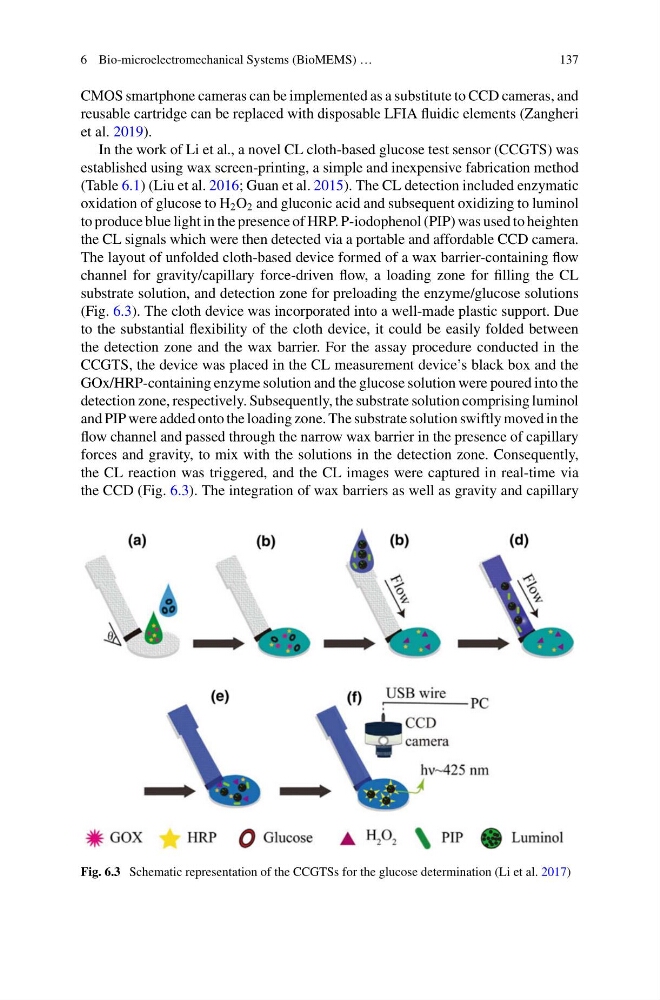
The layout of unfolded cloth-based device formed of a wax barrier-containing flow
channel for gravity/capillary force-driven flow, a loading zone for filling the CL
substrate solution, and detection zone for preloading the enzyme/glucose solutions
(Fig. 6.3). The cloth device was incorporated into a well-made plastic support. Due
to the substantial flexibility of the cloth device, it could be easily folded between
the detection zone and the wax barrier. For the assay procedure conducted in the
CCGTS, the device was placed in the CL measurement device’s black box and the
GOx/HRP-containing enzyme solution and the glucose solution were poured into the
detection zone, respectively. Subsequently, the substrate solution comprising luminol
and PIP were added onto the loading zone. The substrate solution swiftly moved in the
flow channel and passed through the narrow wax barrier in the presence of capillary
forces and gravity, to mix with the solutions in the detection zone. Consequently,
the CL reaction was triggered, and the CL images were captured in real-time via
the CCD (Fig. 6.3). The integration of wax barriers as well as gravity and capillary
Fig. 6.3 Schematic representation of the CCGTSs for the glucose determination (Li et al. 2017)
137
CMOS smartphone cameras can be implemented as a substitute to CCD cameras, and
reusable cartridge can be replaced with disposable LFIA fluidic elements (Zangheri
et al. 2019).
In the work of Li et al., a novel CL cloth-based glucose test sensor (CCGTS) was
established using wax screen-printing, a simple and inexpensive fabrication method
(Table 6.1) (Liu et al. 2016; Guan et al. 2015). The CL detection included enzymatic
oxidation of glucose to H 2 O 2 and gluconic acid and subsequent oxidizing to luminol
to produce blue light in the presence of HRP. P-iodophenol (PIP) was used to heighten
the CL signals which were then detected via a portable and affordable CCD camera.
The layout of unfolded cloth-based device formed of a wax barrier-containing flow
channel for gravity/capillary force-driven flow, a loading zone for filling the CL
substrate solution, and detection zone for preloading the enzyme/glucose solutions
(Fig. 6.3). The cloth device was incorporated into a well-made plastic support. Due
to the substantial flexibility of the cloth device, it could be easily folded between
the detection zone and the wax barrier. For the assay procedure conducted in the
CCGTS, the device was placed in the CL measurement device’s black box and the
GOx/HRP-containing enzyme solution and the glucose solution were poured into the
detection zone, respectively. Subsequently, the substrate solution comprising luminol
and PIP were added onto the loading zone. The substrate solution swiftly moved in the
flow channel and passed through the narrow wax barrier in the presence of capillary
forces and gravity, to mix with the solutions in the detection zone. Consequently,
the CL reaction was triggered, and the CL images were captured in real-time via
the CCD (Fig. 6.3). The integration of wax barriers as well as gravity and capillary
Fig. 6.3 Schematic representation of the CCGTSs for the glucose determination (Li et al. 2017)