

132
A. S. Cerda-Kipper and S. Hosseini
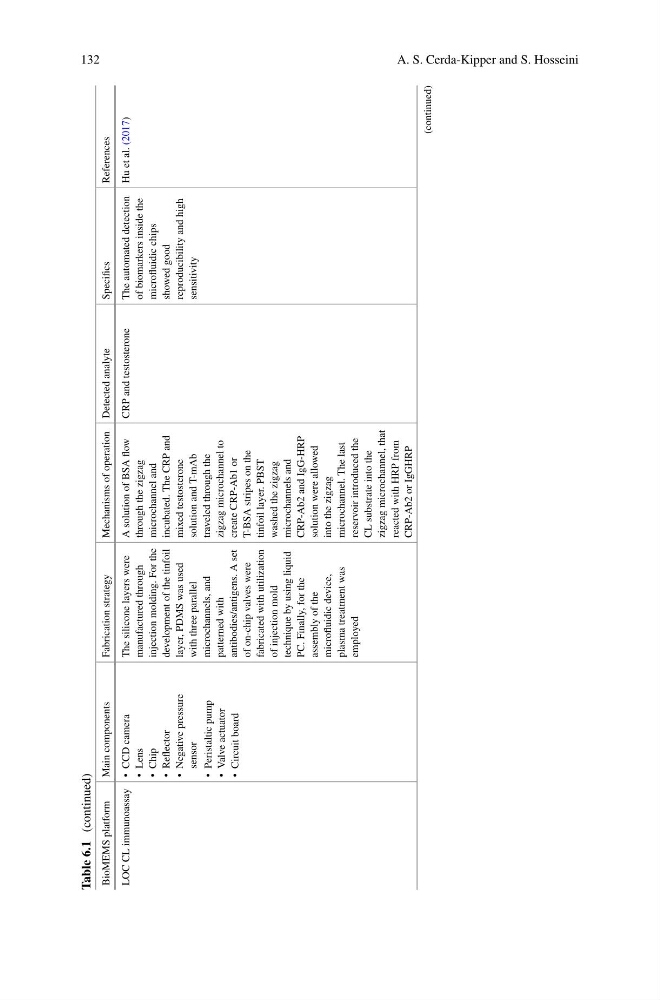
Table 6.1
(continued)
BioMEMS platform
Main components
Fabrication strategy
Mechanisms of operation Detected analyte
Specifics
References
LOC CL immunoassay • CCD camera
• Lens
• Chip
• Reflector
• Negative pressure
sensor
• Peristaltic pump
• Valve actuator
• Circuit board
The silicone layers were
manufactured through
injection molding. For the
development of the tinfoil
layer, PDMS was used
with three parallel
microchannels, and
patterned with
antibodies/antigens. A set
of on-chip valves were
fabricated with utilization
of injection mold
technique by using liquid
PC. Finally, for the
assembly of the
microfluidic device,
plasma treatment was
employed
A solution of BSA flow
through the zigzag
microchannel and
incubated. The CRP and
mixed testosterone
solution and T-mAb
traveled through the
zigzag microchannel to
create CRP-Ab1 or
T-BSA stripes on the
tinfoil layer. PBST
washed the zigzag
microchannels and
CRP-Ab2 and IgG-HRP
solution were allowed
into the zigzag
microchannel. The last
reservoir introduced the
CL substrate into the
zigzag microchannel, that
reacted with HRP from
CRP-Ab2 or IgGHRP
CRP and testosterone
The automated detection
of biomarkers inside the
microfluidic chips
showed good
reproducibility and high
sensitivity
Hu et al. (2017)
(continued)
A. S. Cerda-Kipper and S. Hosseini
Table 6.1
(continued)
BioMEMS platform
Main components
Fabrication strategy
Mechanisms of operation Detected analyte
Specifics
References
LOC CL immunoassay • CCD camera
• Lens
• Chip
• Reflector
• Negative pressure
sensor
• Peristaltic pump
• Valve actuator
• Circuit board
The silicone layers were
manufactured through
injection molding. For the
development of the tinfoil
layer, PDMS was used
with three parallel
microchannels, and
patterned with
antibodies/antigens. A set
of on-chip valves were
fabricated with utilization
of injection mold
technique by using liquid
PC. Finally, for the
assembly of the
microfluidic device,
plasma treatment was
employed
A solution of BSA flow
through the zigzag
microchannel and
incubated. The CRP and
mixed testosterone
solution and T-mAb
traveled through the
zigzag microchannel to
create CRP-Ab1 or
T-BSA stripes on the
tinfoil layer. PBST
washed the zigzag
microchannels and
CRP-Ab2 and IgG-HRP
solution were allowed
into the zigzag
microchannel. The last
reservoir introduced the
CL substrate into the
zigzag microchannel, that
reacted with HRP from
CRP-Ab2 or IgGHRP
CRP and testosterone
The automated detection
of biomarkers inside the
microfluidic chips
showed good
reproducibility and high
sensitivity
Hu et al. (2017)
(continued)