

128
A. S. Cerda-Kipper and S. Hosseini
Table 6.1
(continued)
BioMEMS platform
Main components
Fabrication strategy
Mechanisms of operation Detected analyte
Specifics
References
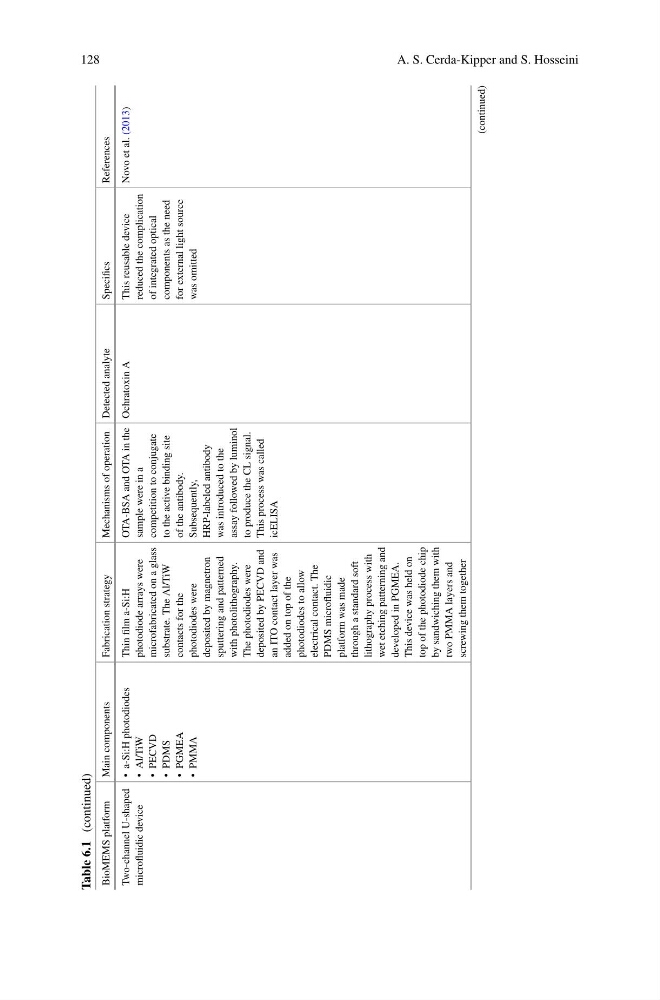
Two-channel U-shaped
microfluidic device
• a-Si:H photodiodes
• Al/TiW
• PECVD
• PDMS
• PGMEA
• PMMA
Thin film a-Si:H
photodiode arrays were
microfabricated on a glass
substrate. The Al/TiW
contacts for the
photodiodes were
deposited by magnetron
sputtering and patterned
with photolithography.
The photodiodes were
deposited by PECVD and
an ITO contact layer was
added on top of the
photodiodes to allow
electrical contact. The
PDMS microfluidic
platform was made
through a standard soft
lithography process with
wet etching patterning and
developed in PGMEA.
This device was held on
top of the photodiode chip
by sandwiching them with
two PMMA layers and
screwing them together
OTA-BSA and OTA in the
sample were in a
competition to conjugate
to the active binding site
of the antibody.
Subsequently,
HRP-labeled antibody
was introduced to the
assay followed by luminol
to produce the CL signal.
This process was called
icELISA
Ochratoxin A
This reusable device
reduced the complication
of integrated optical
components as the need
for external light source
was omitted
Novo et al. (2013)
(continued)
A. S. Cerda-Kipper and S. Hosseini
Table 6.1
(continued)
BioMEMS platform
Main components
Fabrication strategy
Mechanisms of operation Detected analyte
Specifics
References
Two-channel U-shaped
microfluidic device
• a-Si:H photodiodes
• Al/TiW
• PECVD
• PDMS
• PGMEA
• PMMA
Thin film a-Si:H
photodiode arrays were
microfabricated on a glass
substrate. The Al/TiW
contacts for the
photodiodes were
deposited by magnetron
sputtering and patterned
with photolithography.
The photodiodes were
deposited by PECVD and
an ITO contact layer was
added on top of the
photodiodes to allow
electrical contact. The
PDMS microfluidic
platform was made
through a standard soft
lithography process with
wet etching patterning and
developed in PGMEA.
This device was held on
top of the photodiode chip
by sandwiching them with
two PMMA layers and
screwing them together
OTA-BSA and OTA in the
sample were in a
competition to conjugate
to the active binding site
of the antibody.
Subsequently,
HRP-labeled antibody
was introduced to the
assay followed by luminol
to produce the CL signal.
This process was called
icELISA
Ochratoxin A
This reusable device
reduced the complication
of integrated optical
components as the need
for external light source
was omitted
Novo et al. (2013)
(continued)