

5 Bio-microelectromechanical Systems (BioMEMS) in Bio-sensing …
115
samples at the inner outlet were, in fact, MNC-ECs. In this specific case, the luminescence signal was detected merely from the inner outlet. The results have shown
that the separation had taken place effectively. The addition of 3D-printing facilitated the fabrication of the microfluidic platform with its complicated components
for successful on site detection of pathogenic bacteria Dong and Zhao (2015).
The work of Caputo et al. proposes a miniaturized lab-on-chip (LOC) favorable for
monitoring living cells’ activity via the on-chip BL measurement. On a single glass
substrate, this system integrated hydrogenated amorphous silicon (a-Si:H) diodes
which acted as temperature and light detectors, and indium tin oxide (ITO) film used
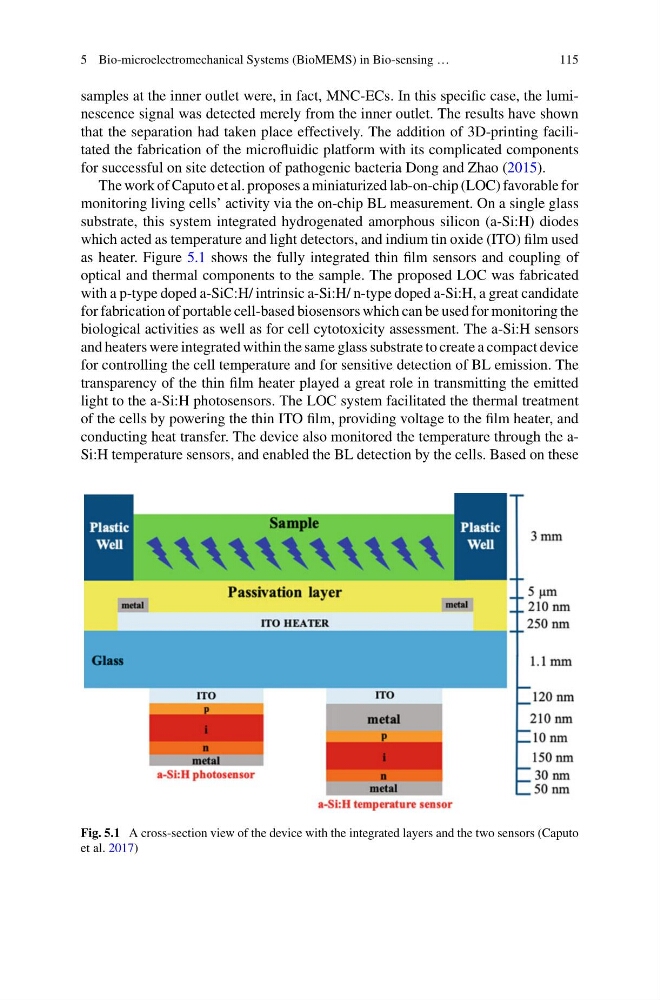
as heater. Figure 5.1 shows the fully integrated thin film sensors and coupling of
optical and thermal components to the sample. The proposed LOC was fabricated
with a p-type doped a-SiC:H/ intrinsic a-Si:H/ n-type doped a-Si:H, a great candidate
for fabrication of portable cell-based biosensors which can be used for monitoring the
biological activities as well as for cell cytotoxicity assessment. The a-Si:H sensors
and heaters were integrated within the same glass substrate to create a compact device
for controlling the cell temperature and for sensitive detection of BL emission. The
transparency of the thin film heater played a great role in transmitting the emitted
light to the a-Si:H photosensors. The LOC system facilitated the thermal treatment
of the cells by powering the thin ITO film, providing voltage to the film heater, and
conducting heat transfer. The device also monitored the temperature through the aSi:H temperature sensors, and enabled the BL detection by the cells. Based on these
Fig. 5.1 A cross-section view of the device with the integrated layers and the two sensors (Caputo
et al. 2017)
115
samples at the inner outlet were, in fact, MNC-ECs. In this specific case, the luminescence signal was detected merely from the inner outlet. The results have shown
that the separation had taken place effectively. The addition of 3D-printing facilitated the fabrication of the microfluidic platform with its complicated components
for successful on site detection of pathogenic bacteria Dong and Zhao (2015).
The work of Caputo et al. proposes a miniaturized lab-on-chip (LOC) favorable for
monitoring living cells’ activity via the on-chip BL measurement. On a single glass
substrate, this system integrated hydrogenated amorphous silicon (a-Si:H) diodes
which acted as temperature and light detectors, and indium tin oxide (ITO) film used
as heater. Figure 5.1 shows the fully integrated thin film sensors and coupling of
optical and thermal components to the sample. The proposed LOC was fabricated
with a p-type doped a-SiC:H/ intrinsic a-Si:H/ n-type doped a-Si:H, a great candidate
for fabrication of portable cell-based biosensors which can be used for monitoring the
biological activities as well as for cell cytotoxicity assessment. The a-Si:H sensors
and heaters were integrated within the same glass substrate to create a compact device
for controlling the cell temperature and for sensitive detection of BL emission. The
transparency of the thin film heater played a great role in transmitting the emitted
light to the a-Si:H photosensors. The LOC system facilitated the thermal treatment
of the cells by powering the thin ITO film, providing voltage to the film heater, and
conducting heat transfer. The device also monitored the temperature through the aSi:H temperature sensors, and enabled the BL detection by the cells. Based on these
Fig. 5.1 A cross-section view of the device with the integrated layers and the two sensors (Caputo
et al. 2017)