

112
A. S. Cerda-Kipper and S. Hosseini
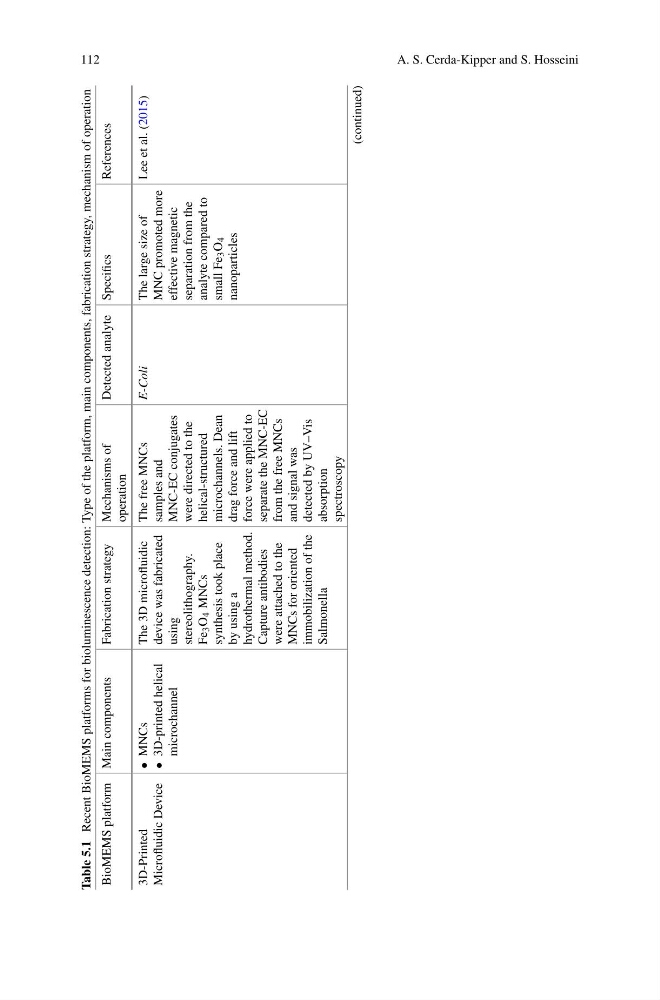
Table 5.1
Recent BioMEMS platforms for bioluminescence detection: Type of the platform, main components, fabrication strategy, mechanism of operation
BioMEMS platform Main components
Fabrication strategy
Mechanisms of
operation
Detected analyte Specifics
References
3D-Printed
Microfluidic Device
• MNCs
• 3D-printed helical
microchannel
The 3D microfluidic
device was fabricated
using
stereolithography.
Fe
3 O
4 MNCs
synthesis took place
by using a
hydrothermal method.
Capture antibodies
were attached to the
MNCs for oriented
immobilization of the
Salmonella
The free MNCs
samples and
MNC-EC conjugates
were directed to the
helical-structured
microchannels. Dean
drag force and lift
force were applied to
separate the MNC-EC
from the free MNCs
and signal was
detected by UV–Vis
absorption
spectroscopy
E-Coli
The large size of
MNC promoted more
effective magnetic
separation from the
analyte compared to
small Fe
3 O
4
nanoparticles
Lee et al. (2015)
(continued)
A. S. Cerda-Kipper and S. Hosseini
Table 5.1
Recent BioMEMS platforms for bioluminescence detection: Type of the platform, main components, fabrication strategy, mechanism of operation
BioMEMS platform Main components
Fabrication strategy
Mechanisms of
operation
Detected analyte Specifics
References
3D-Printed
Microfluidic Device
• MNCs
• 3D-printed helical
microchannel
The 3D microfluidic
device was fabricated
using
stereolithography.
Fe
3 O
4 MNCs
synthesis took place
by using a
hydrothermal method.
Capture antibodies
were attached to the
MNCs for oriented
immobilization of the
Salmonella
The free MNCs
samples and
MNC-EC conjugates
were directed to the
helical-structured
microchannels. Dean
drag force and lift
force were applied to
separate the MNC-EC
from the free MNCs
and signal was
detected by UV–Vis
absorption
spectroscopy
E-Coli
The large size of
MNC promoted more
effective magnetic
separation from the
analyte compared to
small Fe
3 O
4
nanoparticles
Lee et al. (2015)
(continued)