

4 Bio-microelectromechanical Systems (BioMEMS) in Bio-sensing …
105
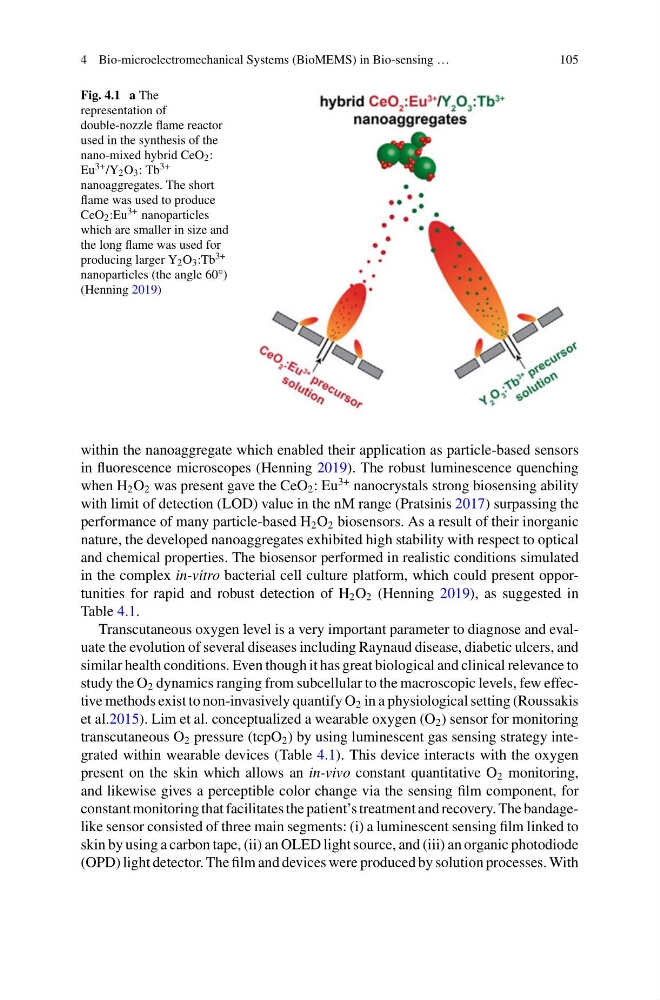
Fig. 4.1 a The
representation of
double-nozzle flame reactor
used in the synthesis of the
nano-mixed hybrid CeO 2 :
Eu 3+ /Y 2 O 3 : Tb 3+
nanoaggregates. The short
flame was used to produce
CeO 2 :Eu 3+ nanoparticles
which are smaller in size and
the long flame was used for
producing larger Y 2 O 3 :Tb 3+
nanoparticles (the angle 60°)
(Henning 2019)
within the nanoaggregate which enabled their application as particle-based sensors
in fluorescence microscopes (Henning 2019). The robust luminescence quenching
when H 2 O 2 was present gave the CeO 2 : Eu
3+ nanocrystals strong biosensing ability
with limit of detection (LOD) value in the nM range (Pratsinis 2017) surpassing the
performance of many particle-based H 2 O 2 biosensors. As a result of their inorganic
nature, the developed nanoaggregates exhibited high stability with respect to optical
and chemical properties. The biosensor performed in realistic conditions simulated
in the complex in-vitro bacterial cell culture platform, which could present opportunities for rapid and robust detection of H 2 O 2 (Henning 2019), as suggested in
Table 4.1.
Transcutaneous oxygen level is a very important parameter to diagnose and evaluate the evolution of several diseases including Raynaud disease, diabetic ulcers, and
similar health conditions. Even though it has great biological and clinical relevance to
study the O 2 dynamics ranging from subcellular to the macroscopic levels, few effective methods exist to non-invasively quantify O 2 in a physiological setting (Roussakis
et al.2015). Lim et al. conceptualized a wearable oxygen (O 2 ) sensor for monitoring
transcutaneous O 2 pressure (tcpO 2 ) by using luminescent gas sensing strategy integrated within wearable devices (Table 4.1). This device interacts with the oxygen
present on the skin which allows an in-vivo constant quantitative O 2 monitoring,
and likewise gives a perceptible color change via the sensing film component, for
constant monitoring that facilitates the patient’s treatment and recovery. The bandagelike sensor consisted of three main segments: (i) a luminescent sensing film linked to
skin by using a carbon tape, (ii) an OLED light source, and (iii) an organic photodiode
(OPD) light detector. The film and devices were produced by solution processes. With
105
Fig. 4.1 a The
representation of
double-nozzle flame reactor
used in the synthesis of the
nano-mixed hybrid CeO 2 :
Eu 3+ /Y 2 O 3 : Tb 3+
nanoaggregates. The short
flame was used to produce
CeO 2 :Eu 3+ nanoparticles
which are smaller in size and
the long flame was used for
producing larger Y 2 O 3 :Tb 3+
nanoparticles (the angle 60°)
(Henning 2019)
within the nanoaggregate which enabled their application as particle-based sensors
in fluorescence microscopes (Henning 2019). The robust luminescence quenching
when H 2 O 2 was present gave the CeO 2 : Eu
3+ nanocrystals strong biosensing ability
with limit of detection (LOD) value in the nM range (Pratsinis 2017) surpassing the
performance of many particle-based H 2 O 2 biosensors. As a result of their inorganic
nature, the developed nanoaggregates exhibited high stability with respect to optical
and chemical properties. The biosensor performed in realistic conditions simulated
in the complex in-vitro bacterial cell culture platform, which could present opportunities for rapid and robust detection of H 2 O 2 (Henning 2019), as suggested in
Table 4.1.
Transcutaneous oxygen level is a very important parameter to diagnose and evaluate the evolution of several diseases including Raynaud disease, diabetic ulcers, and
similar health conditions. Even though it has great biological and clinical relevance to
study the O 2 dynamics ranging from subcellular to the macroscopic levels, few effective methods exist to non-invasively quantify O 2 in a physiological setting (Roussakis
et al.2015). Lim et al. conceptualized a wearable oxygen (O 2 ) sensor for monitoring
transcutaneous O 2 pressure (tcpO 2 ) by using luminescent gas sensing strategy integrated within wearable devices (Table 4.1). This device interacts with the oxygen
present on the skin which allows an in-vivo constant quantitative O 2 monitoring,
and likewise gives a perceptible color change via the sensing film component, for
constant monitoring that facilitates the patient’s treatment and recovery. The bandagelike sensor consisted of three main segments: (i) a luminescent sensing film linked to
skin by using a carbon tape, (ii) an OLED light source, and (iii) an organic photodiode
(OPD) light detector. The film and devices were produced by solution processes. With