

66
3 Rotatable-Polarisation Terahertz Time-Domain Spectroscopy of Anisotropic Media
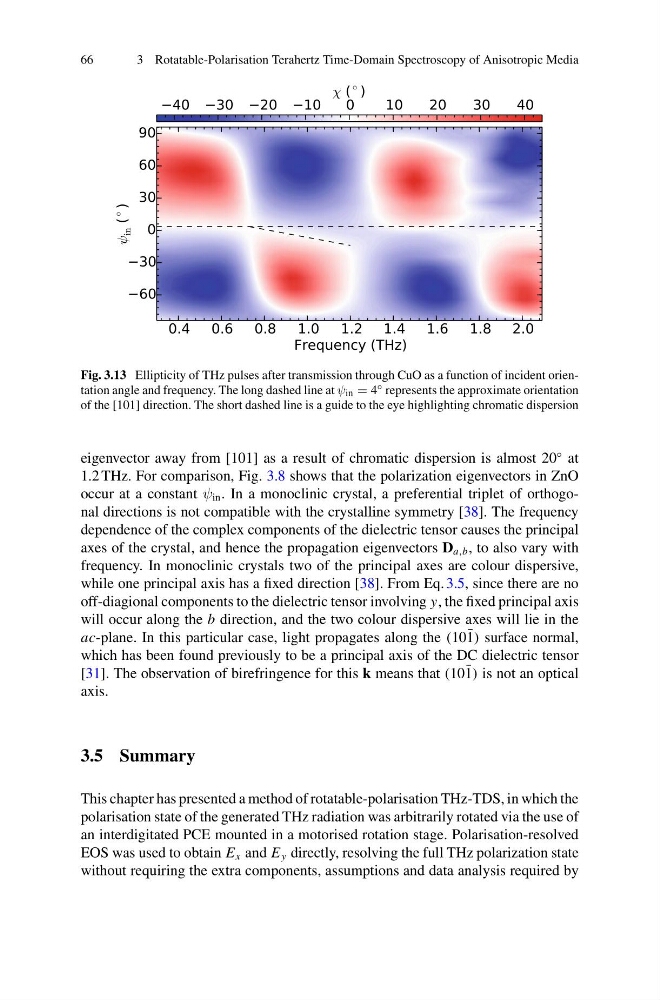
Fig. 3.13 Ellipticity of THz pulses after transmission through CuO as a function of incident orientation angle and frequency. The long dashed line at ψ in = 4 ◦ represents the approximate orientation
of the [101] direction. The short dashed line is a guide to the eye highlighting chromatic dispersion
eigenvector away from [101] as a result of chromatic dispersion is almost 20
◦ at
1.2 THz. For comparison, Fig. 3.8 shows that the polarization eigenvectors in ZnO
occur at a constant ψ in . In a monoclinic crystal, a preferential triplet of orthogonal directions is not compatible with the crystalline symmetry [38]. The frequency
dependence of the complex components of the dielectric tensor causes the principal
axes of the crystal, and hence the propagation eigenvectors D a,b , to also vary with
frequency. In monoclinic crystals two of the principal axes are colour dispersive,
while one principal axis has a fixed direction [38]. From Eq. 3.5, since there are no
off-diagional components to the dielectric tensor involving y, the fixed principal axis
will occur along the b direction, and the two colour dispersive axes will lie in the
ac-plane. In this particular case, light propagates along the (10 ¯
1) surface normal,
which has been found previously to be a principal axis of the DC dielectric tensor
[31]. The observation of birefringence for this k means that (10 ¯
1) is not an optical
axis.
3.5 Summary
This chapter has presented a method of rotatable-polarisation THz-TDS, in which the
polarisation state of the generated THz radiation was arbitrarily rotated via the use of
an interdigitated PCE mounted in a motorised rotation stage. Polarisation-resolved
EOS was used to obtain E x and E y directly, resolving the full THz polarization state
without requiring the extra components, assumptions and data analysis required by
3 Rotatable-Polarisation Terahertz Time-Domain Spectroscopy of Anisotropic Media
Fig. 3.13 Ellipticity of THz pulses after transmission through CuO as a function of incident orientation angle and frequency. The long dashed line at ψ in = 4 ◦ represents the approximate orientation
of the [101] direction. The short dashed line is a guide to the eye highlighting chromatic dispersion
eigenvector away from [101] as a result of chromatic dispersion is almost 20
◦ at
1.2 THz. For comparison, Fig. 3.8 shows that the polarization eigenvectors in ZnO
occur at a constant ψ in . In a monoclinic crystal, a preferential triplet of orthogonal directions is not compatible with the crystalline symmetry [38]. The frequency
dependence of the complex components of the dielectric tensor causes the principal
axes of the crystal, and hence the propagation eigenvectors D a,b , to also vary with
frequency. In monoclinic crystals two of the principal axes are colour dispersive,
while one principal axis has a fixed direction [38]. From Eq. 3.5, since there are no
off-diagional components to the dielectric tensor involving y, the fixed principal axis
will occur along the b direction, and the two colour dispersive axes will lie in the
ac-plane. In this particular case, light propagates along the (10 ¯
1) surface normal,
which has been found previously to be a principal axis of the DC dielectric tensor
[31]. The observation of birefringence for this k means that (10 ¯
1) is not an optical
axis.
3.5 Summary
This chapter has presented a method of rotatable-polarisation THz-TDS, in which the
polarisation state of the generated THz radiation was arbitrarily rotated via the use of
an interdigitated PCE mounted in a motorised rotation stage. Polarisation-resolved
EOS was used to obtain E x and E y directly, resolving the full THz polarization state
without requiring the extra components, assumptions and data analysis required by