

12
1 Introduction
The four components of the Stokes vector in Eq. 1.30 can be interpreted as: (i)
I is the sum of the intensities of the purely linearly horizontal and linearly vertical
components; (ii) Q is the difference between the intensities of the purely linearly
horizontal and linearly vertical components; (iii) U is the difference between the
intensities of the components purely polarised at +45
◦ and −45
◦ ; and (iv) V is the
difference between the intensities of the purely circularly right-hand polarised and
circularly left-hand polarised components.
A similar description of the interaction of light with polarising elements to that
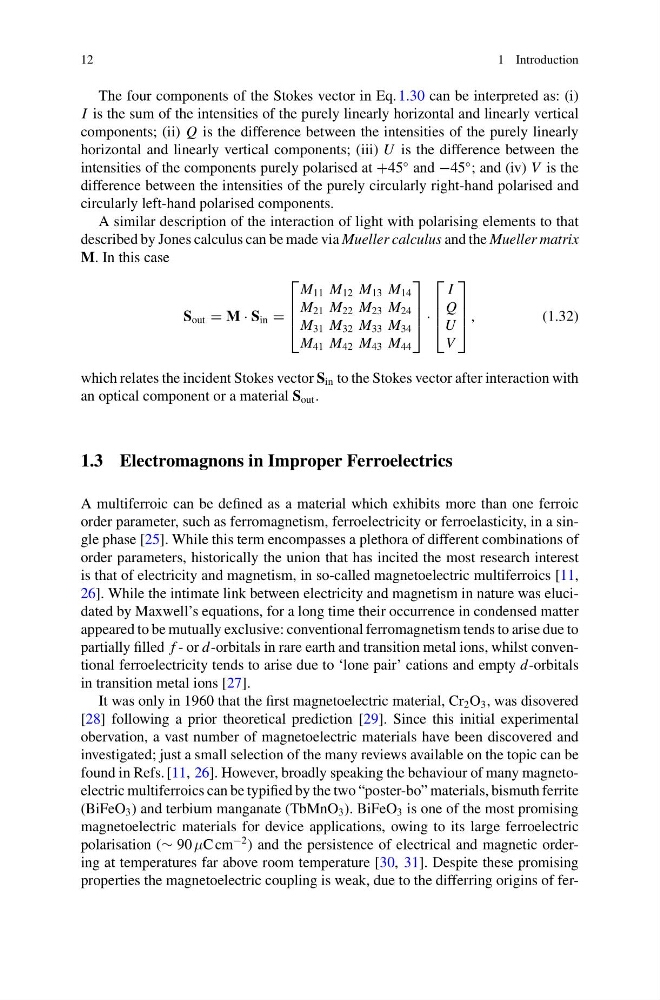
described by Jones calculus can be made via Mueller calculus and the Mueller matrix
M. In this case
S out = M · S in =
⎡
⎢
⎢
⎣
M 11 M 12 M 13 M 14
M 21 M 22 M 23 M 24
M 31 M 32 M 33 M 34
M 41 M 42 M 43 M 44
⎤
⎥
⎥
⎦ ·
⎡
⎢
⎢
⎣
I
Q
U
V
⎤
⎥
⎥
⎦ ,
(1.32)
which relates the incident Stokes vector S in to the Stokes vector after interaction with
an optical component or a material S out .
1.3 Electromagnons in Improper Ferroelectrics
A multiferroic can be defined as a material which exhibits more than one ferroic
order parameter, such as ferromagnetism, ferroelectricity or ferroelasticity, in a single phase [25]. While this term encompasses a plethora of different combinations of
order parameters, historically the union that has incited the most research interest
is that of electricity and magnetism, in so-called magnetoelectric multiferroics [11,
26]. While the intimate link between electricity and magnetism in nature was elucidated by Maxwell’s equations, for a long time their occurrence in condensed matter
appeared to be mutually exclusive: conventional ferromagnetism tends to arise due to
partially filled f - or d-orbitals in rare earth and transition metal ions, whilst conventional ferroelectricity tends to arise due to ‘lone pair’ cations and empty d-orbitals
in transition metal ions [27].
It was only in 1960 that the first magnetoelectric material, Cr 2 O 3 , was disovered
[28] following a prior theoretical prediction [29]. Since this initial experimental
obervation, a vast number of magnetoelectric materials have been discovered and
investigated; just a small selection of the many reviews available on the topic can be
found in Refs. [11, 26]. However, broadly speaking the behaviour of many magnetoelectric multiferroics can be typified by the two “poster-bo” materials, bismuth ferrite
(BiFeO 3 ) and terbium manganate (TbMnO 3 ). BiFeO 3 is one of the most promising
magnetoelectric materials for device applications, owing to its large ferroelectric
polarisation (∼ 90 μC cm
−2 ) and the persistence of electrical and magnetic ordering at temperatures far above room temperature [30, 31]. Despite these promising
properties the magnetoelectric coupling is weak, due to the differring origins of fer-
1 Introduction
The four components of the Stokes vector in Eq. 1.30 can be interpreted as: (i)
I is the sum of the intensities of the purely linearly horizontal and linearly vertical
components; (ii) Q is the difference between the intensities of the purely linearly
horizontal and linearly vertical components; (iii) U is the difference between the
intensities of the components purely polarised at +45
◦ and −45
◦ ; and (iv) V is the
difference between the intensities of the purely circularly right-hand polarised and
circularly left-hand polarised components.
A similar description of the interaction of light with polarising elements to that
described by Jones calculus can be made via Mueller calculus and the Mueller matrix
M. In this case
S out = M · S in =
⎡
⎢
⎢
⎣
M 11 M 12 M 13 M 14
M 21 M 22 M 23 M 24
M 31 M 32 M 33 M 34
M 41 M 42 M 43 M 44
⎤
⎥
⎥
⎦ ·
⎡
⎢
⎢
⎣
I
Q
U
V
⎤
⎥
⎥
⎦ ,
(1.32)
which relates the incident Stokes vector S in to the Stokes vector after interaction with
an optical component or a material S out .
1.3 Electromagnons in Improper Ferroelectrics
A multiferroic can be defined as a material which exhibits more than one ferroic
order parameter, such as ferromagnetism, ferroelectricity or ferroelasticity, in a single phase [25]. While this term encompasses a plethora of different combinations of
order parameters, historically the union that has incited the most research interest
is that of electricity and magnetism, in so-called magnetoelectric multiferroics [11,
26]. While the intimate link between electricity and magnetism in nature was elucidated by Maxwell’s equations, for a long time their occurrence in condensed matter
appeared to be mutually exclusive: conventional ferromagnetism tends to arise due to
partially filled f - or d-orbitals in rare earth and transition metal ions, whilst conventional ferroelectricity tends to arise due to ‘lone pair’ cations and empty d-orbitals
in transition metal ions [27].
It was only in 1960 that the first magnetoelectric material, Cr 2 O 3 , was disovered
[28] following a prior theoretical prediction [29]. Since this initial experimental
obervation, a vast number of magnetoelectric materials have been discovered and
investigated; just a small selection of the many reviews available on the topic can be
found in Refs. [11, 26]. However, broadly speaking the behaviour of many magnetoelectric multiferroics can be typified by the two “poster-bo” materials, bismuth ferrite
(BiFeO 3 ) and terbium manganate (TbMnO 3 ). BiFeO 3 is one of the most promising
magnetoelectric materials for device applications, owing to its large ferroelectric
polarisation (∼ 90 μC cm
−2 ) and the persistence of electrical and magnetic ordering at temperatures far above room temperature [30, 31]. Despite these promising
properties the magnetoelectric coupling is weak, due to the differring origins of fer-