

1.2 Describing the Polarisation State of Electromagnetic Waves
11
tan e
i
=
|E p |
|E s |
e
i(φ p −φ s )
(1.27)
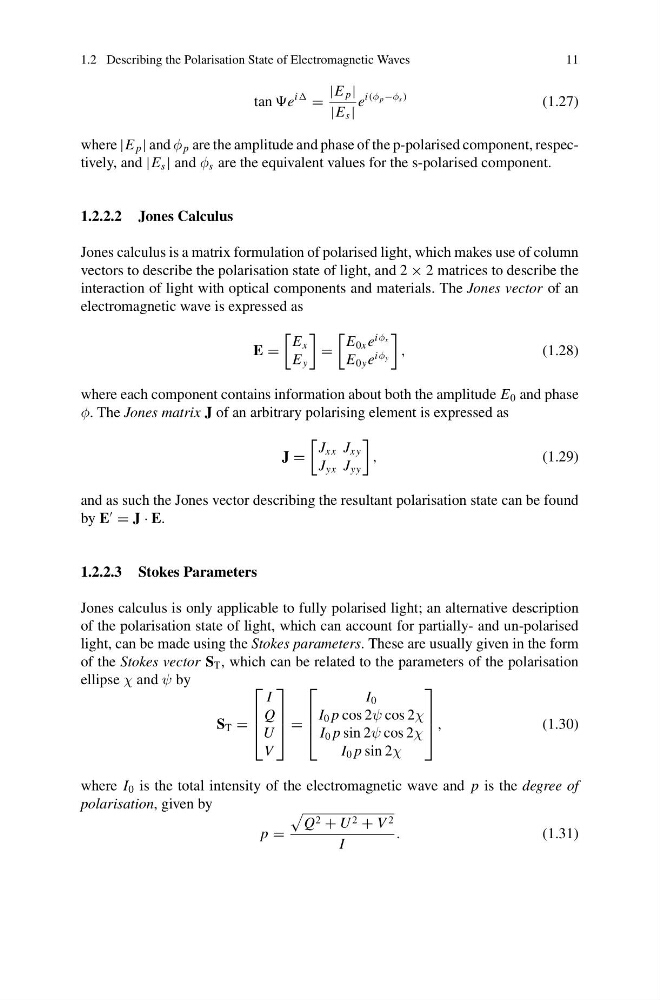
where |E p | and φ p are the amplitude and phase of the p-polarised component, respectively, and |E s | and φ s are the equivalent values for the s-polarised component.
1.2.2.2 Jones Calculus
Jones calculus is a matrix formulation of polarised light, which makes use of column
vectors to describe the polarisation state of light, and 2 × 2 matrices to describe the
interaction of light with optical components and materials. The Jones vector of an
electromagnetic wave is expressed as
E =
E x
E y
=
E 0x e
iφ x
E 0y e
iφ y
,
(1.28)
where each component contains information about both the amplitude E 0 and phase
φ. The Jones matrix J of an arbitrary polarising element is expressed as
J =
J xx J xy
J yx J yy
,
(1.29)
and as such the Jones vector describing the resultant polarisation state can be found
by E
= J · E.
1.2.2.3 Stokes Parameters
Jones calculus is only applicable to fully polarised light; an alternative description
of the polarisation state of light, which can account for partially- and un-polarised
light, can be made using the Stokes parameters. These are usually given in the form
of the Stokes vector S T , which can be related to the parameters of the polarisation
ellipse χ and ψ by
S T =
⎡
⎢
⎢
⎣
I
Q
U
V
⎤
⎥
⎥
⎦ =
⎡
⎢
⎢
⎣
I 0
I 0 p cos 2ψ cos 2χ
I 0 p sin 2ψ cos 2χ
I 0 p sin 2χ
⎤
⎥
⎥
⎦ ,
(1.30)
where I 0 is the total intensity of the electromagnetic wave and p is the degree of
polarisation, given by
p =
Q 2 + U 2 + V 2
I
.
(1.31)
11
tan e
i
=
|E p |
|E s |
e
i(φ p −φ s )
(1.27)
where |E p | and φ p are the amplitude and phase of the p-polarised component, respectively, and |E s | and φ s are the equivalent values for the s-polarised component.
1.2.2.2 Jones Calculus
Jones calculus is a matrix formulation of polarised light, which makes use of column
vectors to describe the polarisation state of light, and 2 × 2 matrices to describe the
interaction of light with optical components and materials. The Jones vector of an
electromagnetic wave is expressed as
E =
E x
E y
=
E 0x e
iφ x
E 0y e
iφ y
,
(1.28)
where each component contains information about both the amplitude E 0 and phase
φ. The Jones matrix J of an arbitrary polarising element is expressed as
J =
J xx J xy
J yx J yy
,
(1.29)
and as such the Jones vector describing the resultant polarisation state can be found
by E
= J · E.
1.2.2.3 Stokes Parameters
Jones calculus is only applicable to fully polarised light; an alternative description
of the polarisation state of light, which can account for partially- and un-polarised
light, can be made using the Stokes parameters. These are usually given in the form
of the Stokes vector S T , which can be related to the parameters of the polarisation
ellipse χ and ψ by
S T =
⎡
⎢
⎢
⎣
I
Q
U
V
⎤
⎥
⎥
⎦ =
⎡
⎢
⎢
⎣
I 0
I 0 p cos 2ψ cos 2χ
I 0 p sin 2ψ cos 2χ
I 0 p sin 2χ
⎤
⎥
⎥
⎦ ,
(1.30)
where I 0 is the total intensity of the electromagnetic wave and p is the degree of
polarisation, given by
p =
Q 2 + U 2 + V 2
I
.
(1.31)