

5.4 Nonlinear THz Transmission in Single-Walled Carbon Nanotube Films
103
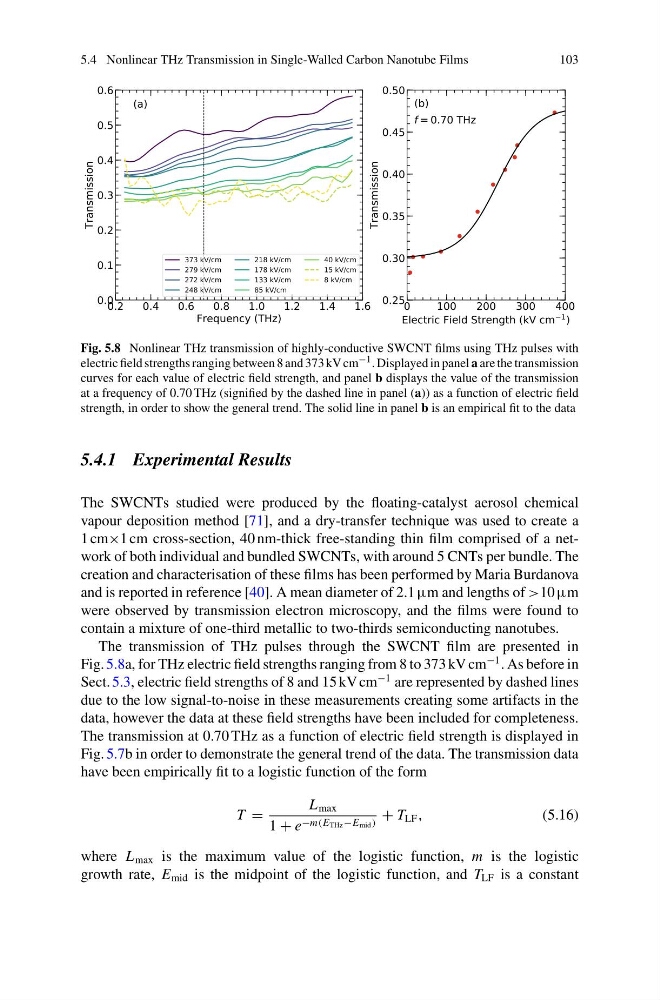
Fig. 5.8 Nonlinear THz transmission of highly-conductive SWCNT films using THz pulses with
electric field strengths ranging between 8 and 373 kV cm −1 . Displayed in panel a are the transmission
curves for each value of electric field strength, and panel b displays the value of the transmission
at a frequency of 0.70 THz (signified by the dashed line in panel (a)) as a function of electric field
strength, in order to show the general trend. The solid line in panel b is an empirical fit to the data
5.4.1 Experimental Results
The SWCNTs studied were produced by the floating-catalyst aerosol chemical
vapour deposition method [71], and a dry-transfer technique was used to create a
1 cm×1 cm cross-section, 40 nm-thick free-standing thin film comprised of a network of both individual and bundled SWCNTs, with around 5 CNTs per bundle. The
creation and characterisation of these films has been performed by Maria Burdanova
and is reported in reference [40]. A mean diameter of 2.1 µm and lengths of >10 µm
were observed by transmission electron microscopy, and the films were found to
contain a mixture of one-third metallic to two-thirds semiconducting nanotubes.
The transmission of THz pulses through the SWCNT film are presented in
Fig. 5.8a, for THz electric field strengths ranging from 8 to 373 kV cm
−1 . As before in
Sect. 5.3, electric field strengths of 8 and 15 kV cm
−1 are represented by dashed lines
due to the low signal-to-noise in these measurements creating some artifacts in the
data, however the data at these field strengths have been included for completeness.
The transmission at 0.70 THz as a function of electric field strength is displayed in
Fig. 5.7b in order to demonstrate the general trend of the data. The transmission data
have been empirically fit to a logistic function of the form
T =
L max
1 + e −m(E THz −E mid ) + T LF ,
(5.16)
where L max is the maximum value of the logistic function, m is the logistic
growth rate, E mid is the midpoint of the logistic function, and T LF is a constant
103
Fig. 5.8 Nonlinear THz transmission of highly-conductive SWCNT films using THz pulses with
electric field strengths ranging between 8 and 373 kV cm −1 . Displayed in panel a are the transmission
curves for each value of electric field strength, and panel b displays the value of the transmission
at a frequency of 0.70 THz (signified by the dashed line in panel (a)) as a function of electric field
strength, in order to show the general trend. The solid line in panel b is an empirical fit to the data
5.4.1 Experimental Results
The SWCNTs studied were produced by the floating-catalyst aerosol chemical
vapour deposition method [71], and a dry-transfer technique was used to create a
1 cm×1 cm cross-section, 40 nm-thick free-standing thin film comprised of a network of both individual and bundled SWCNTs, with around 5 CNTs per bundle. The
creation and characterisation of these films has been performed by Maria Burdanova
and is reported in reference [40]. A mean diameter of 2.1 µm and lengths of >10 µm
were observed by transmission electron microscopy, and the films were found to
contain a mixture of one-third metallic to two-thirds semiconducting nanotubes.
The transmission of THz pulses through the SWCNT film are presented in
Fig. 5.8a, for THz electric field strengths ranging from 8 to 373 kV cm
−1 . As before in
Sect. 5.3, electric field strengths of 8 and 15 kV cm
−1 are represented by dashed lines
due to the low signal-to-noise in these measurements creating some artifacts in the
data, however the data at these field strengths have been included for completeness.
The transmission at 0.70 THz as a function of electric field strength is displayed in
Fig. 5.7b in order to demonstrate the general trend of the data. The transmission data
have been empirically fit to a logistic function of the form
T =
L max
1 + e −m(E THz −E mid ) + T LF ,
(5.16)
where L max is the maximum value of the logistic function, m is the logistic
growth rate, E mid is the midpoint of the logistic function, and T LF is a constant