

the rationale for considering near and far future projections
separately in most assessments.
Singh and AchutaRao (2018) quantified the uncertainties
associated with models and internal variability over the
Indian land region for each season using the RCP8.5 scenario of CMIP5 models. They showed that the uncertainty in
precipitation change has a more complex picture such that
uncertainty from internal variability persists and is quite
large and comparable to model related uncertainty during the
southwest and post-monsoon season by the end of the
twenty-first century. The spatial heterogeneity in the uncertainty was comparatively more over the arid northwest
region compared with the west-central region (part of the
core monsoon area). This in a way enhances the confidence
in the assessment of changes in precipitation over the central
Indian region.
3.6 Knowledge Gaps
Though the modelling of the climate system has come a long
way, there are still many issues that remain to be addressed.
It is important to understand the complete monsoon system
and to model the interactive processes that govern it. Identification of the coupled air-sea interactions, coupled
land-atmosphere interactions, and flow-orography interactions that are critical in shaping the precipitation processes
needs to be carried out. It is important to assess whether the
model represents the phase transition in convection (shallow
to deep to stratiform clouds). Bush et al. (2014) suggest that
monsoon precipitation biases are sensitive to the entrainment
and detrainment rates of convective parameterization. From
observations and in models, it is important to identify the
required thermodynamic conditions for convective phase
transitions over the Asian monsoon region. There is lack of
high-quality observations (atmosphere and ocean) over the
monsoon-influenced regions to constrain the model physics.
More realistic biogeophysical processes-based land surface
models are needed to realistically assess the impact of
land-use/land-cover change on the monsoon. The present
models fail to adequately simulate the intra-seasonal variability of monsoon. There is limited knowledge about relative contributions of internal variability such as the Pacific
Decadal Oscillation/Inter-decadal Pacific Oscillation
(PDO/IPO) and external forcing in driving the historical
evolution of monsoons and other modes of variability. It is
challenging to project the behaviour of climate forcing.
ENSO-Monsoon relationship is observed to have weakened
in recent decades; however, models do not capture the
ENSO behaviour in the future and how ENSO–monsoon
relationship may evolve. Increased extremes and increased
spatial variability have been observed in recent decades and
also projected to increase, and it is likely due to regional
forcings such as aerosols and land-use/urbanization changes.
3.7 Summary
Monsoons are the most important mode of seasonal climate
variation in the tropics, and almost all parts of India receive
more than 70% of the rains in summer monsoon season (June
through September). The intensity, length and timing of
monsoon are related to atmospheric moisture content, land–
sea temperature contrast, land surface feedbacks, atmospheric
aerosol loading and other factors. Overall, monsoonal rainfall
is projected to become more intense in future, and to affect
larger areas mainly due to increase in atmospheric moisture
content with temperature. The temperature gradient between
land and sea, regional distribution of land and ocean as well as
topography play major role in monsoon.
Summer monsoon rainfall has decreased over India in the
post-1950 period with more reduction in rainfall over the
Indo-Gangetic plains and the Western Ghats. Global-scale
anthropogenic forcings such as GHGs as well as
regional-scale forcings such as aerosols and land-use/
land-cover changes may have played a role in driving the
changes observed in recent decades. The frequency of localized heavy rain occurrences has significantly increased over
central India, which is partly attributed to changes in the
availability of moisture due to greenhouse gas-based warming, aerosols, stability of the atmosphere and increasing
urbanization. Extreme rains are concentrated around urban
regions of India suggesting there is an urbanization feedback.
Global as well as regional models project an increase in
seasonal mean rainfall over India while also projecting a
weakening monsoon circulation. However, this weakening
of circulation is compensated by increased atmospheric
moisture content leading to more precipitation. Frequency of
extreme precipitation events may increase all over India, and
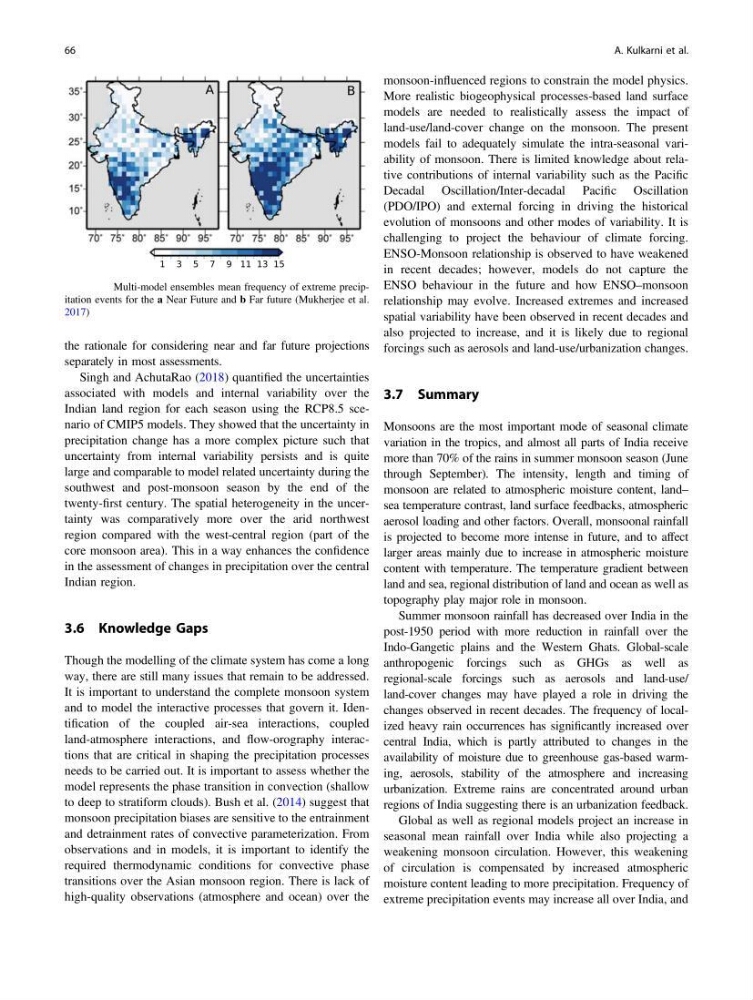
Fig. 3.14 Multi-model ensembles mean frequency of extreme precipitation events for the a Near Future and b Far future (Mukherjee et al.
2017)
66
A. Kulkarni et al.
separately in most assessments.
Singh and AchutaRao (2018) quantified the uncertainties
associated with models and internal variability over the
Indian land region for each season using the RCP8.5 scenario of CMIP5 models. They showed that the uncertainty in
precipitation change has a more complex picture such that
uncertainty from internal variability persists and is quite
large and comparable to model related uncertainty during the
southwest and post-monsoon season by the end of the
twenty-first century. The spatial heterogeneity in the uncertainty was comparatively more over the arid northwest
region compared with the west-central region (part of the
core monsoon area). This in a way enhances the confidence
in the assessment of changes in precipitation over the central
Indian region.
3.6 Knowledge Gaps
Though the modelling of the climate system has come a long
way, there are still many issues that remain to be addressed.
It is important to understand the complete monsoon system
and to model the interactive processes that govern it. Identification of the coupled air-sea interactions, coupled
land-atmosphere interactions, and flow-orography interactions that are critical in shaping the precipitation processes
needs to be carried out. It is important to assess whether the
model represents the phase transition in convection (shallow
to deep to stratiform clouds). Bush et al. (2014) suggest that
monsoon precipitation biases are sensitive to the entrainment
and detrainment rates of convective parameterization. From
observations and in models, it is important to identify the
required thermodynamic conditions for convective phase
transitions over the Asian monsoon region. There is lack of
high-quality observations (atmosphere and ocean) over the
monsoon-influenced regions to constrain the model physics.
More realistic biogeophysical processes-based land surface
models are needed to realistically assess the impact of
land-use/land-cover change on the monsoon. The present
models fail to adequately simulate the intra-seasonal variability of monsoon. There is limited knowledge about relative contributions of internal variability such as the Pacific
Decadal Oscillation/Inter-decadal Pacific Oscillation
(PDO/IPO) and external forcing in driving the historical
evolution of monsoons and other modes of variability. It is
challenging to project the behaviour of climate forcing.
ENSO-Monsoon relationship is observed to have weakened
in recent decades; however, models do not capture the
ENSO behaviour in the future and how ENSO–monsoon
relationship may evolve. Increased extremes and increased
spatial variability have been observed in recent decades and
also projected to increase, and it is likely due to regional
forcings such as aerosols and land-use/urbanization changes.
3.7 Summary
Monsoons are the most important mode of seasonal climate
variation in the tropics, and almost all parts of India receive
more than 70% of the rains in summer monsoon season (June
through September). The intensity, length and timing of
monsoon are related to atmospheric moisture content, land–
sea temperature contrast, land surface feedbacks, atmospheric
aerosol loading and other factors. Overall, monsoonal rainfall
is projected to become more intense in future, and to affect
larger areas mainly due to increase in atmospheric moisture
content with temperature. The temperature gradient between
land and sea, regional distribution of land and ocean as well as
topography play major role in monsoon.
Summer monsoon rainfall has decreased over India in the
post-1950 period with more reduction in rainfall over the
Indo-Gangetic plains and the Western Ghats. Global-scale
anthropogenic forcings such as GHGs as well as
regional-scale forcings such as aerosols and land-use/
land-cover changes may have played a role in driving the
changes observed in recent decades. The frequency of localized heavy rain occurrences has significantly increased over
central India, which is partly attributed to changes in the
availability of moisture due to greenhouse gas-based warming, aerosols, stability of the atmosphere and increasing
urbanization. Extreme rains are concentrated around urban
regions of India suggesting there is an urbanization feedback.
Global as well as regional models project an increase in
seasonal mean rainfall over India while also projecting a
weakening monsoon circulation. However, this weakening
of circulation is compensated by increased atmospheric
moisture content leading to more precipitation. Frequency of
extreme precipitation events may increase all over India, and
Fig. 3.14 Multi-model ensembles mean frequency of extreme precipitation events for the a Near Future and b Far future (Mukherjee et al.
2017)
66
A. Kulkarni et al.