

2013); (d) to strong Atlantic Multidecadal Oscillation
(AMO) which weakens the meridional temperature gradient
resulting in early withdrawal of monsoon over India and
thus reducing the mean rainfall (Goswami et al. 2006);
(e) to significant increase in the duration and frequency of
‘monsoon- breaks’ (dry spells) over India since the 1970s
(e.g. Ramesh Kumar et al. 2009; Turner and Hannachi
2010);(f) to rapid warming of western Indian ocean which
reduces the meridional temperature gradient dampening the
monsoon circulation (Gnanaseelan et al. 2017; Roxy 2015;
Roxy et al. 2015) and (g) to changes in land use/land cover
(Niyogi et al. 2010; Pathak et al. 2014; Paul et al. 2016;
Krishnan et al. 2016). However, enhanced warming over
Indian subcontinent and comparatively slower rate of
warming over India Ocean has favoured the land-ocean
temperature gradient in the recent decade (2002–2014) and
helped a possible short-term revival of the monsoon over
India at the rate of 1.34 mm/day/decade (Jin and Wang
2017). Thus, over the recent three decades (1986–2015)
all-India summer monsoon shows a decreasing tendency,
but the decline is not statistically significant.
There is considerable spatial variability in precipitation
changes. As compared to the period 1901–1975, rainfall has
reduced by 1–5 mm/day during 1976–2015 over central
parts of India (the core monsoon zone), Kerala and extreme
northeastern parts and increased over the Jammu and
Kashmir region as well as in parts of western India (Kulkarni
et al. 2017). Regional anthropogenic forcings such as from
aerosols and land-use change from urbanization and agricultural intensification could be dominant contributors to this
recent spatial variability (Paul et al. 2018).
Trends in Indian rainfall records have been extensively
studied, but the subject remains complicated by the high
spatiotemporal variability of rainfall arising from complex
atmospheric dynamics and, to some extent, differences that
emerge from the methods used in creating the datasets.
Monsoon rainfall has shown moderate increasing trends in 27
(out of 36) subdivisions across India (Guhathakurta and
Rajeevan 2008). The linear trend in annual as well as seasonal
rainfall shows a statistically significant decreasing trend over
Jharkhand, Chhattisgarh, and Kerala, and eight subdivisions,
viz. Gangetic WB, West UP, Jammu and Kashmir, Konkan
and Goa, Madhya Maharashtra, Rayalaseema, Coastal AP and
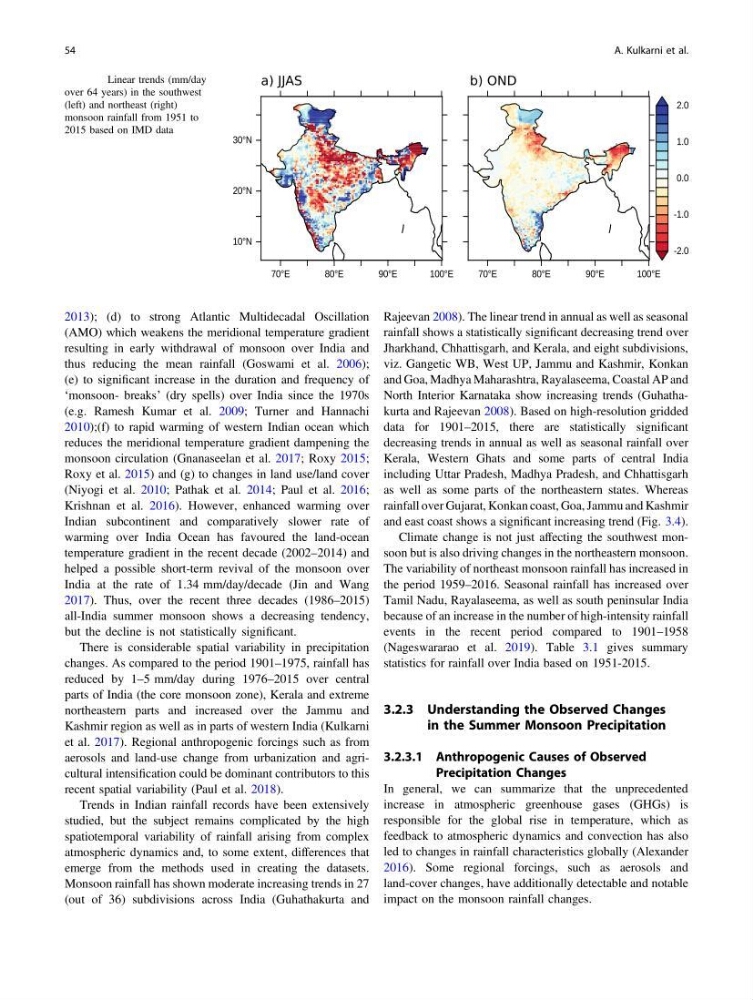
North Interior Karnataka show increasing trends (Guhathakurta and Rajeevan 2008). Based on high-resolution gridded
data for 1901–2015, there are statistically significant
decreasing trends in annual as well as seasonal rainfall over
Kerala, Western Ghats and some parts of central India
including Uttar Pradesh, Madhya Pradesh, and Chhattisgarh
as well as some parts of the northeastern states. Whereas
rainfall over Gujarat, Konkan coast, Goa, Jammu and Kashmir
and east coast shows a significant increasing trend (Fig. 3.4).
Climate change is not just affecting the southwest monsoon but is also driving changes in the northeastern monsoon.
The variability of northeast monsoon rainfall has increased in
the period 1959–2016. Seasonal rainfall has increased over
Tamil Nadu, Rayalaseema, as well as south peninsular India
because of an increase in the number of high-intensity rainfall
events in the recent period compared to 1901–1958
(Nageswararao et al. 2019). Table 3.1 gives summary
statistics for rainfall over India based on 1951-2015.
3.2.3 Understanding the Observed Changes
in the Summer Monsoon Precipitation
3.2.3.1 Anthropogenic Causes of Observed
Precipitation Changes
In general, we can summarize that the unprecedented
increase in atmospheric greenhouse gases (GHGs) is
responsible for the global rise in temperature, which as
feedback to atmospheric dynamics and convection has also
led to changes in rainfall characteristics globally (Alexander
2016). Some regional forcings, such as aerosols and
land-cover changes, have additionally detectable and notable
impact on the monsoon rainfall changes.
Fig. 3.4 Linear trends (mm/day
over 64 years) in the southwest
(left) and northeast (right)
monsoon rainfall from 1951 to
2015 based on IMD data
54
A. Kulkarni et al.
(AMO) which weakens the meridional temperature gradient
resulting in early withdrawal of monsoon over India and
thus reducing the mean rainfall (Goswami et al. 2006);
(e) to significant increase in the duration and frequency of
‘monsoon- breaks’ (dry spells) over India since the 1970s
(e.g. Ramesh Kumar et al. 2009; Turner and Hannachi
2010);(f) to rapid warming of western Indian ocean which
reduces the meridional temperature gradient dampening the
monsoon circulation (Gnanaseelan et al. 2017; Roxy 2015;
Roxy et al. 2015) and (g) to changes in land use/land cover
(Niyogi et al. 2010; Pathak et al. 2014; Paul et al. 2016;
Krishnan et al. 2016). However, enhanced warming over
Indian subcontinent and comparatively slower rate of
warming over India Ocean has favoured the land-ocean
temperature gradient in the recent decade (2002–2014) and
helped a possible short-term revival of the monsoon over
India at the rate of 1.34 mm/day/decade (Jin and Wang
2017). Thus, over the recent three decades (1986–2015)
all-India summer monsoon shows a decreasing tendency,
but the decline is not statistically significant.
There is considerable spatial variability in precipitation
changes. As compared to the period 1901–1975, rainfall has
reduced by 1–5 mm/day during 1976–2015 over central
parts of India (the core monsoon zone), Kerala and extreme
northeastern parts and increased over the Jammu and
Kashmir region as well as in parts of western India (Kulkarni
et al. 2017). Regional anthropogenic forcings such as from
aerosols and land-use change from urbanization and agricultural intensification could be dominant contributors to this
recent spatial variability (Paul et al. 2018).
Trends in Indian rainfall records have been extensively
studied, but the subject remains complicated by the high
spatiotemporal variability of rainfall arising from complex
atmospheric dynamics and, to some extent, differences that
emerge from the methods used in creating the datasets.
Monsoon rainfall has shown moderate increasing trends in 27
(out of 36) subdivisions across India (Guhathakurta and
Rajeevan 2008). The linear trend in annual as well as seasonal
rainfall shows a statistically significant decreasing trend over
Jharkhand, Chhattisgarh, and Kerala, and eight subdivisions,
viz. Gangetic WB, West UP, Jammu and Kashmir, Konkan
and Goa, Madhya Maharashtra, Rayalaseema, Coastal AP and
North Interior Karnataka show increasing trends (Guhathakurta and Rajeevan 2008). Based on high-resolution gridded
data for 1901–2015, there are statistically significant
decreasing trends in annual as well as seasonal rainfall over
Kerala, Western Ghats and some parts of central India
including Uttar Pradesh, Madhya Pradesh, and Chhattisgarh
as well as some parts of the northeastern states. Whereas
rainfall over Gujarat, Konkan coast, Goa, Jammu and Kashmir
and east coast shows a significant increasing trend (Fig. 3.4).
Climate change is not just affecting the southwest monsoon but is also driving changes in the northeastern monsoon.
The variability of northeast monsoon rainfall has increased in
the period 1959–2016. Seasonal rainfall has increased over
Tamil Nadu, Rayalaseema, as well as south peninsular India
because of an increase in the number of high-intensity rainfall
events in the recent period compared to 1901–1958
(Nageswararao et al. 2019). Table 3.1 gives summary
statistics for rainfall over India based on 1951-2015.
3.2.3 Understanding the Observed Changes
in the Summer Monsoon Precipitation
3.2.3.1 Anthropogenic Causes of Observed
Precipitation Changes
In general, we can summarize that the unprecedented
increase in atmospheric greenhouse gases (GHGs) is
responsible for the global rise in temperature, which as
feedback to atmospheric dynamics and convection has also
led to changes in rainfall characteristics globally (Alexander
2016). Some regional forcings, such as aerosols and
land-cover changes, have additionally detectable and notable
impact on the monsoon rainfall changes.
Fig. 3.4 Linear trends (mm/day
over 64 years) in the southwest
(left) and northeast (right)
monsoon rainfall from 1951 to
2015 based on IMD data
54
A. Kulkarni et al.