

to have accelerated during 1971–2002 (Kothawale et al.
2008) and is evident in multiple datasets (Annamalai et al.
2013). This secular decline in mean rainfall is attributed to
wakening monsoon Hadley circulation. A decreasing trend
in rainfall may also be a result of multi-decadal epochal
variability associated with an east-west shift in monsoon
rainfall due to anomalous warming of the Indo-Pacific
warm pool (Annamalai et al. 2013; Guhathakurta et al.
2015) or weakening of the land-ocean temperature gradient
(Kulkarni 2012). The drying trend may be attributed to a
number of factors such as: (a) increasing anthropogenic
aerosol concentration over northern hemisphere which may
cool northern hemisphere and slowing of the tropical
meridional overturning circulation (e.g. Ramanathan et al.
2005; Chung and Ramanathan 2006; Bollasina et al. 2011,
2014); (b) to increasing trend of the Pacific Decadal
Oscillation (Salzmann and Cherian 2015); (c) to significant
weakening of monsoon low-level southwesterly winds, the
upper-tropospheric tropical easterlies from the out-flow
aloft, the large-scale monsoon meridional overturning circulations (Rao et al. 2010; Joseph and Simon 2005;
Sathiyamoorthy 2005; Fan et al. 2010; Krishnan et al.
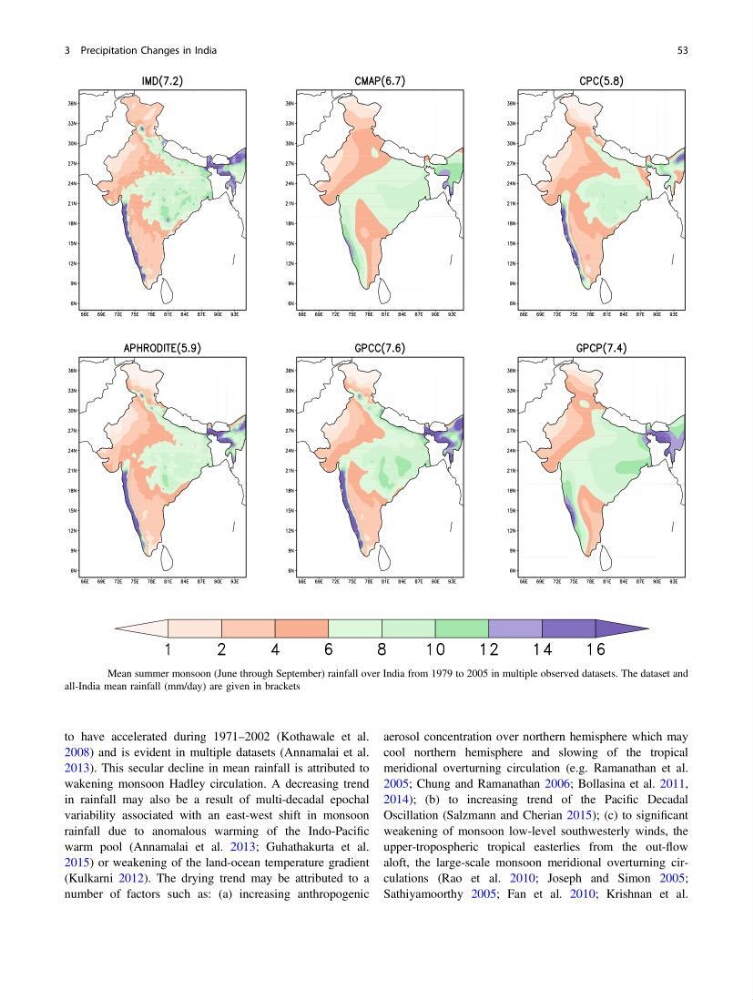
Fig. 3.3 Mean summer monsoon (June through September) rainfall over India from 1979 to 2005 in multiple observed datasets. The dataset and
all-India mean rainfall (mm/day) are given in brackets
3 Precipitation Changes in India
53
2008) and is evident in multiple datasets (Annamalai et al.
2013). This secular decline in mean rainfall is attributed to
wakening monsoon Hadley circulation. A decreasing trend
in rainfall may also be a result of multi-decadal epochal
variability associated with an east-west shift in monsoon
rainfall due to anomalous warming of the Indo-Pacific
warm pool (Annamalai et al. 2013; Guhathakurta et al.
2015) or weakening of the land-ocean temperature gradient
(Kulkarni 2012). The drying trend may be attributed to a
number of factors such as: (a) increasing anthropogenic
aerosol concentration over northern hemisphere which may
cool northern hemisphere and slowing of the tropical
meridional overturning circulation (e.g. Ramanathan et al.
2005; Chung and Ramanathan 2006; Bollasina et al. 2011,
2014); (b) to increasing trend of the Pacific Decadal
Oscillation (Salzmann and Cherian 2015); (c) to significant
weakening of monsoon low-level southwesterly winds, the
upper-tropospheric tropical easterlies from the out-flow
aloft, the large-scale monsoon meridional overturning circulations (Rao et al. 2010; Joseph and Simon 2005;
Sathiyamoorthy 2005; Fan et al. 2010; Krishnan et al.
Fig. 3.3 Mean summer monsoon (June through September) rainfall over India from 1979 to 2005 in multiple observed datasets. The dataset and
all-India mean rainfall (mm/day) are given in brackets
3 Precipitation Changes in India
53